


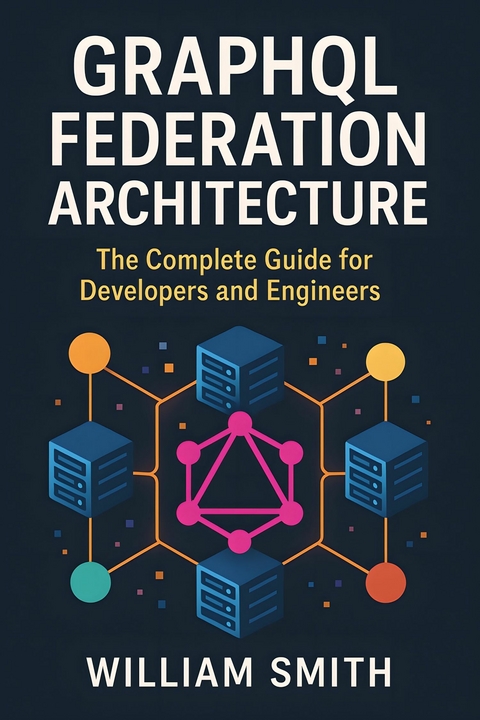
GraphQL Federation Architecture (eBook)
250 Seiten
HiTeX Press (Verlag)
978-0-00-102497-7 (ISBN)
'GraphQL Federation Architecture'
Unlock the full potential of your enterprise APIs with 'GraphQL Federation Architecture,' the definitive guide to designing, building, and managing robust federated GraphQL platforms at scale. This book systematically traces the evolution of API architectures, from REST to GraphQL, illuminating the unique motivations and distributed systems principles that underpin federation. Offering a thorough grounding in key concepts-from schema composition and service boundaries to domain ownership and API composition patterns-it empowers architects and engineers to rethink API integration and governance for the modern era.
Structured for both foundational learning and deep technical mastery, the text navigates the intricacies of the Apollo Federation specification, advanced schema modeling techniques, and the engineering of subgraphs and gateways. Readers will master end-to-end federation lifecycles including gateway orchestration, entity resolution, query planning, and operational excellence, with special emphasis on security, compliance, observability, and performance optimization. Strategies for unit testing, CI/CD deployment, rate limiting, distributed tracing, caching, and scaling multi-region deployments are explored in detail, ensuring actionable takeaways for real-world challenges.
With dedicated chapters on migration of monolithic APIs, legacy system integration, multi-tenancy, and industry-specific concerns, as well as foresight into emerging trends like real-time federated APIs and polyglot architectures, this book is invaluable for technical leaders and practitioners alike. Supported by pragmatic case studies and future-focused discussions, 'GraphQL Federation Architecture' is the essential resource to confidently architect, optimize, and future-proof federated GraphQL solutions in any enterprise environment.
Chapter 2
GraphQL Federation Specification and Protocols
Unravel the mechanics and underlying standards that fuel federated GraphQL platforms. This chapter offers a precise, inside look at the protocols, directives, and orchestrating flows that define how independently managed APIs unite seamlessly-equipping you to leverage, customize, and extend federation in production and beyond.
2.1 Overview of the Apollo Federation Specification
Apollo Federation has emerged as the predominant architectural specification for composing multiple GraphQL services into a unified graph, addressing limitations inherent to a monolithic GraphQL server paradigm. Its genesis traces back to the practical challenges faced by organizations striving to scale GraphQL adoption across diverse teams and complex system landscapes. Early GraphQL implementations centralized the schema and resolver logic within a single gateway, leading to tightly coupled development cycles and bottlenecks in schema evolution. The Apollo Federation specification responded to this by introducing a formalized approach to service composition, decentralizing schema ownership while maintaining a coherent API contract.
At its core, Apollo Federation is distinguished by a design that emphasizes modularity, explicit schema boundaries, and inter-service collaboration mechanisms. The specification introduces several key constructs: federated services, entities, and directives that declare ownership and extendability of types across service boundaries. Specifically, the @key directive allows individual services to identify fields that uniquely represent an entity, enabling reference resolution between federated schemas. The @extends directive signals augmentation of types defined elsewhere, facilitating incremental schema evolution without requiring global coordination. Alongside these, directives such as @external highlight fields resolved externally, clarifying responsibilities and preventing conflicts during query execution.
Apollo Federation’s architecture effectively segments a graph into multiple subgraphs, each independently owned and deployed, yet collectively accessible via a gateway implementing the specification’s query planning algorithms. The gateway is responsible for parsing incoming client queries, validating them against the composed schema, and dispatching requests to appropriate subgraphs. This approach ensures separation of concerns between teams, allowing each to evolve services autonomously while preserving the integrity of the overall graph.
Positioning Apollo Federation within the broader GraphQL and API ecosystem reveals its dual role as both a specification and an ecosystem facilitator. Unlike many API composition approaches reliant on bespoke orchestration or client-driven stitching, Federation introduces a declarative schema-first methodology backed by a formal specification. It addresses the critical problem of schema ownership and cross-service references with explicit metadata, aligning well with GraphQL’s principle of a strongly typed, introspectable schema. The specification thus embodies GraphQL’s ethos, extending its benefits to a distributed environment.
Historically, Federation evolved from Apollo’s earlier open-source product, Schema Stitching, which provided a more ad hoc mechanism for creating unified GraphQL APIs. While schema stitching allowed multiple schemas to be merged at runtime, it suffered from complexity in de-duplication, conflict resolution, and lacked a standardized way to express inter-schema relationships. Federation’s specification remedies these issues by enforcing a contract-driven federation pattern where services declare their schema extensions at design time, enabling more predictable and performant composition strategies.
Design choices embedded in the Federation specification reveal a pragmatic balance between developer ergonomics and system reliability. For example, the propagation of contextual information such as query trace identifiers and the ability to perform data normalization within the gateway improve observability and caching strategies. Moreover, the specification’s extensible directive system anticipates and facilitates custom extensions, allowing organizations to introduce bespoke behaviors while conforming to a common federation framework. This extensibility underlines Federation’s role as a platform rather than a fixed protocol, encouraging ecosystem growth and innovation.
Federation also integrates smoothly with existing GraphQL tooling and practices, preserving compatibility with standard SDL (Schema Definition Language) constructs and runtime validations. Its specification is designed to coexist with the GraphQL type system, rather than redefining it, thus lowering the cognitive load for GraphQL developers transitioning to federated architectures. Furthermore, by adopting compositional validation and query planning at the gateway, Federation abstracts away complexity from clients, which continue issuing standard GraphQL queries without having to target multiple endpoints or orchestrate subgraph queries manually.
In the wider API community, Apollo Federation’s impact extends beyond technical specification. It has become a reference design for microservice orchestration in the API-first development paradigm, promoting clearer boundaries, accountability, and autonomy at organizational scale. Concurrently, it has catalyzed discussions around schema governance, versioning policies, and backward compatibility in federated environments. This effect has encouraged complementary tools and best practices around schema registries, federation-aware deployment pipelines, and client-side tooling, fostering a mature ecosystem.
Nevertheless, the Apollo Federation specification is not without critique or challenges. Its complexity requires thoughtful operational discipline, including rigorous schema coordination and gateway performance tuning. Understanding the intricate directives and entity references demands a learning curve that teams must overcome. Moreover, Federation’s reliance on the centralized gateway as the composition runtime can be seen as a potential bottleneck or single point of failure in some architectures, motivating ongoing research into distributed query planning and execution models.
The Apollo Federation specification represents a seminal advancement in the evolution of GraphQL architectures. Its historical development embodies a shift from monolithic API design to service-oriented schema composition, underscored by principled design choices that foreground ownership, extensibility, and interoperability. By formalizing a federated graph as a first-class construct, Apollo Federation has firmly established itself as the de facto standard within the GraphQL landscape, shaping current and future approaches to scalable API design.
2.2 Federation Directives and their Semantics
Federation directives are pivotal constructs in the architecture of a federated GraphQL schema, serving as semantic annotations that orchestrate the distribution and resolution of data across multiple distinct subgraphs. Their presence and interplay define boundaries, references, and responsibilities for entities, effectively enabling a modular yet cohesive data graph. This section dissects the core federation directives, explicating their individual semantics and the collective impact they exert on schema composition and query execution.
The @key directive is foundational-it designates the primary identifier(s) for an entity type within a particular subgraph. By specifying one or more fields that form a unique identifier, @key establishes the entity boundary in terms of referential integrity and resolution. For example, a Product entity annotated with @key(fields: "upc") declares that the upc field uniquely identifies instances of Product within the subgraph. This explicit uniqueness is critical for the federated query planner to correctly route requests and enable entity resolution across subgraph boundaries. Multiple @key directives can be supplied to denote composite or alternate identifiers, supporting polymorphic or context-specific keys.
The @external directive marks fields that are not resolved within the owning subgraph but are imported as dependencies from other subgraphs. It signals that the annotated field exists on the entity but the local subgraph delegates actual resolution to another federated service. Semantically, @external acts as a contract, informing the gateway and other subgraphs that this field’s value is authoritative elsewhere. This annotation prevents data duplication and enforces separation of concerns, enabling modular schema evolution. For instance, a subgraph responsible for pricing information may extend a Product entity but mark the name field as @external, implying that the name definition and resolution occur in the product information subgraph.
The @requires directive refines the resolution logic by specifying additional fields that a resolver depends on but are external to the current subgraph’s data...
| Erscheint lt. Verlag | 20.8.2025 |
|---|---|
| Sprache | englisch |
| Themenwelt | Mathematik / Informatik ► Informatik ► Programmiersprachen / -werkzeuge |
| ISBN-10 | 0-00-102497-3 / 0001024973 |
| ISBN-13 | 978-0-00-102497-7 / 9780001024977 |
| Informationen gemäß Produktsicherheitsverordnung (GPSR) | |
| Haben Sie eine Frage zum Produkt? |
 EPUB (Adobe DRM)
Größe: 754 KB
Kopierschutz: Adobe-DRM
Adobe-DRM ist ein Kopierschutz, der das eBook vor Mißbrauch schützen soll. Dabei wird das eBook bereits beim Download auf Ihre persönliche Adobe-ID autorisiert. Lesen können Sie das eBook dann nur auf den Geräten, welche ebenfalls auf Ihre Adobe-ID registriert sind.
Details zum Adobe-DRM
Dateiformat: EPUB (Electronic Publication)
EPUB ist ein offener Standard für eBooks und eignet sich besonders zur Darstellung von Belletristik und Sachbüchern. Der Fließtext wird dynamisch an die Display- und Schriftgröße angepasst. Auch für mobile Lesegeräte ist EPUB daher gut geeignet.
Systemvoraussetzungen:
PC/Mac: Mit einem PC oder Mac können Sie dieses eBook lesen. Sie benötigen eine
eReader: Dieses eBook kann mit (fast) allen eBook-Readern gelesen werden. Mit dem amazon-Kindle ist es aber nicht kompatibel.
Smartphone/Tablet: Egal ob Apple oder Android, dieses eBook können Sie lesen. Sie benötigen eine
Geräteliste und zusätzliche Hinweise
Buying eBooks from abroad
For tax law reasons we can sell eBooks just within Germany and Switzerland. Regrettably we cannot fulfill eBook-orders from other countries.
aus dem Bereich


