


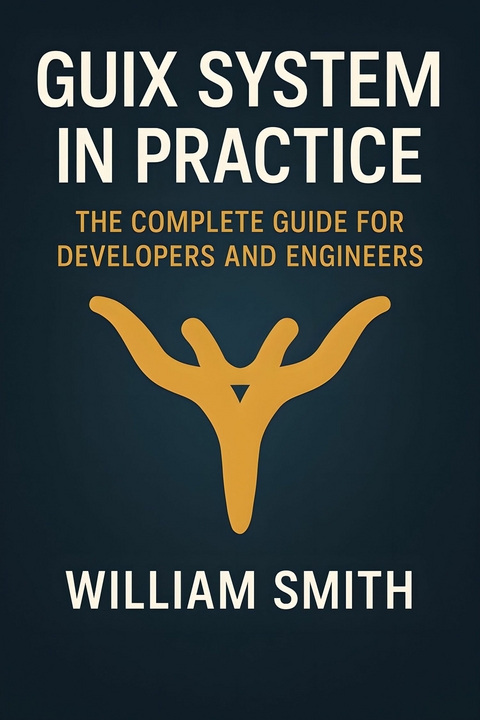
Guix System in Practice (eBook)
250 Seiten
HiTeX Press (Verlag)
978-0-00-102494-6 (ISBN)
'Guix System in Practice'
'Guix System in Practice' is a comprehensive guide to the design, customization, and operational nuances of the Guix System, a modern GNU/Linux distribution built on the principles of functional package management. Rooted in a robust theoretical framework, the book first examines the core tenets underpinning Guix-such as declarative system configuration, the extensive use of Guile Scheme for extensibility, and the mechanisms that ensure reproducibility and system rollbacks. By contrasting Guix with systems like NixOS and traditional distributions, readers gain critical insight into what sets Guix apart in both design philosophy and everyday practice.
The book methodically guides readers through the complete lifecycle of system management on Guix, with in-depth coverage on configuring users, networking, devices, package management, and services. It provides hands-on strategies for defining and modifying packages, maintaining secure, reproducible environments, and composing modular system services. Special attention is devoted to topics such as secure software delivery, isolation strategies, and auditing-making it a vital resource for professionals charged with maintaining robust, trustworthy infrastructures.
Beyond local deployment, 'Guix System in Practice' explores advanced topics including automation, infrastructure as code, and leveraging Guix in cloud and distributed environments. Real-world case studies across scientific, enterprise, and regulated sectors illustrate both the flexibility and depth of the system. The closing chapters trace current research and future directions, addressing scaling, formal verification, and the evolving Guix ecosystem-making this book both an indispensable reference and a forward-looking survey for systems engineers, DevOps practitioners, and anyone passionate about reproducible, reliable computing.
Chapter 2
Declarative System Configuration
Step into the world of fully declarative configuration, where the entire system state is shaped by transparent, reproducible code rather than opaque scripts or brittle runbooks. This chapter unpacks how Guix empowers administrators and developers to define, reason about, and evolve complete systems-users, services, filesystems, networks, locales, and hardware-with precision and confidence. Discover how declarative methods not only prevent configuration drift but also pave the way for automated, auditable, and reproducible infrastructure at scale.
2.1 Operating-System Declarations
Guix’s approach to operating-system configuration leverages the full expressive power of Scheme to create first-class declarative system descriptions. Unlike traditional configuration methods relying on imperative scripts or static configuration files, Guix treats the entire operating-system declaration as a Scheme object. This enables not only a uniform representation of system states but also composability, modularity, and precise control over system evolution.
At its core, the operating-system declaration is a Scheme record built using the operating-system form, which specifies key parameters such as installed packages, service bundles, user accounts, file system mounts, and various system settings. The primary form takes the following shape:
(hostname "example-host")
(timezone "UTC")
(locale "en_US.UTF-8")
(packages (cons* gcc glibc coreutils %base-packages))
(services (cons* (ssh-service)
(gnome-service)
%base-services))
(users (list (user-account
(name "alice")
(home-directory "/home/alice")
(shell (string-append %bash "/bin/bash")))))
(file-systems (list (file-system
(device "/dev/sda1")
...
| Erscheint lt. Verlag | 20.8.2025 |
|---|---|
| Sprache | englisch |
| Themenwelt | Mathematik / Informatik ► Informatik ► Programmiersprachen / -werkzeuge |
| ISBN-10 | 0-00-102494-9 / 0001024949 |
| ISBN-13 | 978-0-00-102494-6 / 9780001024946 |
| Informationen gemäß Produktsicherheitsverordnung (GPSR) | |
| Haben Sie eine Frage zum Produkt? |
 EPUB (Adobe DRM)
Größe: 533 KB
Kopierschutz: Adobe-DRM
Adobe-DRM ist ein Kopierschutz, der das eBook vor Mißbrauch schützen soll. Dabei wird das eBook bereits beim Download auf Ihre persönliche Adobe-ID autorisiert. Lesen können Sie das eBook dann nur auf den Geräten, welche ebenfalls auf Ihre Adobe-ID registriert sind.
Details zum Adobe-DRM
Dateiformat: EPUB (Electronic Publication)
EPUB ist ein offener Standard für eBooks und eignet sich besonders zur Darstellung von Belletristik und Sachbüchern. Der Fließtext wird dynamisch an die Display- und Schriftgröße angepasst. Auch für mobile Lesegeräte ist EPUB daher gut geeignet.
Systemvoraussetzungen:
PC/Mac: Mit einem PC oder Mac können Sie dieses eBook lesen. Sie benötigen eine
eReader: Dieses eBook kann mit (fast) allen eBook-Readern gelesen werden. Mit dem amazon-Kindle ist es aber nicht kompatibel.
Smartphone/Tablet: Egal ob Apple oder Android, dieses eBook können Sie lesen. Sie benötigen eine
Geräteliste und zusätzliche Hinweise
Buying eBooks from abroad
For tax law reasons we can sell eBooks just within Germany and Switzerland. Regrettably we cannot fulfill eBook-orders from other countries.
aus dem Bereich


