


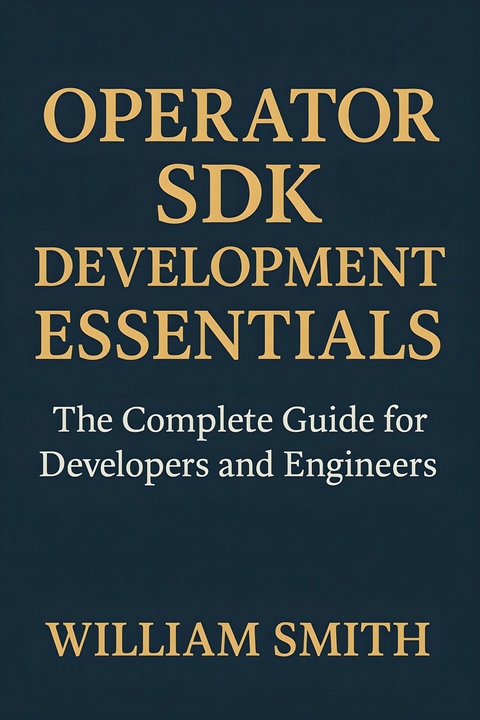
Operator SDK Development Essentials (eBook)
250 Seiten
HiTeX Press (Verlag)
978-0-00-102478-6 (ISBN)
'Operator SDK Development Essentials'
Operator SDK Development Essentials is the definitive guide for modern application and infrastructure automation on Kubernetes. This comprehensive book introduces readers to the Operator pattern, walking through fundamental concepts such as Custom Resource Definitions (CRDs), controller workflows, and Operator maturity models. Through real-world cloud-native use cases, it illustrates how Operators encapsulate complex operational knowledge and promote automation, security, and scalability within Kubernetes environments.
From initial setup to production deployment, the book provides expert coverage of the Operator SDK, including hands-on instruction for Go, Ansible, and Helm-based Operators. Readers learn to scaffold projects, manage dependencies, design advanced reconciliation logic, and implement robust testing strategies-ensuring quality and performance at every stage. Deep technical sections explore performance profiling, multi-cluster patterns, secure RBAC implementations, CI/CD integration, and lifecycle management through the Operator Lifecycle Manager (OLM) and OperatorHub.
Beyond development, Operator SDK Development Essentials emphasizes best practices for security, compliance, and observability in large-scale deployments. Readers discover advanced topics such as incident response, audit and compliance automation, workload sharding, and the evolving landscape of Operator-powered AI and policy integration. Whether for platform engineers, SREs, or application developers, this book delivers practical wisdom and future-proof techniques for mastering automated operations with the Operator SDK in any Kubernetes ecosystem.
Chapter 2
Getting Started with the Operator SDK
Every expert Operator begins with the right tools-and in the Kubernetes world, the Operator SDK is the gateway to operational intelligence. This chapter is your hands-on initiation, equipping you to move beyond theory and immerse yourself in the disciplined art of Operator construction. Explore the architecture, master the SDK’s scaffolding, and learn to command its CLI with confidence, laying an unshakable foundation for advanced automation.
2.1 SDK Overview and Architecture
The Operator SDK represents a pivotal advancement in the Kubernetes ecosystem, providing a well-structured framework for developing cloud-native applications that extend Kubernetes functionality. At its core, the SDK abstracts the complexity involved in interacting with Kubernetes primitives, thereby enabling developers to focus on domain-specific logic rather than infrastructure plumbing. The design rationale behind the Operator SDK arises from the need to standardize Operator development, reduce boilerplate, and promote best practices, which collectively enhance Operator reliability, maintainability, and community adoption.
The SDK’s architecture is characterized by a modular and extensible structure supporting multiple programming paradigms, including Go, Ansible, and Helm. This multi-language support acknowledges diverse developer expertise and operational requirements, offering flexibility while maintaining a coherent Operator lifecycle model.
Rationale for the SDK
Historically, building Kubernetes Operators required a deep understanding of client libraries, informer caches, controllers, and reconciliation loops. Such tasks imposed steep learning curves, code duplication, and inconsistencies across Operator implementations. The Operator SDK addresses these challenges by encapsulating common Operator patterns, thereby providing:
- Standardization: A predictable project layout, scaffolding, and code generation that conform to Kubernetes API conventions.
- Automation: Tooling for code generation, manifests, and testing to expedite development.
- Integration: Seamless interaction with Kubernetes controller-runtime and client-go libraries, leveraging informers and work queues.
- Lifecycle Management: Support for Operator lifecycle events and status updates aligned with Kubernetes controller patterns.
The SDK’s design principle fosters consistent Operator behavior, which plays a foundational role in the broader Kubernetes Operator ecosystem’s stability and interoperability.
Modular Architecture
The SDK’s internal structure is partitioned into distinct submodules, each corresponding to a facet of the Operator development process and runtime behavior. These modules collectively form a lifecycle that progresses from scaffolding and building Operators to runtime management and enhancement.
1. Project Scaffolding and Code Generation
This module provides language-specific templates and generators that bootstrap new Operator projects with idiomatic folder layouts, API type definitions, and reconciliation boilerplate. For Go-based Operators, this encompasses code generation tools such as controller-gen and kubebuilder, which produce Custom Resource Definitions (CRDs), client sets, and deep-copy functions. For Ansible and Helm, scaffolding establishes directory structures and manifests tailored to their respective domain-specific languages and packaging styles.
operator-sdk create api --group cache --version v1alpha1 --kind Memcached --resource --controller
2. Language-Specific Controllers
The SDK supports three primary Operator types:
- Go Operators: These Operators leverage the controller-runtime library to implement the reconciliation loop in Go, providing fine-grained control over event handling, caching, and Kubernetes API interactions.
- Ansible Operators: These utilize Ansible playbooks or roles to drive the reconciliation logic, abstracting Kubernetes interactions through declarative automation tasks.
- Helm Operators: These Operators manage lifecycle through Helm charts, offering a package-centric approach suited for templated Kubernetes resource management.
Each controller type is tightly integrated with the SDK’s shared machinery, allowing consistent event watching, queue processing, and status management despite differences in implementation language or paradigm.
3. Controller Runtime and Kubernetes Integration
Underpinning all Operator types is the controller-runtime library, a core SDK submodule that manages the interaction with Kubernetes API servers. It orchestrates the watches on resources, event handling, and reconciliation triggers through a well-architected event-driven processing pipeline:
- Informers: Efficient caching of Kubernetes resource states, reducing API server load.
- Work Queues: Buffered event processing ensuring resilient and order-preserving reconciliation.
- Reconciler Interface: User-implemented reconciliation logic, invoked with the current resource state.
The controller-runtime further integrates leader election, metrics, and health probes, promoting best practices for production-grade Operator deployments.
4. Custom Resource Definitions and APIs
A critical component handled by the SDK is Custom Resource Definition generation and versioning. The SDK automates the generation of CRDs from API Go types or metadata annotations in Ansible and Helm projects, ensuring consistency and correctness. This feature supports multi-version Kubernetes APIs, conversion webhooks, and validation schemas, allowing Operators to evolve their resource schemas without breaking clusters.
5. Lifecycle Submodules
The Operator lifecycle is systematically mapped onto submodules responsible for:
- Installation and Upgrade: Handling CRD deployment and Operator version management.
- Reconciliation Logic: Implemented differently for Go, Ansible, and Helm but following the same contract of observing and converging resource state.
- Status Management: Updating resource status fields to report Operator progress, errors, or conditions back to Kubernetes.
- Event Recording and Logging: Emitting structured events into the Kubernetes event stream for observability.
By decomposing the lifecycle into these concerns, the SDK enables clear separation of responsibilities and easier extension or customization if needed.
6. Metrics and Telemetry
To facilitate operational insight, the SDK embeds instrumentation capabilities consistent across all Operator types. Metrics exposed via Prometheus help track reconciliation duration, errors, and resource-specific events, enabling integration with Kubernetes monitoring stacks. These observability standards encourage continual reliability improvements.
Integration with the Broader Ecosystem
The Operator SDK’s architecture maximizes interoperability with Kubernetes native components and third-party tools. By adhering closely to Kubernetes API conventions and controller patterns, operators built with the SDK can be deployed via Operator Lifecycle Manager (OLM), managed by GitOps tools, and monitored using standard telemetry ...
| Erscheint lt. Verlag | 20.8.2025 |
|---|---|
| Sprache | englisch |
| Themenwelt | Mathematik / Informatik ► Informatik ► Programmiersprachen / -werkzeuge |
| ISBN-10 | 0-00-102478-7 / 0001024787 |
| ISBN-13 | 978-0-00-102478-6 / 9780001024786 |
| Informationen gemäß Produktsicherheitsverordnung (GPSR) | |
| Haben Sie eine Frage zum Produkt? |
 EPUB (Adobe DRM)
Größe: 971 KB
Kopierschutz: Adobe-DRM
Adobe-DRM ist ein Kopierschutz, der das eBook vor Mißbrauch schützen soll. Dabei wird das eBook bereits beim Download auf Ihre persönliche Adobe-ID autorisiert. Lesen können Sie das eBook dann nur auf den Geräten, welche ebenfalls auf Ihre Adobe-ID registriert sind.
Details zum Adobe-DRM
Dateiformat: EPUB (Electronic Publication)
EPUB ist ein offener Standard für eBooks und eignet sich besonders zur Darstellung von Belletristik und Sachbüchern. Der Fließtext wird dynamisch an die Display- und Schriftgröße angepasst. Auch für mobile Lesegeräte ist EPUB daher gut geeignet.
Systemvoraussetzungen:
PC/Mac: Mit einem PC oder Mac können Sie dieses eBook lesen. Sie benötigen eine
eReader: Dieses eBook kann mit (fast) allen eBook-Readern gelesen werden. Mit dem amazon-Kindle ist es aber nicht kompatibel.
Smartphone/Tablet: Egal ob Apple oder Android, dieses eBook können Sie lesen. Sie benötigen eine
Geräteliste und zusätzliche Hinweise
Buying eBooks from abroad
For tax law reasons we can sell eBooks just within Germany and Switzerland. Regrettably we cannot fulfill eBook-orders from other countries.
aus dem Bereich


