


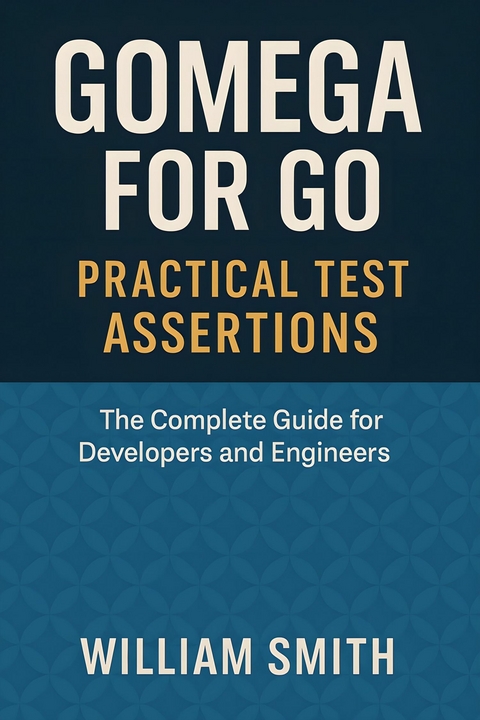
Gomega for Go: Practical Test Assertions (eBook)
250 Seiten
HiTeX Press (Verlag)
978-0-00-102460-1 (ISBN)
'Gomega for Go: Practical Test Assertions'
'Gomega for Go: Practical Test Assertions' is an indispensable guide for Go developers seeking to master expressive, maintainable, and robust test assertions using the Gomega library. The book opens with a meticulous exploration of assertion fundamentals, charting the landscape from native Go testing capabilities to the philosophy and core concepts of Gomega's matcher-based approach. Readers are guided through the process of integrating Gomega into diverse projects, understanding its synergy with frameworks like Ginkgo, and setting up scalable, reliable testing environments.
Delving into the mechanics and elegant syntax of Gomega, the book empowers practitioners to craft clear, fluent assertions for every level of complexity-from simple type comparisons to intricate validations of collections, structs, channels, and concurrent behaviors. Specialized chapters address advanced challenges such as error handling, panics, asynchronous testing, and integrating with property-based or fuzz testing. Readers gain deep insight into writing custom matchers, optimizing performance, managing massive test suites, and ensuring high reliability even in edge and failure scenarios.
Drawing from industry best practices and real-world case studies, the book closes with a forward-looking perspective on effective assertion design, anti-patterns to avoid, and the evolving future of testing in the Go ecosystem. Whether you are building enterprise-grade systems or open source projects, 'Gomega for Go' stands as both a practical reference and a strategic manual for elevating your Go testing to the highest standards.
Chapter 1
Foundations of Test Assertions in Go
Before achieving precision in automated testing, it is vital to grasp how assertions underpin every robust Go codebase. This chapter digs beneath the surface of familiar tools, revealing the architectural and philosophical underpinnings that shape Go’s distinct approach to testing. Through a critical exploration of assertion paradigms and their evolution in Go, readers will uncover both the present capabilities and future potential of this essential pillar of software quality.
1.1 Role of Assertions in Go Testing
Assertions in Go testing transcend mere technical utilities; they embody a critical nexus between code correctness, defect prevention, and long-term system maintainability. Unlike traditional error checks or log statements, assertions articulate explicit expectations about program behavior at designated points in test executions. This explicitness cements their function as both correctness validators and as unambiguous documentation of intended functionality.
At a fundamental level, assertions in Go serve as predicates that must hold true for tests to pass, thus providing an automated checkpoint against regressions and faulty logic. Their placement within test functions transforms the abstract requirements of the software into concrete, verifiable conditions. This shift from implicit understanding to explicit declaration is pivotal for early defect detection. A failing assertion immediately highlights a deviation from expected behavior, enabling rapid identification and resolution of bugs before they propagate deeper into production.
Assertions also codify assumptions which might otherwise remain uncertain or buried within convoluted logic. For example, when testing a function that processes input data to generate a sorted slice, an assertion succinctly verifies both the correct length and the sorted property of the result. This clarity helps prevent silent failures—cases where incorrect but plausible outputs quietly pass unnoticed. Assertions thus tighten the feedback loop between code correctness and developer awareness, enforcing a discipline that prioritizes correctness from the ground up.
Beyond technical correctness, assertions operate as vehicles of communication that improve test readability and maintainability. Each assertion encodes intent: what the software is supposed to do under given conditions. Well-crafted assertions enable tests to serve as executable specifications, significantly reducing the cognitive load for developers who must understand or modify the code later. The precision of assertions helps eliminate guesswork, making the tests self-explanatory artifacts. This advantage is particularly valuable in collaborative and evolving codebases, where clarity of intent mitigates the risk of regression and misinterpretation.
Consider the following example illustrating a typical assertion pattern using Go’s standard library testing framework. The function under test calculates the factorial of a non-negative integer:
if n == 0 {
return 1
}
return n * Factorial(n-1)
}
func TestFactorial(t *testing.T) {
result := Factorial(5)
expected := 120
if result != expected {
t.Errorf("Factorial(5) = %d; want %d", result, expected)
}
}
Here, the assertion is embedded in the conditional check. While effective, it is verbose and focuses primarily on the binary pass/fail outcome. This example can be enhanced by leveraging third-party assertion libraries such as testify/assert, which promote clearer intent and improved test structure:
"testing"
"github.com/stretchr/testify/assert"
)
func TestFactorialWithAssert(t *testing.T) {
result := Factorial(5)
...
| Erscheint lt. Verlag | 20.8.2025 |
|---|---|
| Sprache | englisch |
| Themenwelt | Mathematik / Informatik ► Informatik ► Programmiersprachen / -werkzeuge |
| ISBN-10 | 0-00-102460-4 / 0001024604 |
| ISBN-13 | 978-0-00-102460-1 / 9780001024601 |
| Informationen gemäß Produktsicherheitsverordnung (GPSR) | |
| Haben Sie eine Frage zum Produkt? |
 EPUB (Adobe DRM)
Größe: 651 KB
Kopierschutz: Adobe-DRM
Adobe-DRM ist ein Kopierschutz, der das eBook vor Mißbrauch schützen soll. Dabei wird das eBook bereits beim Download auf Ihre persönliche Adobe-ID autorisiert. Lesen können Sie das eBook dann nur auf den Geräten, welche ebenfalls auf Ihre Adobe-ID registriert sind.
Details zum Adobe-DRM
Dateiformat: EPUB (Electronic Publication)
EPUB ist ein offener Standard für eBooks und eignet sich besonders zur Darstellung von Belletristik und Sachbüchern. Der Fließtext wird dynamisch an die Display- und Schriftgröße angepasst. Auch für mobile Lesegeräte ist EPUB daher gut geeignet.
Systemvoraussetzungen:
PC/Mac: Mit einem PC oder Mac können Sie dieses eBook lesen. Sie benötigen eine
eReader: Dieses eBook kann mit (fast) allen eBook-Readern gelesen werden. Mit dem amazon-Kindle ist es aber nicht kompatibel.
Smartphone/Tablet: Egal ob Apple oder Android, dieses eBook können Sie lesen. Sie benötigen eine
Geräteliste und zusätzliche Hinweise
Buying eBooks from abroad
For tax law reasons we can sell eBooks just within Germany and Switzerland. Regrettably we cannot fulfill eBook-orders from other countries.
aus dem Bereich


