


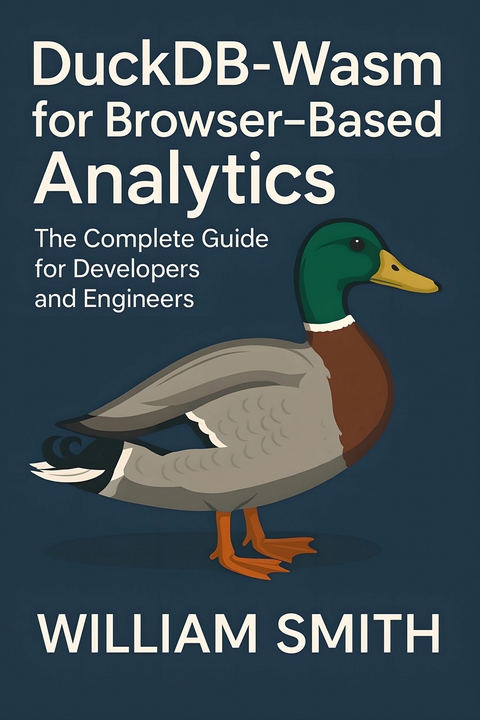
DuckDB-Wasm for Browser-Based Analytics (eBook)
250 Seiten
HiTeX Press (Verlag)
978-0-00-102456-4 (ISBN)
'DuckDB-Wasm for Browser-Based Analytics'
DuckDB-Wasm for Browser-Based Analytics offers an authoritative and comprehensive exploration of the rapidly evolving landscape of in-browser data analytics, providing readers with both foundational knowledge and in-depth technical insights. The book traces the remarkable journey from traditional server-hosted databases to high-performance, client-side analytics engines powered by modern technologies like WebAssembly (Wasm). With a focus on the pioneering DuckDB-Wasm project, readers are introduced to the architectural requirements, enabling technologies, and motivations behind delivering full-featured analytics directly in the browser-empowering new domains from offline-first applications to real-time data exploration in secure, privacy-conscious contexts.
This guide meticulously unpacks the internals of DuckDB-Wasm, from cross-compilation and JavaScript-Wasm interoperability, to advanced memory management, virtual file system integration, and sandboxed security. It provides practical, actionable advice for developers and architects on installation, deployment strategies, data ingestion from diverse sources, and building resilient data pipelines under browser constraints. Chapters detail best practices for integrating DuckDB-Wasm with leading web frameworks, optimizing performance for analytical workloads, managing large datasets in limited environments, and ensuring robust security, privacy, and compliance in every facet of the in-browser analytics stack.
Rich with detailed use cases, real-world performance case studies, and forward-looking guidance, DuckDB-Wasm for Browser-Based Analytics not only equips technical readers to build scalable, maintainable, and high-performance browser-based analytical applications, but also envisions an open, democratized future for data-driven decision making. Whether you are a developer, data engineer, or product leader, this book serves as both a practical manual and an inspirational roadmap for leveraging analytics at the edge, where data meets the user-securely, efficiently, and interactively.
Chapter 2
DuckDB-Wasm Architecture and Internals
Behind every seamless browser-based analytical experience lies a carefully orchestrated system of compilation, runtime management, and security mechanisms. This chapter opens the black box of DuckDB-Wasm, exploring its transformation from C++ source to high-speed WebAssembly, the subtleties of memory and file system integration, and the intricate interplay between Wasm and JavaScript. Through a close examination of these internals, you’ll uncover the engineering ingenuity that makes interactive, secure, and high-performance analytics possible entirely within the browser.
2.1 Cross-Compiling DuckDB to WebAssembly
Porting DuckDB, a sophisticated analytical database engine written primarily in C++, to the WebAssembly (Wasm) environment involves a multifaceted technical process that requires careful consideration of the Wasm platform’s constraints and capabilities. The primary objective is to transform DuckDB’s native codebase into a portable, browser-compatible module without compromising its performance characteristics or correctness guarantees.
The process begins with selecting an appropriate toolchain. The industry-standard Emscripten framework is employed to convert DuckDB’s C++ code into Wasm binaries. Emscripten provides LLVM-based compilation pipelines that translate native code to WebAssembly bytecode and generates JavaScript glue code to interface with browsers. A pivotal aspect of this toolchain is its ability to simulate certain system-level APIs, which are crucial for DuckDB’s functionality but are not natively available in browser environments.
Build configuration necessitates multiple adaptations. The DuckDB CMake-based build system must be extended with new targets to output Wasm modules. Compiler flags are meticulously adjusted to suit the Wasm platform’s LLVM backend. For instance, optimization flags like -O3 are retained to maximize performance, albeit within the constraints of Wasm code size and compilation speed. Linker settings are configured to produce a single combined Wasm file accompanied by the necessary JavaScript bootstrap.
Complex dependencies inherent in DuckDB require special attention. DuckDB relies on low-level system interfaces for filesystem operations, threading, and memory management, many of which are limited or behave differently within browsers. The Wasm environment restricts direct access to native OS calls, necessitating replacement or emulation strategies.
To handle filesystem interactions, a virtualized filesystem layer provided by Emscripten’s MEMFS or IDBFS is integrated to emulate persistent storage using IndexedDB or in-memory constructs. This enables DuckDB to read and write database files without native disk access. Threading presents a substantial challenge since WebAssembly’s threading support depends on SharedArrayBuffer and browser compatibility; therefore, DuckDB’s parallel execution features are conditionally compiled or adapted using Emscripten’s pthreads shim where possible. When threading cannot be reliably supported, execution falls back to a single-threaded mode with minimal impact on correctness but some performance degradation.
Custom code modifications are inevitable to bridge gaps between DuckDB’s assumptions and the browser environment. System calls such as mmap, fork, or POSIX signals are either stubbed out, replaced with safe alternatives, or wrapped inside conditional macros to exclude them from Wasm builds. Additionally, DuckDB’s initialization sequences are adjusted to defer certain operations until the Wasm runtime and JavaScript environment are fully initialized, ensuring compatibility with asynchronous loading models in the browser.
Memory management also requires tuning to align with the Wasm linear memory model. DuckDB’s allocator is adapted to efficiently utilize Wasm’s fixed-size, contiguous memory buffer while enabling dynamic growth when supported. This preserves allocation efficiency and minimizes fragmentation and garbage.
Performance preservation demands particular focus. The compilation process prioritizes inlining, dead code elimination, and loop unrolling to counterbalance the overhead introduced by the Wasm abstraction layer. Profiling and benchmarking guide iterative refinement of configuration parameters, such as adjusting the size of Wasm memory pages and stack limits to avoid expensive runtime bounds checks. Furthermore, preloading and lazy-loading strategies for DuckDB’s data segments and binary components reduce startup latency in the browser environment.
Correctness guarantees hinge on meticulous validation and testing. Automated test suites originally designed for native DuckDB are cross-compiled and run within headless browser environments and Node.js using Wasm to verify functional equivalence. Edge cases related to timing, concurrency, and file I/O are analyzed with attention to discrepancies caused by the browser’s event loop and single-threaded JavaScript execution semantics. This rigorous testing process ensures that the core database engine semantics, query execution accuracy, and transactional integrity are faithfully maintained.
In summary, cross-compiling DuckDB to WebAssembly constitutes a complex interplay of toolchain configuration, dependency adaptation, and custom code modification designed to compensate for missing system-level APIs. Through precise adjustments to the build system, substitution of I/O and concurrency primitives, and careful optimization of memory management, DuckDB preserves its performance and correctness in the Wasm environment, enabling powerful in-browser data processing capabilities.
2.2 Runtime Environment in the Browser
DuckDB-Wasm adapts the DuckDB database engine for execution within modern browser JavaScript engines by compiling native C++ code into WebAssembly (Wasm). This transformation leverages the WebAssembly runtime within JavaScript engines such as V8, SpiderMonkey, or JavaScriptCore, providing near-native performance while operating under the browser’s sandboxed environment. Understanding this runtime environment requires exploring the instantiation and execution of the DuckDB-Wasm module, its lifecycle, bootstrapping mechanisms, sandbox constraints, threading paradigms, and performance characteristics emerging from synchronous and asynchronous API designs.
Module Instantiation and Lifecycle
The core of DuckDB-Wasm is a WebAssembly module compiled from DuckDB’s source using Emscripten or a similar toolchain targeting the WebAssembly System Interface (WASI) or the browser-specific Wasm runtime. During module instantiation, the JavaScript environment fetches and compiles the Wasm bytecode, producing a WebAssembly.Instance that exports functions accessible from JavaScript. This process typically involves three key steps:
- Fetching and Compilation: The .wasm binary is retrieved over the network or locally, then compiled. Modern browsers employ streaming compilation, permitting parsing and compilation concurrent with byte retrieval to reduce startup latency.
- Instantiation: After compilation, the module is instantiated with imports defining required host functions, including memory management, system calls, and asynchronous operations necessary for DuckDB’s operation within the sandbox.
- Initialization: DuckDB sets up its internal structures, including heap memory for data storage, the query execution engine, and virtual tables representing in-memory datasets or persistent storage backends.
The lifecycle of this module extends between creation and explicit destruction (if implemented), with persistent in-memory state retained through JavaScript references. Efficient memory management is crucial, as the WebAssembly linear memory is statically allocated and requires manual resizing strategies. DuckDB-Wasm’s internal engine must perform memory operations within browser-imposed limits, balancing available resources and performance demands.
Bootstrapping and Execution Environment
The bootstrapping phase initiates DuckDB’s database context entirely in the browser, crafting an environment where SQL queries can be parsed, planned, and executed locally. This process relies on the WebAssembly heap for database state and runtime data, isolated from the host environment’s heap and call stacks. Execution of the database engine happens entirely inside the sandboxed WebAssembly environment, insulating it from direct filesystem or network access. Any interactions beyond the Wasm sandbox-such as data import/export-are mediated via JavaScript APIs.
JavaScript serves as the host orchestrator, invoking exported functions for query execution and providing the necessary callbacks or shared buffers for data transfer. The tight integration of JavaScript and Wasm enables DuckDB-Wasm to use zero-copy mechanisms where possible, for example, leveraging SharedArrayBuffer or TypedArray views for passing tabular data with minimal serialization overhead.
Sandboxing Constraints and Security Considerations
...| Erscheint lt. Verlag | 20.8.2025 |
|---|---|
| Sprache | englisch |
| Themenwelt | Mathematik / Informatik ► Informatik ► Programmiersprachen / -werkzeuge |
| ISBN-10 | 0-00-102456-6 / 0001024566 |
| ISBN-13 | 978-0-00-102456-4 / 9780001024564 |
| Informationen gemäß Produktsicherheitsverordnung (GPSR) | |
| Haben Sie eine Frage zum Produkt? |
 EPUB (Adobe DRM)
Größe: 570 KB
Kopierschutz: Adobe-DRM
Adobe-DRM ist ein Kopierschutz, der das eBook vor Mißbrauch schützen soll. Dabei wird das eBook bereits beim Download auf Ihre persönliche Adobe-ID autorisiert. Lesen können Sie das eBook dann nur auf den Geräten, welche ebenfalls auf Ihre Adobe-ID registriert sind.
Details zum Adobe-DRM
Dateiformat: EPUB (Electronic Publication)
EPUB ist ein offener Standard für eBooks und eignet sich besonders zur Darstellung von Belletristik und Sachbüchern. Der Fließtext wird dynamisch an die Display- und Schriftgröße angepasst. Auch für mobile Lesegeräte ist EPUB daher gut geeignet.
Systemvoraussetzungen:
PC/Mac: Mit einem PC oder Mac können Sie dieses eBook lesen. Sie benötigen eine
eReader: Dieses eBook kann mit (fast) allen eBook-Readern gelesen werden. Mit dem amazon-Kindle ist es aber nicht kompatibel.
Smartphone/Tablet: Egal ob Apple oder Android, dieses eBook können Sie lesen. Sie benötigen eine
Geräteliste und zusätzliche Hinweise
Buying eBooks from abroad
For tax law reasons we can sell eBooks just within Germany and Switzerland. Regrettably we cannot fulfill eBook-orders from other countries.
aus dem Bereich


