


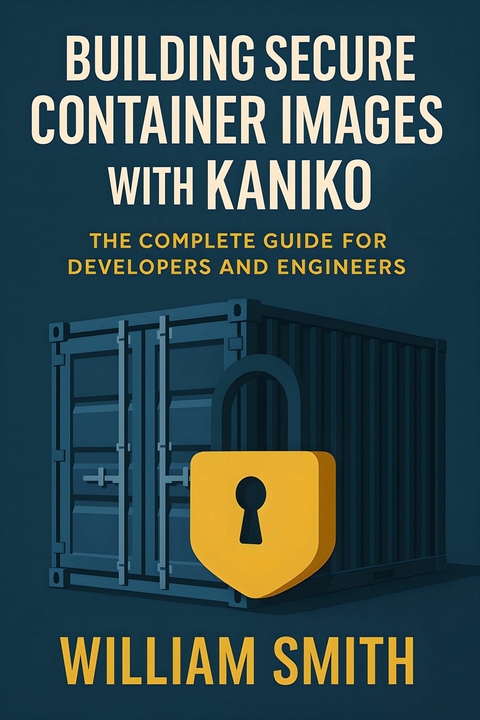
Building Secure Container Images with Kaniko (eBook)
250 Seiten
HiTeX Press (Verlag)
978-0-00-102442-7 (ISBN)
'Building Secure Container Images with Kaniko'
'Building Secure Container Images with Kaniko' is the definitive guide for security-conscious engineers and DevOps professionals looking to modernize their container build pipelines. This book provides a comprehensive exploration of Kaniko's internal architecture, contrasting its highly secure, rootless build process with traditional tools like Docker and BuildKit. Through practical examples and deep technical analysis, readers learn how Kaniko enforces isolation, utilizes ephemeral build environments, and produces standards-compliant images, all while adhering to best practices for minimizing privileges and sandboxing workflows.
Beyond image construction, the book delves into the complex landscape of supply chain threats, providing actionable threat models, mitigation techniques for malicious build contexts, and robust strategies for embedding provenance and SBOM (Software Bill of Materials) into images. Each chapter is meticulously structured to help readers anticipate vulnerabilities-whether stemming from upstream dependencies, insecure secrets management, or the distribution pipeline itself-and implement modern countermeasures, such as image signing, attestation frameworks, and automated policy enforcement in CI/CD.
Designed for forward-thinking teams and enterprises, 'Building Secure Container Images with Kaniko' covers not only hardening of Dockerfiles and Kaniko-specific configurations, but also the integration of Kaniko into secure CI/CD architectures, registry protections, audit trails, and compliance initiatives. The book closes with a look to the future, examining zero trust principles, federated distribution models, and the standardization efforts shaping the next wave of container security. Whether building at scale or safeguarding high-security workloads, this guide equips professionals with the knowledge and tools to deliver trusted software artifacts in today's dynamic cloud environments.
Chapter 2
Supply Chain Threats and Container Image Security
Modern software is only as secure as its supply chain. In this chapter, dive beneath the surface of container image creation to uncover threat vectors, subtle vulnerabilities in dependencies, and advanced adversarial tactics that threaten image integrity. Discover how strategic controls, provenance, and automation redefine what it means to secure container images throughout their lifecycle.
2.1 Threat Modeling for Containerized Supply Chains
Threat modeling within containerized supply chains necessitates a nuanced approach due to the distinct characteristics and complexities of container technology, combined with the layered nature of modern software delivery pipelines. Unlike traditional monolithic environments, container-based supply chains introduce multiple dynamic components such as container images, registries, orchestrators, and runtime environments that expand the attack surface considerably. A robust threat model for these ecosystems must systematically identify, analyze, and prioritize threats across the entire container lifecycle, emphasizing both build-time and run-time vulnerabilities.
Attack Surfaces Unique to Container Builds
The container build process itself constitutes a critical attack surface, starting from the base images to the build tools and processes integrated within continuous integration/continuous deployment (CI/CD) pipelines. Base images sourced from public repositories may contain outdated or vulnerable software packages, misconfigurations, or even embedded malware. Downstream dependencies, introduced via layers in Dockerfiles or other container build specifications, propagate risks that compound with transitive dependencies. Further exposures arise from build scripts and automated tooling that execute arbitrary code, often with elevated privileges during image construction.
Key components posing unique risk vectors during container builds include:
- Base Images and Layered Dependencies: Frequently leveraged images may harbor zero-day vulnerabilities or malicious payloads inserted via compromised maintainers or automated injection.
- Build Infrastructure: CI/CD systems running build agents can be subverted to introduce malicious changes post source code commit but prior to image assembly.
- Secrets and Credentials: Improper handling or embedding of secrets during builds creates high-value targets for credential exfiltration.
- Third-Party Software and Package Managers: Dependency poisoning and abuse of package metadata repositories introduce subtle and persistent compromise vectors.
Identifying these surfaces requires comprehensive mapping of the container development toolchain and the integration points between source control, image creation, and artifact repositories.
Frameworks for Risk Evaluation Across Supply Chain Components
Effective threat modeling leverages established frameworks tailored to container supply chains, integrating systemic risk evaluation with contextual intelligence. The STRIDE model remains a foundational taxonomy-addressing Spoofing, Tampering, Repudiation, Information Disclosure, Denial of Service, and Elevation of Privilege-but must be adapted to container-specific constructs such as image manifests, container runtimes, and orchestration APIs. Complementary frameworks include the MITRE ATT&CK for Containers matrix, which codifies adversarial techniques observed in container scenarios, providing practical risk assessment anchors.
A structured approach entails:
- 1.
- Component Enumeration: Cataloging all supply chain entities including source repositories, build servers, container registries, orchestration platforms, and deployment targets.
- 2.
- Asset Value and Sensitivity Assessment: Determining the criticality of each component concerning confidentiality, integrity, and availability, influenced by business impact analyses.
- 3.
- Threat Identification and Mapping: Aligning known threat vectors and emerging tactics from threat intelligence feeds to specific components and their interfaces.
- 4.
- Vulnerability Correlation: Integrating vulnerability databases (e.g., CVE, vendor advisories) with component-specific software and configurations to quantify exposure.
- 5.
- Risk Scoring and Prioritization: Applying frameworks such as DREAD or CVSS in container contexts to assign risk levels that guide mitigation efforts.
Such frameworks facilitate threat-informed decision-making, focusing limited security resources on the highest-risk elements of containerized supply chains.
Prioritizing Mitigations Based on Real-World Threat Intelligence
Prioritization within supply chain threat mitigation must be dynamically informed by intelligence reflecting active adversary behaviors and emerging vulnerabilities. Threat feeds from open-source communities, commercial cybersecurity providers, and incident reports enable defenders to understand attacker objectives-often espionage, sabotage, or crypto-mining via container compromise-and the favored exploitation techniques targeting containerized workflows.
Mitigation efforts prioritized by threat intelligence commonly emphasize:
- Image Provenance Verification: Enforcing cryptographic signing and provenance metadata validation to mitigate supply chain tampering.
- Build Environment Hardening: Implementing ephemeral, isolated build agents with minimal privileges and comprehensive audit logging.
- Dependency Vetting and Scanning: Automated vulnerability scanning integrated at multiple stages, including pre-build validation of base images and continuous scanning post-build.
- Secrets Management Best Practices: Utilizing dedicated secret stores with fine-grained access controls and eliminating hard-coded credentials from build artifacts.
- Runtime Security Controls: Container security policies enforcing least privilege, mandatory access controls (e.g., seccomp, AppArmor), and anomaly detection through behavioral monitoring.
Prioritizing such mitigations against intelligence-guided threat assessments prevents misallocation of resources toward low-risk areas and enhances resilience against sophisticated adversaries.
Case Studies Illustrating Complex Adversarial Behavior
Several documented incidents illustrate the multifaceted nature of attacks targeting container image workflows. A notable example involves hackers compromising a popular open-source base image repository, inserting cryptojacking malware within otherwise legitimate container layers. In this case, attackers exploited weak integrity verification on image ingestion coupled with the widespread reuse of compromised images across downstream projects. The attack underscored the need for cryptographic integrity checks and supply chain transparency.
Another case involved adversaries infiltrating CI/CD pipelines by abusing overly permissive automation credentials. This allowed unauthorized image modifications post source code reconciliation, ultimately deploying backdoored containers into production. The incident revealed systemic risks inherent in insufficiently segmented build infrastructures and stressed continuous monitoring of build metadata and access logs.
A further example focused on exploitation of outdated package mirrors during image builds, where attackers poisoned secondary repositories to serve malicious packages. This technique exploited blind trust in external package sources and demonstrated how supply chain compromise can persist undetected through multiple dependency layers.
These cases collectively highlight:
- The importance of end-to-end visibility and validation across the container build and deployment continuum.
- The evolving tactics of adversaries who leverage both technical and operational weaknesses.
- The critical role of layered defenses and proactive threat modeling in anticipating and mitigating container supply chain risks.
By systematically applying threat modeling frameworks tailored to containerized environments, security architects can preempt such complex adversarial behaviors and reinforce the integrity and trustworthiness of modern software supply chains.
2.2 Vulnerabilities in Upstream Dependencies
Containerized environments rely fundamentally on upstream components, including base images, shared layers, and imported artifacts. These dependencies introduce a critical attack surface, as vulnerabilities embedded upstream propagate downstream affecting all derived images and applications. Understanding the intrinsic risks associated with these components and implementing rigorous evaluation, monitoring, and verification practices is essential for maintaining supply...
| Erscheint lt. Verlag | 20.8.2025 |
|---|---|
| Sprache | englisch |
| Themenwelt | Mathematik / Informatik ► Informatik ► Programmiersprachen / -werkzeuge |
| ISBN-10 | 0-00-102442-6 / 0001024426 |
| ISBN-13 | 978-0-00-102442-7 / 9780001024427 |
| Informationen gemäß Produktsicherheitsverordnung (GPSR) | |
| Haben Sie eine Frage zum Produkt? |
 EPUB (Adobe DRM)
Größe: 625 KB
Kopierschutz: Adobe-DRM
Adobe-DRM ist ein Kopierschutz, der das eBook vor Mißbrauch schützen soll. Dabei wird das eBook bereits beim Download auf Ihre persönliche Adobe-ID autorisiert. Lesen können Sie das eBook dann nur auf den Geräten, welche ebenfalls auf Ihre Adobe-ID registriert sind.
Details zum Adobe-DRM
Dateiformat: EPUB (Electronic Publication)
EPUB ist ein offener Standard für eBooks und eignet sich besonders zur Darstellung von Belletristik und Sachbüchern. Der Fließtext wird dynamisch an die Display- und Schriftgröße angepasst. Auch für mobile Lesegeräte ist EPUB daher gut geeignet.
Systemvoraussetzungen:
PC/Mac: Mit einem PC oder Mac können Sie dieses eBook lesen. Sie benötigen eine
eReader: Dieses eBook kann mit (fast) allen eBook-Readern gelesen werden. Mit dem amazon-Kindle ist es aber nicht kompatibel.
Smartphone/Tablet: Egal ob Apple oder Android, dieses eBook können Sie lesen. Sie benötigen eine
Geräteliste und zusätzliche Hinweise
Buying eBooks from abroad
For tax law reasons we can sell eBooks just within Germany and Switzerland. Regrettably we cannot fulfill eBook-orders from other countries.
aus dem Bereich


