


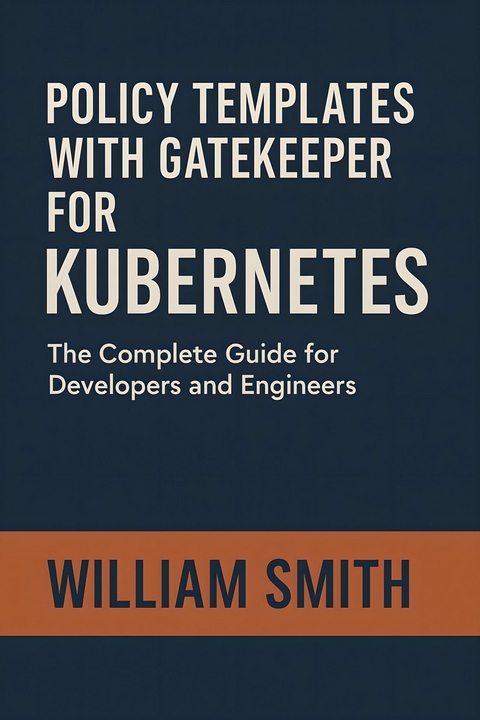
Policy Templates with Gatekeeper for Kubernetes (eBook)
250 Seiten
HiTeX Press (Verlag)
978-0-00-102440-3 (ISBN)
'Policy Templates with Gatekeeper for Kubernetes'
'Policy Templates with Gatekeeper for Kubernetes' is an authoritative and comprehensive guide for practitioners seeking to master policy automation in cloud-native environments. Through an in-depth exploration of the policy-as-code paradigm, this book charts the evolution of Kubernetes policy management-articulating both foundational principles and advanced techniques. Readers will gain a clear understanding of the Open Policy Agent (OPA) ecosystem and how Gatekeeper can be deployed to secure, govern, and automate Kubernetes clusters at scale.
The book methodically covers core architecture concepts, hands-on deployment with leading tools, and the nuanced authoring of reusable ConstraintTemplates using the powerful Rego language. Real-world patterns for policy composition, validation, and automated remediation are detailed alongside strategies for CI/CD integration and large-scale operational monitoring. Advanced sections provide battle-tested advice for policy testing, troubleshooting, performance optimization, and supporting continuous compliance across multi-tenant, regulated, and federated environments.
Whether you are responsible for cluster security, compliance, or operational governance, this book equips you with practical templates, best practices, and forward-looking insights. You will discover how to achieve robust governance, seamless policy delivery, and effective collaboration within your organization-all while preparing for future challenges in Kubernetes security, auditing, and automation. 'Policy Templates with Gatekeeper for Kubernetes' is an indispensable resource for organizations embracing policy as code to drive compliance and operational excellence in cloud-native platforms.
Chapter 1
Foundations of Policy as Code in Kubernetes
In the rapidly evolving cloud-native landscape, the imperative for robust, scalable, and transparent governance has never been greater. This chapter delves into the genesis of policy as code within Kubernetes environments, unraveling the technical forces and organizational demands that drive sophisticated policy automation today. Explore the fundamental principles, architectural pillars, and real-world motivations for treating policy definition, enforcement, and lifecycle as core components of your infrastructure-laying the groundwork for secure, compliant, and auditable clusters at any scale.
1.1 The Evolution of Policy Management
The trajectory of policy management in Kubernetes reflects an ongoing endeavor to reconcile security, compliance, and operational efficiency within increasingly dynamic containerized environments. Initially, the orchestration of access controls and governance was largely a manual process, undertaken by cluster administrators who configured Role-Based Access Control (RBAC) and network policies directly through imperative commands or static manifests. Although RBAC offered a foundational scaffolding for defining user permissions, it was inherently limited by the complexity and scale of modern applications, often resulting in fragmented, inconsistent configurations prone to human error.
Early Kubernetes environments leaned on admission controllers—plugins operating during the API request lifecycle—to enforce policy decisions dynamically. Admission controllers such as the NamespaceLifecycle, LimitRanger, and ServiceAccount introduced necessary guardrails, yet their extensibility for organizational policy enforcement was constrained. Custom admission controllers, developed to validate or mutate requests, often became brittle and difficult to maintain due to tight coupling with cluster internals and the necessity for low-latency responses. The bespoke nature of these controllers impeded portability and fostered operational overhead, especially when diverse teams required varying policy sets tuned to specific compliance or security contexts.
Out-of-band policy audits were an additional approach wherein cluster state and resource configurations were periodically evaluated against predefined policy baselines. Tools conducting these audits—often executed as batch jobs or external scans—provided essential verification for compliance purposes but could only identify drifts post hoc. The latency between policy violation occurrence and detection introduced critical risks, as policy breaches persisted undetected for durations that could expose vulnerabilities or lead to regulatory noncompliance. Moreover, remediation was typically manual or semi-automated, delaying response times and increasing the burden on security teams.
As Kubernetes adoption expanded across enterprises, with workloads embodying diverse provenance and criticality, the insufficiencies of early policy enforcement became increasingly apparent. Operational complexity escalated, driven by diverse teams pushing applications through continuous integration and delivery pipelines with rapid iteration cycles. Concurrently, stringent regulatory frameworks demanded auditable, enforceable policies across development, staging, and production environments. This convergence highlighted the imperative for a consistent, scalable, and flexible governance framework that could adapt seamlessly to accelerating agile development rhythms.
The paradigm shift emerged with the advent of policy as code, a declarative approach that encodes governance rules as machine-readable and version-controlled artifacts. By defining policies in formats such as Open Policy Agent’s Rego or leveraging analytics within Gatekeeper or Kyverno, administrators gained the ability to automate policy enforcement directly within the Kubernetes control plane. This declarative model aligned with GitOps workflows, ensuring that cluster compliance was both observable and reproducible, while enabling policy lifecycle management using the same tooling and practices applied to application code.
Policy as code frameworks address the brittleness of earlier techniques by decoupling policy definitions from tightly bound admission logic, facilitating extensibility and reuse across clusters and teams. Their integration with admission webhooks enforces decisions synchronously during API request processing, combining the rigor of dynamic enforcement with the clarity and auditability of declarative intent. Additionally, these frameworks support rich policy composition, enabling the expression of complex constraints spanning image provenance, resource quotas, network segmentation, and security contexts, mapped to organizational requirements.
Through the evolution from manual access controls and fragile admission controllers to automated, declarative governance, Kubernetes policy management has matured into a foundational pillar of secure and compliant cluster operation. This maturity is indispensable in the era of cloud-native agility, where the speed of innovation must be harmonized with the imperatives of risk mitigation and regulatory adherence. The trajectory underscores the necessity of embedding governance practices into developer workflows and infrastructure provisioning, positioning policy as code not merely as a convenience but as an operational imperative for modern Kubernetes environments.
1.2 Policy as Code: Definition and Core Principles
The abstraction of policy as code signifies a paradigm shift in how organizational policies-ranging from security configurations to compliance mandates-are conceptualized, enacted, and maintained. At its essence, policy as code entails expressing governance rules in a machine-readable format, enabling automated interpretation, enforcement, and validation within computing environments. This formalization transcends traditional textual policy documents, embedding controls directly into software artifacts that interact seamlessly with infrastructure and application lifecycles.
Formally, a policy P is defined as a set of declarative or imperative statements encoded in a structured language L, such that:
where
| Erscheint lt. Verlag | 20.8.2025 |
|---|---|
| Sprache | englisch |
| Themenwelt | Mathematik / Informatik ► Informatik ► Programmiersprachen / -werkzeuge |
| ISBN-10 | 0-00-102440-X / 000102440X |
| ISBN-13 | 978-0-00-102440-3 / 9780001024403 |
| Informationen gemäß Produktsicherheitsverordnung (GPSR) | |
| Haben Sie eine Frage zum Produkt? |
 EPUB (Adobe DRM)
Größe: 601 KB
Kopierschutz: Adobe-DRM
Adobe-DRM ist ein Kopierschutz, der das eBook vor Mißbrauch schützen soll. Dabei wird das eBook bereits beim Download auf Ihre persönliche Adobe-ID autorisiert. Lesen können Sie das eBook dann nur auf den Geräten, welche ebenfalls auf Ihre Adobe-ID registriert sind.
Details zum Adobe-DRM
Dateiformat: EPUB (Electronic Publication)
EPUB ist ein offener Standard für eBooks und eignet sich besonders zur Darstellung von Belletristik und Sachbüchern. Der Fließtext wird dynamisch an die Display- und Schriftgröße angepasst. Auch für mobile Lesegeräte ist EPUB daher gut geeignet.
Systemvoraussetzungen:
PC/Mac: Mit einem PC oder Mac können Sie dieses eBook lesen. Sie benötigen eine
eReader: Dieses eBook kann mit (fast) allen eBook-Readern gelesen werden. Mit dem amazon-Kindle ist es aber nicht kompatibel.
Smartphone/Tablet: Egal ob Apple oder Android, dieses eBook können Sie lesen. Sie benötigen eine
Geräteliste und zusätzliche Hinweise
Buying eBooks from abroad
For tax law reasons we can sell eBooks just within Germany and Switzerland. Regrettably we cannot fulfill eBook-orders from other countries.
aus dem Bereich


