


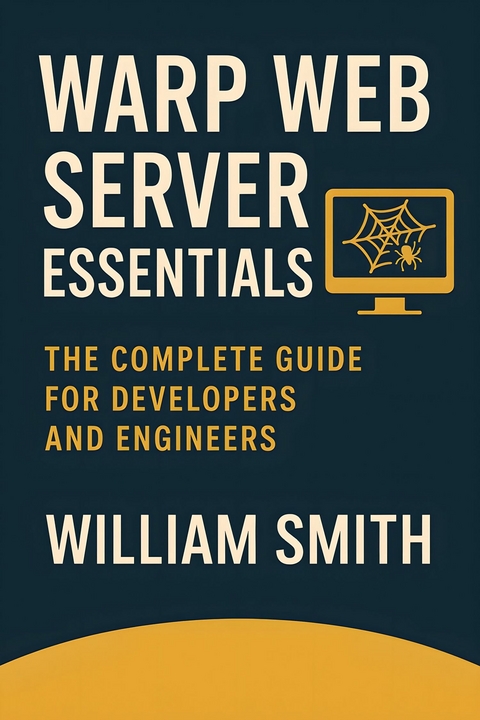
Warp Web Server Essentials (eBook)
250 Seiten
HiTeX Press (Verlag)
978-0-00-102434-2 (ISBN)
'Warp Web Server Essentials'
'Warp Web Server Essentials' is a comprehensive guide to building fast, reliable, and scalable web applications using the Warp framework in Rust. Through meticulously structured chapters, the book demystifies the core abstractions that make Warp unique, including its filter-based approach, robust error handling, and seamless integration with Rust's powerful asynchronous programming model. Readers are introduced to the historical and architectural motivations behind Warp and gain a clear understanding of how it compares to other top Rust web libraries, such as Actix, Axum, and Rocket, allowing informed decisions for project selection.
The book systematically explores every facet of web development with Warp, from declarative routing and type-safe request extraction to advanced state management and security best practices. It provides guidance on handling complex data flows, implementing authentication and access control, managing shared state, and integrating with various backend systems like SQL/NoSQL databases and caching layers. Special emphasis is placed on performance optimization, real-time protocol implementation, and cloud-native deployment patterns, ensuring that solutions are both modern and production-ready.
Beyond the technical essentials, 'Warp Web Server Essentials' addresses the needs of professional developers through practical strategies for testing, observability, fault tolerance, and DevOps integration. Readers learn to automate deployments, monitor application health, and build resilient, self-healing APIs leveraging industry-standard tools and methodologies. The book concludes with extensibility patterns, integration strategies for microservices and emerging technologies, and a forward-looking perspective on the evolving Rust web ecosystem, making it an invaluable resource for both newcomers and experienced practitioners aiming to master web development with Warp.
Chapter 2
Routing, Filters, and Type Safety
What if crafting flexible, high-performance routes could be both elegant and type-safe? In this chapter, we explore how Warp’s unique filter-based routing model marries expressiveness with compile-time guarantees, enabling you to build intricate HTTP APIs without sacrificing maintainability or safety. Discover how deep integration with Rust’s type system elevates error prevention to a new standard.
2.1 Declarative Routing Approaches
Warp’s routing model is distinguished by its declarative route definitions that abstract away low-level HTTP handling details, enabling the construction of expressive, type-safe, and composable web services. At the core of Warp’s design is the concept of filters, which form a powerful and flexible mechanism for specifying request matching logic through compositional trees. This section delves into the principles underlying declarative routing in Warp, focusing on how filter trees translate paths, HTTP methods, and parameters into robust route handlers. Moreover, it analyzes the comparative advantages of nested filters versus imperative routing strategies common in other frameworks.
Declarative routing in Warp is predicated on defining filters using a combinatorial API that treats each filter as a function mapping requests to a result, typically encapsulating potential extraction and validation of parameters. These combinators are chained and combined using logical operators, fostering modular route definitions. Filters are designed to be first-class, composable constructs that allow a fluid assembly of complex matching criteria without manual parsing of the request state.
A typical Warp filter corresponds to a predicate applied to incoming HTTP requests, such as matching the URL path segments, HTTP method, headers, query parameters, or even request bodies. Filters combine via logical conjunction (“and”) and disjunction (“or”) to form trees that model hierarchical route structures. For instance, a path filter specifying a static segment can be composed with a filter extracting a path parameter to create precise route patterns:
.and(warp::path::param::<u64>())
.and(warp::get());
Here, the user_route filter only matches paths beginning with /user followed by a parameter that is parsed as a 64-bit unsigned integer, and restricts the HTTP method to GET requests. If all constituent filters succeed, the parameters extracted-in this case, the u64-are passed downstream to the handler.
This composability extends beyond simple path matching. Filters for query strings, headers, and bodies can be seamlessly integrated. The declarative nature emerges by specifying desired constraints without programmer intervention on control flow, promoting clarity and correctness. Warp’s type system enforces that parameter extraction aligns with the expected types, leveraging Rust’s static typing for compile-time safety.
Nested filters form hierarchical route definitions reflecting the URL path’s tree structure. Take, for example, a set of nested routes for an API under /api/v1:
.and(warp::path("v1"))
.and(
warp::path("users")
.and(warp::path::end())
.and(warp::get())
.map(|| "List users")
.or(
warp::path(u64::parse)
...
| Erscheint lt. Verlag | 20.8.2025 |
|---|---|
| Sprache | englisch |
| Themenwelt | Mathematik / Informatik ► Informatik ► Programmiersprachen / -werkzeuge |
| ISBN-10 | 0-00-102434-5 / 0001024345 |
| ISBN-13 | 978-0-00-102434-2 / 9780001024342 |
| Informationen gemäß Produktsicherheitsverordnung (GPSR) | |
| Haben Sie eine Frage zum Produkt? |
 EPUB (Adobe DRM)
Größe: 697 KB
Kopierschutz: Adobe-DRM
Adobe-DRM ist ein Kopierschutz, der das eBook vor Mißbrauch schützen soll. Dabei wird das eBook bereits beim Download auf Ihre persönliche Adobe-ID autorisiert. Lesen können Sie das eBook dann nur auf den Geräten, welche ebenfalls auf Ihre Adobe-ID registriert sind.
Details zum Adobe-DRM
Dateiformat: EPUB (Electronic Publication)
EPUB ist ein offener Standard für eBooks und eignet sich besonders zur Darstellung von Belletristik und Sachbüchern. Der Fließtext wird dynamisch an die Display- und Schriftgröße angepasst. Auch für mobile Lesegeräte ist EPUB daher gut geeignet.
Systemvoraussetzungen:
PC/Mac: Mit einem PC oder Mac können Sie dieses eBook lesen. Sie benötigen eine
eReader: Dieses eBook kann mit (fast) allen eBook-Readern gelesen werden. Mit dem amazon-Kindle ist es aber nicht kompatibel.
Smartphone/Tablet: Egal ob Apple oder Android, dieses eBook können Sie lesen. Sie benötigen eine
Geräteliste und zusätzliche Hinweise
Buying eBooks from abroad
For tax law reasons we can sell eBooks just within Germany and Switzerland. Regrettably we cannot fulfill eBook-orders from other countries.
aus dem Bereich


