


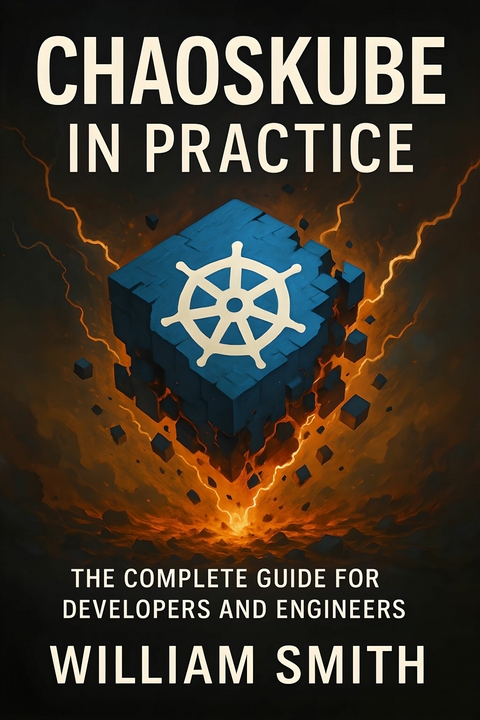
ChaosKube in Practice (eBook)
250 Seiten
HiTeX Press (Verlag)
978-0-00-102424-3 (ISBN)
'ChaosKube in Practice'
'ChaosKube in Practice' is a definitive guide for engineers, architects, and technical leaders aiming to unlock resilient, cloud-native systems through chaos engineering on Kubernetes. The book begins by establishing a strong theoretical foundation in chaos engineering principles, examining the evolution of the practice and its vital role in enhancing the reliability of modern infrastructures. Readers are introduced to Kubernetes as an ideal testbed for controlled failures, where the value proposition of proactive resilience measures is articulated for both technical practitioners and business stakeholders. Safety, ethics, and seamless integration with DevOps and SRE pipelines highlight the responsible and pragmatic approach advocated throughout.
Transitioning from theory to hands-on implementation, the book dives deeply into the architecture and internals of ChaosKube, illuminating its core components, algorithms, and chaos injection mechanisms. Through clear explanations, it covers advanced topics including observability, security, scalability, and disaster recovery, providing a holistic perspective on deploying and managing ChaosKube in production clusters of all sizes. Step-by-step guidance on configuration, deployment strategies, and experimentation frameworks enables readers to confidently design, execute, and monitor chaos experiments tailored to real-world stateful and stateless workloads.
What sets 'ChaosKube in Practice' apart is its comprehensive coverage of complex scenarios, multi-cluster and multi-region simulations, advanced integrations with cloud-native tooling, and rigorous observability and postmortem practices. The book also addresses essential governance, compliance, and organizational scaling challenges, offering actionable insights and case studies that bridge technical excellence and cultural transformation. With a forward-looking view on emerging trends, automation, and the future of resilient infrastructure, this book empowers teams to institutionalize chaos engineering as a cornerstone of reliability and learning in the Kubernetes era.
Chapter 2
ChaosKube: Architecture and Internals
At the heart of reliable chaos engineering in Kubernetes lies a precise technical machinery, transforming theoretical intent into controlled disruption. This chapter uncovers the inner workings of ChaosKube, dissecting its architecture, logic, and extensibility. Through an in-depth examination of its algorithms, event flows, and operational safeguards, readers will gain not only a blueprint of ChaosKube but also a framework for understanding how deliberate chaos evolves from code into resilient cloud-native practice.
2.1 ChaosKube Core Components
ChaosKube is architected around a concise set of core components that collectively enable the automated injection of pod-level disruptions within a Kubernetes cluster. At its heart, ChaosKube integrates tightly with Kubernetes control plane primitives to execute chaos engineering experiments with minimal operational overhead. This section delineates these core building blocks, highlighting their roles, interactions, and design considerations related to fault tolerance and modularity.
The primary building block of ChaosKube is its main controller, a Kubernetes-native controller that continuously watches for specific custom resources and schedules targeted pod deletions. Implemented as a Go program leveraging the client-go library, this controller embodies a reconciliation loop pattern common to Kubernetes controllers. It periodically queries the Kubernetes API server for pods matching user-specified criteria, then performs deletion operations to simulate node or application failures. This controller follows the standard controller-runtime approach, whereby a reconciler responds to changes in watched resources and ensures that the cluster state converges towards the desired outcome-in this case, controlled pod terminations.
ChaosKube’s controller interacts extensively with Kubernetes API integration points. The Kubernetes API server acts as both the observer and manipulator of cluster state. To orchestrate chaos experiments, ChaosKube issues DELETE HTTP requests targeting individual pod resources. It also employs LIST and WATCH operations to stay abreast of cluster pod state in near real-time. The API server’s role is pivotal, providing a consistent, authoritative view of cluster resources and enabling ChaosKube to perform causal changes atomically. This reliance on the API server isolates ChaosKube from direct node-level operations, thus simplifying permissions and enhancing portability.
Lifecycle management within ChaosKube incorporates patterns that ensure graceful and controlled chaos execution. The controller’s reconciliation loop is duration-driven, with pod deletions occurring at configurable intervals. Pods are selected for deletion based on labels, namespaces, and pod readiness state, enabling highly customizable targeting. Once a pod is deleted, Kubernetes itself assumes responsibility for lifecycle recovery via its ReplicaSets, StatefulSets, or DaemonSets controllers, which instantiate new pods to replace those removed by ChaosKube. This explicit division of concerns leverages Kubernetes’ built-in self-healing mechanisms, ensuring that chaos injections do not cause irreversible cluster degradation.
The design of ChaosKube emphasizes fault tolerance at multiple levels. Communication with the Kubernetes API server is designed to gracefully handle transient failures by incorporating retry logic and exponential backoff within the client-go interactions. If a pod deletion fails due to temporary network partitions or API server overload, ChaosKube logs the failure but continues the reconciliation loop without crashing. This resilience prevents the introduction of instability in the controller itself, which is critical because chaos orchestration tools operate in already unstable cluster conditions. Furthermore, ChaosKube includes leader election capabilities when run in a multi-instance configuration, preventing conflicting controllers from simultaneously deleting pods and thus preserving consistency.
Modularity is a key architectural principle in ChaosKube, facilitating extensibility and ease of maintenance. The core controller is separated cleanly from configuration and selection logic. Selection logic, expressed in configurable label selectors and namespace filters, allows administrators to define the precise scope of chaos experiments without modifying code. Moreover, the core controller abstraction allows for straightforward embedding within larger chaos engineering toolchains. For instance, integrations with higher-level chaos workflows or continuous delivery pipelines can invoke ChaosKube’s API endpoints to trigger pod disruptions on demand, decoupling orchestration from experiment execution.
The controller’s internal architecture further exhibits modularity through its reconciliation phases, which can be extended or overridden with additional logic such as blacklisting critical pods or implementing pod-specific exclusion policies. This adaptability supports safe operation in clusters with mixed criticality workloads. Additionally, the containerized deployment model isolates ChaosKube’s runtime dependencies, enabling independent lifecycle management and resource constraints tuned to cluster scale and stability requirements.
Interactions between ChaosKube’s core components and Kubernetes primitives highlight a symbiotic control loop: ChaosKube deletes pods to simulate faults, while Kubernetes controllers restore desired state by recreating pods. This interplay harnesses Kubernetes’ declarative nature, ensuring that chaos is injected transiently and safely. The repetition of this cycle over time, with varying pod selection criteria, provides a stochastic yet controlled approach to probing system resilience. Unlike more invasive fault injection frameworks, ChaosKube’s minimalist model limits scope to pod deletion, simplifying analysis of downstream effects.
ChaosKube’s core components-principally its main controller, Kubernetes API integration points, and lifecycle orchestration approach-forge a robust, fault-tolerant, and modular system for pod-level chaos experiments. Its design tightly aligns with Kubernetes’ native abstractions and lifecycle mechanisms, enabling reliable fault injection without compromising cluster stability. These architectural choices facilitate broad adoption and integration within diverse Kubernetes environments, empowering operators to systematically validate application robustness through controlled chaos.
2.2 Pod Selection Algorithms
The core mechanism that enables ChaosKube to randomly terminate pods within a Kubernetes cluster relies on sophisticated pod selection algorithms designed to achieve a balance between fairness, unpredictability, and reproducibility. The randomness embedded in ChaosKube’s logic is not a simple uniform random draw but a nuanced combination of filtering, selectors, exclusion rules, and entropy sources. Each of these components contributes to a finely tuned selection process, ensuring the efficacy of chaos experiments while respecting cluster stability and operational constraints.
Pod selection begins with a filtering phase, which constrains the candidate pool based on user-defined criteria. Filters operate as predicates on pod metadata, including namespace, labels, annotations, and status conditions. By leveraging Kubernetes’s powerful label selectors, ChaosKube can restrict selection to specific application tiers, environments, or ownership domains. The use of label selectors is expressed as logical conjunctions or disjunctions, forming Boolean expressions that prune the pod list.
Formally, if
| Erscheint lt. Verlag | 20.8.2025 |
|---|---|
| Sprache | englisch |
| Themenwelt | Mathematik / Informatik ► Informatik ► Programmiersprachen / -werkzeuge |
| ISBN-10 | 0-00-102424-8 / 0001024248 |
| ISBN-13 | 978-0-00-102424-3 / 9780001024243 |
| Informationen gemäß Produktsicherheitsverordnung (GPSR) | |
| Haben Sie eine Frage zum Produkt? |
 EPUB (Adobe DRM)
Größe: 881 KB
Kopierschutz: Adobe-DRM
Adobe-DRM ist ein Kopierschutz, der das eBook vor Mißbrauch schützen soll. Dabei wird das eBook bereits beim Download auf Ihre persönliche Adobe-ID autorisiert. Lesen können Sie das eBook dann nur auf den Geräten, welche ebenfalls auf Ihre Adobe-ID registriert sind.
Details zum Adobe-DRM
Dateiformat: EPUB (Electronic Publication)
EPUB ist ein offener Standard für eBooks und eignet sich besonders zur Darstellung von Belletristik und Sachbüchern. Der Fließtext wird dynamisch an die Display- und Schriftgröße angepasst. Auch für mobile Lesegeräte ist EPUB daher gut geeignet.
Systemvoraussetzungen:
PC/Mac: Mit einem PC oder Mac können Sie dieses eBook lesen. Sie benötigen eine
eReader: Dieses eBook kann mit (fast) allen eBook-Readern gelesen werden. Mit dem amazon-Kindle ist es aber nicht kompatibel.
Smartphone/Tablet: Egal ob Apple oder Android, dieses eBook können Sie lesen. Sie benötigen eine
Geräteliste und zusätzliche Hinweise
Buying eBooks from abroad
For tax law reasons we can sell eBooks just within Germany and Switzerland. Regrettably we cannot fulfill eBook-orders from other countries.
aus dem Bereich


