


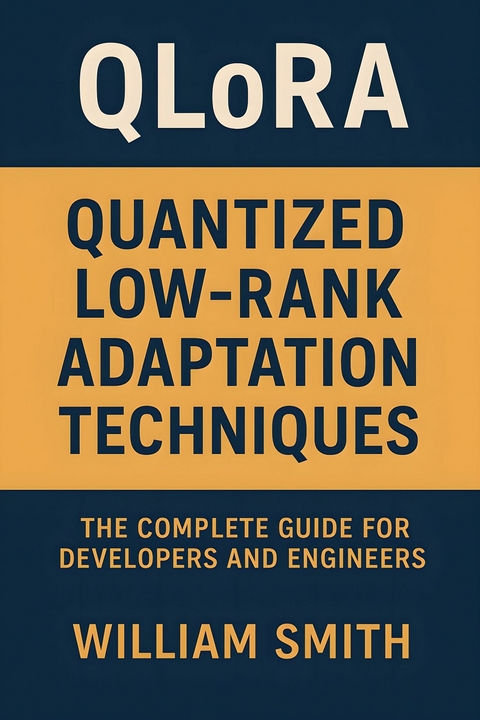
QLoRA (eBook)
250 Seiten
HiTeX Press (Verlag)
978-0-00-102421-2 (ISBN)
'QLoRA: Quantized Low-Rank Adaptation Techniques'
'QLoRA: Quantized Low-Rank Adaptation Techniques' is the definitive guide to cutting-edge methods for making large neural networks adaptive, efficient, and scalable through the synergy of quantization and low-rank adaptation. The book opens with a thorough exploration of the challenges inherent in traditional fine-tuning approaches, emphasizing the urgent need for parameter-efficient strategies to keep pace with the growth of model sizes. Through a historical lens, it situates QLoRA at the intersection of classic adaptation techniques, providing foundational concepts and a clear structural roadmap for readers.
Diving deep into the theoretical and engineering underpinnings, the text elucidates the mathematics of quantized neural networks, low-rank matrix factorizations, and their profound implications for gradient stability, information retention, and model generalization. Readers are guided through canonical QLoRA architectures, advanced variants including hierarchical and multi-task scenarios, and practical workflows for efficient large-scale deployment-covering vital topics such as memory optimization, distributed training, mixed precision, and debugging. Extensive benchmarking studies, interpretability techniques, and visualizations help demystify the intricate trade-offs and real-world performance of QLoRA compared to alternative methods.
Beyond technical mastery, the book addresses pressing concerns of security, privacy, fairness, and compliance, empowering practitioners to deploy QLoRA responsibly across domains from NLP and multimodal AI to edge and federated learning. Forward-thinking applications and research trajectories discussed in the final chapters position QLoRA as pivotal to sustainable, high-impact, and trustworthy AI-equipping researchers, engineers, and practitioners alike with the insights and tools to redefine the future of model adaptation.
Chapter 1
Introduction to Parameter-Efficient Model Adaptation
Why train billions of parameters when you can adapt them with surgical precision? This chapter unpacks the revolution in neural network adaptation, exploring how machine learning practitioners are moving from monolithic fine-tuning toward hyper-efficient techniques that preserve accuracy, minimize computational cost, and unlock new potential for massive models in real-world environments.
1.1 Motivation for Parameter-Efficient Fine-Tuning
The increasing scale of deep learning models, which has driven substantial advances in performance across a variety of tasks, simultaneously imposes significant constraints on practical deployment and adaptability. Modern neural architectures often contain hundreds of millions to billions of parameters, rendering straightforward full fine-tuning both computationally expensive and storage-intensive. This scaling trend exacerbates limitations in hardware resources, creating acute challenges particularly for applications requiring rapid iteration and widespread deployment.
Hardware constraints present a primary driver for parameter-efficient fine-tuning methodologies. Despite advances in accelerator technologies and distributed training frameworks, the cost of fine-tuning state-of-the-art models remains prohibitive in many real-world settings. Memory bandwidth, GPU/TPU onboard memory capacity, and energy consumption all limit the feasibility of updating all model weights without incurring substantial latency and infrastructure expenditures. For example, full adaptation of large transformer-based architectures on commodity hardware requires resources typically unavailable in many edge or mobile environments. Consequently, approaches that minimize parameter updates while retaining performance have become essential to circumvent these hardware bottlenecks.
Beyond computational resource limits, the explosive growth in model size presents a significant storage and versioning challenge. Fine-tuning traditionally necessitates saving a complete parameter set for each task or domain-specific variant, which quickly leads to impractical storage demands. In professional environments where multiple customized instances of a base model are trained, maintaining potentially hundreds or thousands of full parameter copies is unsustainable. Parameter-efficient fine-tuning techniques reduce this overhead by adapting only a small subset of parameters or introducing lightweight side modules, thereby enabling scalable version control and deployment with minimal additional memory footprint.
Practical deployment considerations also serve as a critical motivation. Many real-world AI applications operate in heterogeneous environments with varying computational and connectivity capabilities. Models deployed on edge devices, embedded systems, or specialized hardware require not only fast inference but also the flexibility to adapt to new tasks or user preferences without complete retraining. Parameter-efficient fine-tuning facilitates rapid customization by isolating fine-tuning to a small, manageable parameter set, which can be efficiently updated or replaced. This modularity supports continuous learning and incremental updates, critical for applications in personalized recommendation, healthcare diagnostics, and adaptive user interfaces.
The shift toward edge and embedded AI further accentuates the necessity for parameter-efficient adaptation techniques. Edge computing prioritizes low latency, privacy, and operational independence from centralized cloud resources. However, deploying large-scale models on edge devices is often infeasible without aggressive model compression or fine-tuning optimizations. Parameter-efficient fine-tuning enables local adaptation using minimal resources, preserving the advantages of edge inference while allowing models to specialize on-device. This trend aligns with emerging business use-cases where data privacy, bandwidth constraints, and real-time responsiveness are paramount, such as autonomous vehicles, IoT devices, and mobile applications.
From a business perspective, the ability to quickly and cost-effectively customize models to specific domains or clients holds significant value. Full fine-tuning requires prolonged compute cycles and specialized expertise, which translates into higher operational costs and slower innovation cycles. Parameter-efficient methods reduce these costs by enabling domain adaptation with smaller computational footprints and simpler deployment pipelines. This facilitates agile development practices and rapid iteration in dynamic market environments. For instance, industries such as finance, retail, and customer service benefit from swift adaptation of models to evolving conditions or specialized data sets, achievable through efficient parameter updates rather than wholesale retraining.
The pursuit of parameter efficiency also reflects a broader research objective to democratize access to powerful AI models. Large pretrained models are often developed and maintained by organizations with extensive computational resources. Parameter-efficient fine-tuning offers pathways for smaller entities to leverage these models without replicating the original training efforts. By tuning only a fraction of the parameters, researchers, startups, and domain specialists gain practical means to deploy state-of-the-art models in resource-constrained settings. This fosters a more inclusive ecosystem and encourages innovation across diverse sectors.
The fundamental drivers for parameter-efficient fine-tuning coalesce around hardware resource limitations, economic and operational challenges of scaling large-scale model customization, and the evolving landscape of AI deployment contexts. These factors collectively motivate continued investigation into methods that reduce the number of parameters needing modification, thereby enabling rapid, flexible, and cost-efficient adaptation of deep learning models. The resulting techniques provide critical leverage for practical utilization of increasingly complex architectures, accommodating the rising demand for personalized, scalable, and resource-conscious AI solutions.
1.2 Limitations of Traditional Fine-Tuning Approaches
Traditional fine-tuning methods, wherein all parameters of a pretrained model are adjusted for a downstream task, confront significant challenges as models and datasets grow in scale. While effective for moderate-sized models and focused tasks, these strategies increasingly prove untenable when applied to state-of-the-art architectures with billions of parameters. This section elucidates the core limitations underlying full-parameter fine-tuning, tracing the implications for memory, training efficiency, scalability, and model robustness.
A primary constraint emerges from the vast memory demands incurred during fine-tuning. Modern large-scale models routinely contain over a hundred billion parameters, translating into hundreds of gigabytes of storage just for the network weights. Fine-tuning mandates not only storing these parameters but also caching intermediate activations for backpropagation, which further inflates GPU memory consumption. Techniques such as mixed precision training and model parallelism mitigate this growth to some degree; however, their complexity and hardware requirements escalate rapidly. Consequently, fine-tuning all parameters becomes infeasible on widely accessible hardware, restricting cutting-edge model adaptation to specialized, high-end compute environments.
Closely related is the dramatic increase in training duration associated with full fine-tuning of expansive models. The computational cost scales linearly with the number of parameters adjusted, and large architectures exhibit diminishing returns on additional training epochs due to optimization landscape peculiarities. Long training times delay experimentation cycles and subsequent deployment, impeding agile development workflows. Furthermore, fine-tuning large models demands careful hyperparameter tuning and regularization strategies to avoid overfitting the target task, further prolonging the iteration process. These empirical bottlenecks highlight that full model updating trades off optimization speed and resource efficiency for modest gains in task-specific performance.
The scalability of full fine-tuning across multiple tasks and domains also deteriorates markedly at scale. Each fine-tuned model instance requires storing a complete copy of the adjusted parameters, leading to prohibitive memory and storage demands when supporting numerous applications or language domains. This replicability challenge hampers practical deployment in settings such as multi-tenant cloud services or multitask learning scenarios. Additionally, excessively tailoring the entire parameter set to a specific task complicates transferability; the resulting models tend to lack robustness to domain shifts or novel inputs, as their knowledge becomes overly specialized. Thus, the traditional paradigm is not well suited to environments demanding flexible, modular model adaptation across heterogeneous data distributions.
Another critical limitation relates to the phenomenon known as catastrophic forgetting. When fine-tuning all parameters, networks often overwrite the generalizable representations learned during...
| Erscheint lt. Verlag | 20.8.2025 |
|---|---|
| Sprache | englisch |
| Themenwelt | Mathematik / Informatik ► Informatik ► Programmiersprachen / -werkzeuge |
| ISBN-10 | 0-00-102421-3 / 0001024213 |
| ISBN-13 | 978-0-00-102421-2 / 9780001024212 |
| Informationen gemäß Produktsicherheitsverordnung (GPSR) | |
| Haben Sie eine Frage zum Produkt? |
 EPUB (Adobe DRM)
Größe: 951 KB
Kopierschutz: Adobe-DRM
Adobe-DRM ist ein Kopierschutz, der das eBook vor Mißbrauch schützen soll. Dabei wird das eBook bereits beim Download auf Ihre persönliche Adobe-ID autorisiert. Lesen können Sie das eBook dann nur auf den Geräten, welche ebenfalls auf Ihre Adobe-ID registriert sind.
Details zum Adobe-DRM
Dateiformat: EPUB (Electronic Publication)
EPUB ist ein offener Standard für eBooks und eignet sich besonders zur Darstellung von Belletristik und Sachbüchern. Der Fließtext wird dynamisch an die Display- und Schriftgröße angepasst. Auch für mobile Lesegeräte ist EPUB daher gut geeignet.
Systemvoraussetzungen:
PC/Mac: Mit einem PC oder Mac können Sie dieses eBook lesen. Sie benötigen eine
eReader: Dieses eBook kann mit (fast) allen eBook-Readern gelesen werden. Mit dem amazon-Kindle ist es aber nicht kompatibel.
Smartphone/Tablet: Egal ob Apple oder Android, dieses eBook können Sie lesen. Sie benötigen eine
Geräteliste und zusätzliche Hinweise
Buying eBooks from abroad
For tax law reasons we can sell eBooks just within Germany and Switzerland. Regrettably we cannot fulfill eBook-orders from other countries.
aus dem Bereich


