


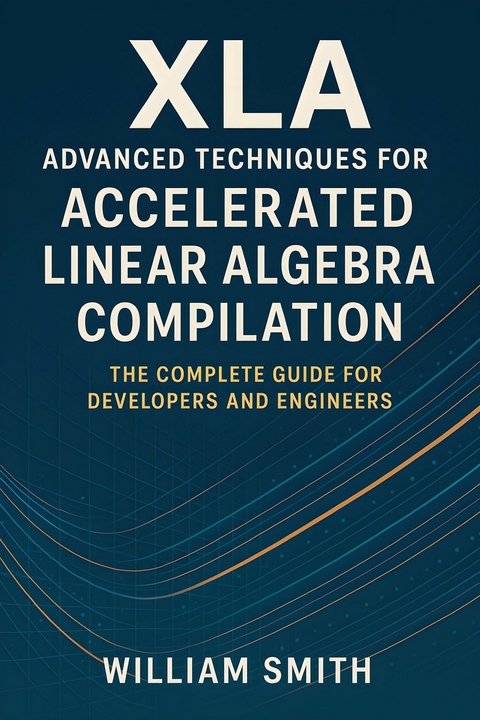
XLA (eBook)
250 Seiten
HiTeX Press (Verlag)
978-0-00-102417-5 (ISBN)
'XLA: Advanced Techniques for Accelerated Linear Algebra Compilation'
'XLA: Advanced Techniques for Accelerated Linear Algebra Compilation' offers a rigorous and comprehensive exploration of the XLA compiler, a cornerstone technology for high-performance numerical computing in modern scientific and machine learning workloads. Beginning with foundational concepts, the book surveys the vital role of linear algebra in computational science before delving into the architectural principles and abstractions that define XLA. Readers are introduced to the compiler's high-level optimizer (HLO), intermediate representations, and the integration pathways with leading machine learning frameworks, with careful attention given to the performance and domain-specific constraints that shape real-world applications.
The text methodically guides practitioners and researchers through advanced program analysis, transformation techniques, and low-level code generation strategies tailored for CPUs, GPUs, and emerging accelerators such as TPUs. Specialized chapters dissect cutting-edge topics such as parallelization, vectorization, backend extensibility, and distributed compilation across multi-device and clustered environments. A dedicated focus on customization empowers users to implement domain-specific operators, extend compiler backends, and inject user-driven optimizations, ensuring adaptability in the ever-evolving landscape of hardware and software co-design.
Rounding out this authoritative reference are insights into performance analysis, numerical stability, security considerations, and rigorous verification of compiled graph correctness. Real-world case studies, profiling and benchmarking methodologies, and reproducible research practices provide actionable guidance for engineers in production settings. Looking forward, the book addresses emerging trends in unified programming models, AI-assisted optimizations, and open research challenges, establishing itself as an indispensable resource for anyone seeking to master the state of the art in accelerated linear algebra compilation.
Chapter 2
The High-Level Optimizer (HLO): Semantics and Design
Peer into the intellectual heart of XLA, where abstract computation is sculpted into highly efficient execution plans. The High-Level Optimizer (HLO) is not merely an intermediate step-it’s the crucible in which complex tensor operations are refined, analyzed, and prepared for deployment across vastly different hardware architectures. This chapter unfolds the schema, semantics, and extensibility of HLO, offering advanced insight into how it empowers both generality and specialization through its carefully crafted design.
2.1 Structure of HLO Graphs
High-Level Optimization (HLO) graphs serve as a core intermediate representation in modern compiler infrastructures for machine learning and numerical computation frameworks. Fundamentally, an HLO graph is conceptualized as a directed acyclic graph (DAG), where nodes correspond to computational operations and edges represent data dependencies. This graph-based abstraction enables fine-grained optimization, ease of analysis, and flexible transformation passes, making it especially suitable for complex programs with nested control flows and dynamically composed computations.
Node Types and Semantics
The nodes within an HLO graph are typed operators that encapsulate computations ranging from primitive arithmetic, tensor reshaping, and broadcasting to more complex linear algebra routines (e.g., matrix multiplication, convolution) and control flow constructs (e.g., conditional execution, loops). Each node is characterized by:
- Operation Code: Specifies the particular computation or transformation performed. The opcodes are standardized and extensible, allowing new operation semantics to be integrated as hardware and software evolve.
- Operands: References to one or more input nodes, establishing the data flow dependencies. These operands enforce the directional edges of the graph.
- Shape Information: Detailed data types and tensor dimensions of inputs and outputs, critical for type checking and layout-sensitive optimizations.
- Attributes and Parameters: Static properties such as algorithmic parameters (e.g., convolution strides, padding), constant values, or qualifiers that influence execution semantics.
Each node can be viewed as a functional unit producing output tensors solely based on its inputs, supporting referential transparency. This functional purity is a deliberate design choice to simplify reasoning about equivalences, transformations, and parallelization.
Edge Types and Data Flow
Edges in an HLO graph explicitly model value dependencies. Unlike typical control-flow graphs where edges may carry control tokens or represent scheduling constraints, HLO edges are value-centric and semantically denote the flow of tensors between operations. The absence of cycles on these data edges ensures deterministic evaluation order and facilitates optimization passes that rely on topological sorting. This acyclic property underpins many compiler analyses, such as dead code elimination and common subexpression elimination, by guaranteeing no recursive dependencies among operations.
Moreover, edges connect nodes in a manner that respects tensor shape compatibility, enforced through static shape inference. Whenever operations compose, the output edge shapes must align with subsequent inputs, enabling shape-driven transformations and verification mechanisms.
Subgraph Composition and Module Encapsulation
HLO supports hierarchical composition by encapsulating groups of nodes into subgraphs, often represented as computation submodules or called computations. These subgraphs can themselves be invoked as modular units inside larger graphs. This compositionality is key to representing complex programs featuring function calls, loops, and conditionals without flattening or duplicating code.
Each subgraph is defined by an interface specifying formal parameters and return values, closely mirroring high-level function signatures. Such modularization brings several advantages:
- Reusability: Identical subgraphs can be instantiated multiple times within a larger program, allowing shared optimization across instances.
- Isolation: Encapsulation limits the scope of side effects and intermediate computations, simplifying reasoning and enabling separate compilation or partial evaluation.
- Scalability: Large programs generate large HLO graphs; modular division into subgraphs allows partitioning, distributing compilation, or accelerated specialization.
Control-flow constructs leverage these subgraphs by encoding branches and loop bodies as computations attached to control nodes. For example, a conditional node in the graph comprises pointers to two subgraphs representing the then and else branches, each a DAG of HLO nodes representing the respective computations.
Metadata and Auxiliary Structures
Beyond the core nodes and edges, HLO graphs embed metadata components essential for compilation, optimization, and runtime execution:
- Debug Information: Source-level mappings, variable names, and annotations allow correlating HLO operations back to the original program code, aiding debugging and profiling.
- Layout Annotations: Memory layout metadata dictates how tensors are stored and accessed, influencing tiling, vectorization, and hardware mapping.
- Optimization Hints: Instructions may carry hints such as preferred fusion opportunities, target-specific scheduling priorities, or quantization parameters.
- Side-effect Markers: Although HLO operations are predominantly pure, some incorporate side effects (e.g., I/O or atomic updates). Such nodes contain metadata flags to preserve ordering constraints.
Handling metadata explicitly and separately from computational semantics allows flexible optimization pipelines, where passes can modify transformations or schedule decisions without altering functional correctness.
Design Rationale for Acyclic and Modular Structure
The restriction of HLO graphs to be acyclic is a deliberate and profound architectural decision. Cyclic dependencies complicate both evaluation and optimization due to the potential for infinite loops or recursion. By enforcing acyclicity at the graph level, HLO requires all iterative or recursive computations to be represented explicitly via control flow subgraphs and special iterative constructs. This separation of data dependencies and control flow simplifies both the compiler’s analysis and the runtime’s scheduling logic.
Modularity, as embodied by subgraph encapsulation, promotes decomposition of computation into well-defined units. Such modularity allows reusability and targeted optimization while maintaining the isolation needed for composability across heterogeneous hardware backends. It also reduces the complexity of transformations, as localized changes can be confined to subgraphs without impacting the entire graph topology.
These design choices result in an intermediate representation that is both expressive and amenable to formal reasoning, facilitating the compilation of progressively complex machine learning models and numerical algorithms.
Graph Integrity and Validation
To maintain the correctness and usability of HLO graphs, a series of validation criteria are applied:
- Shape Consistency: Ensuring output shapes of nodes match expected input shapes on downstream edges.
- Operand Validity: Verifying all operand references point to legitimate nodes within the graph or subgraph scopes.
- Acyclicity Checks: Employing topological ordering algorithms to detect and reject cycles on data flow edges.
- Interface Conformance: Confirming that subgraph parameters and return values conform in shape and type with their call sites.
- Metadata Coherence: Guaranteeing that all required metadata annotations are present and within valid ranges.
Automated verification tools embedded in compilation pipelines ensure the HLO graphs maintain structural integrity at every transformation phase, thus preventing subtle semantic errors from propagating downstream.
Summary of Structural Features
The structure of HLO graphs—centered on typed computation nodes, acyclic data flow edges, subgraph modularization, and rich metadata annotations—creates a robust foundation for optimizing diverse computational workloads. Through explicit modeling of both operations and their dependencies, the representation balances expressivity with analyzability. Its modular, acyclic nature enables advanced compiler techniques while supporting extensibility for future computational patterns and hardware abstractions. This design ...
| Erscheint lt. Verlag | 20.8.2025 |
|---|---|
| Sprache | englisch |
| Themenwelt | Mathematik / Informatik ► Informatik ► Programmiersprachen / -werkzeuge |
| ISBN-10 | 0-00-102417-5 / 0001024175 |
| ISBN-13 | 978-0-00-102417-5 / 9780001024175 |
| Informationen gemäß Produktsicherheitsverordnung (GPSR) | |
| Haben Sie eine Frage zum Produkt? |
 EPUB (Adobe DRM)
Größe: 807 KB
Kopierschutz: Adobe-DRM
Adobe-DRM ist ein Kopierschutz, der das eBook vor Mißbrauch schützen soll. Dabei wird das eBook bereits beim Download auf Ihre persönliche Adobe-ID autorisiert. Lesen können Sie das eBook dann nur auf den Geräten, welche ebenfalls auf Ihre Adobe-ID registriert sind.
Details zum Adobe-DRM
Dateiformat: EPUB (Electronic Publication)
EPUB ist ein offener Standard für eBooks und eignet sich besonders zur Darstellung von Belletristik und Sachbüchern. Der Fließtext wird dynamisch an die Display- und Schriftgröße angepasst. Auch für mobile Lesegeräte ist EPUB daher gut geeignet.
Systemvoraussetzungen:
PC/Mac: Mit einem PC oder Mac können Sie dieses eBook lesen. Sie benötigen eine
eReader: Dieses eBook kann mit (fast) allen eBook-Readern gelesen werden. Mit dem amazon-Kindle ist es aber nicht kompatibel.
Smartphone/Tablet: Egal ob Apple oder Android, dieses eBook können Sie lesen. Sie benötigen eine
Geräteliste und zusätzliche Hinweise
Buying eBooks from abroad
For tax law reasons we can sell eBooks just within Germany and Switzerland. Regrettably we cannot fulfill eBook-orders from other countries.
aus dem Bereich


