


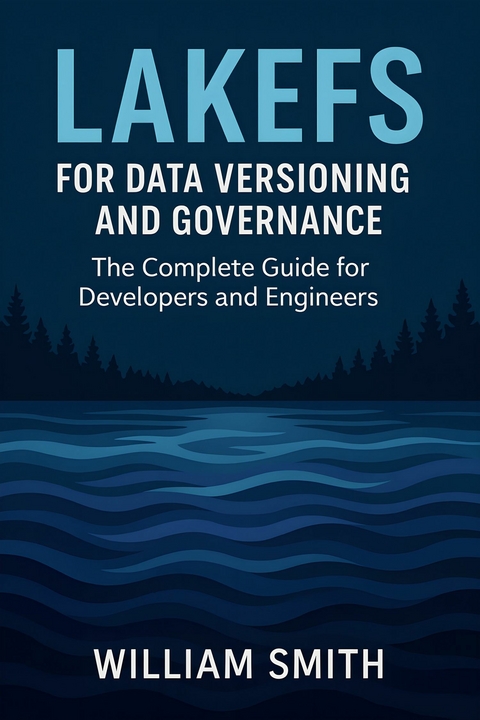
LakeFS for Data Versioning and Governance (eBook)
250 Seiten
HiTeX Press (Verlag)
978-0-00-102391-8 (ISBN)
'LakeFS for Data Versioning and Governance'
In the rapidly evolving world of data engineering, 'LakeFS for Data Versioning and Governance' presents an essential guide to mastering data version control, compliance, and governance within modern data lakes. This comprehensive book begins by exploring the fundamental shifts in data management, articulating why traditional tools fall short for today's large-scale, distributed datasets. Readers are led through the principles of data versioning, key compliance and auditability demands, and the growing complexity of enforcing governance at scale. Anchored by a detailed introduction to LakeFS, the book illustrates how its architecture and operational model shape the modern data stack.
Delving deep into technical implementation, the book provides actionable guidance for deploying, operating, and scaling LakeFS. Topics such as system architecture, deployment topologies, disaster recovery, integration with cloud storage and identity platforms, and security best practices form the backbone of real-world operational success. Advanced strategies for branching, tagging, experimentation, and reproducibility are thoroughly examined, alongside techniques for managing data lineage, handling large-scale commits, and optimizing storage and compute resources for ever-expanding data environments.
Crucially, the book extends beyond technical mastery to address holistic data governance, privacy, and regulatory compliance. Readers will learn to construct robust policy frameworks, automate quality gates, and integrate with established data catalog and governance systems. Practical chapters outline integrating LakeFS with workflow orchestration, DataOps pipelines, and event-driven automation, while the final sections provide blueprints for extending and customizing LakeFS through APIs, SDKs, custom hooks, and plugins-all illustrated with real-world case studies. Whether you are a data engineer, architect, or governance professional, this book equips you with the patterns and practices for resilient, compliant, and future-ready data platforms.
Chapter 2
LakeFS Architecture and Operational Model
Behind every transformative data platform is a set of foundational architectural choices that dictate performance, resilience, and extensibility. This chapter lifts the lid on the inner workings of LakeFS, revealing how its distributed core, rich metadata layer, and security model coalesce to deliver Git-like version control for massive datasets. Whether you’re architecting for scale, reliability, or integration with a sprawling enterprise tech stack, this chapter equips you with the conceptual scaffolding and operational insight to leverage LakeFS as a cornerstone for data governance and agility.
2.1 System Architecture Overview
The architecture of LakeFS is designed to provide a Git-like version control system for object storage, integrating distributed components to deliver stateless, scalable, and highly available storage management. At the macro level, LakeFS is composed of three principal components: the gateway nodes, the metadata database, and the storage backends. These components collectively form a modular system that supports horizontal scaling and fault tolerance while maintaining consistent internal state across distributed deployment environments.
Gateway Nodes
Gateway nodes serve as the primary interface between clients and the LakeFS system. Each gateway node exposes a RESTful API compatible with Git commands and object storage protocols, allowing users to perform operations such as commit, branch, and list. Importantly, these nodes are designed to be stateless, enabling them to be independently scaled horizontally without complex coordination requirements.
The statelessness of gateway nodes is realized by offloading all transactional and persistent data to the metadata database and storage backends. Gateway nodes maintain ephemeral caches and queues solely to optimize short-term performance. This architectural choice prevents single points of failure and promotes elasticity; in the event of node failure, requests can be routed transparently to other gateways without data loss or inconsistency.
Metadata Database
The metadata database functions as the central coordination plane within the LakeFS architecture. It maintains all transactional metadata essential for versioning, including commit histories, branch references, and presence indicators of objects within repositories. The database schema is optimized for append-only operations and consistent snapshotting, facilitating atomicity in commits and immutability guarantees in stored data.
To fulfill requirements for durability and availability, the metadata database typically employs high-availability configurations, supporting leader election and synchronous replication across multiple nodes. This ensures that metadata remains consistent and accessible even under network partitions or node failures. Furthermore, the design supports optimistic concurrency controls, allowing parallel commits and conflict detection that align with Git’s branching semantics.
Storage Backends
Underpinning LakeFS’s versioning capabilities are the storage backends, which persist all physical data objects. These backends abstract various object stores such as Amazon S3, Google Cloud Storage, or Azure Blob Storage, providing a uniform interface while leveraging their inherent capabilities. Objects are stored immutably and referenced by unique content-addressed identifiers, a strategy that reduces redundant data transmission and accelerates caching.
The storage backend is responsible for performing efficient copy-on-write (CoW) and deduplication operations. By managing object namespaces using prefix trees or hash-indexing structures, the backend facilitates rapid retrieval and updates at a fine granularity while ensuring that data integrity is maintained across versions.
Interaction and Data Flow
Figure illustrates the data flow and interaction patterns between gateway nodes, metadata database, and storage backends. Client requests first reach a gateway node, which parses API calls and translates them into transactional sequences. For a commit operation, the gateway node orchestrates the following:
- Initiate a transactional context in the metadata database.
- Store new or updated objects to the immutable storage backend.
- Update the metadata database with references to these objects, branch pointers, and commit metadata.
- Commit the transactional context to achieve atomic visibility of changes.
Design Patterns for Statelessness and Scalability
The stateless design pattern for gateway nodes, coupled with centralized metadata storage, allows LakeFS to implement load balancing and scaling through well-known distributed system paradigms. By considering each gateway node as a microservice instance, Kubernetes pods or container orchestrators can easily add or remove nodes based on workload, health metrics, or failure recovery processes.
Stateful information is confined strictly to the metadata database and consistent storage backends, which are themselves configured for high availability through replication and consensus protocols (e.g., Raft or Paxos). This separation enables independent scaling of API frontends and persistent layers, accommodating diverse operational loads.
Fault Tolerance and High Availability
Fault tolerance in LakeFS is achieved through several complementary mechanisms. Since gateway nodes are stateless, failures result only in transient request rerouting without recovery overhead. The metadata database supports leader election and multi-node replication, enabling failover in circumstances of node crashes or network partitions without loss of committed transaction data.
Storage backends rely on the durability guarantees of underlying object stores, which typically replicate data across availability zones and regions. LakeFS leverages this by ensuring that object references in metadata are consistent with stored data, avoiding dangling pointers or partially committed states. Additionally, the system employs periodic consistency checks and garbage collection to detect and remediate orphaned objects originating from aborted or partial operations.
LakeFS’s architecture capitalizes on a modular design with loosely coupled components to ensure robustness and performance. The stateless gateways support elastic scaling and fault isolation, the metadata database provides a durable, strongly consistent coordination plane, and the storage backends anchor the system’s immutability and data integrity guarantees. By integrating these layers through well-defined, transactional APIs, LakeFS manages to extend the principles of distributed version control systems to modern cloud object storage, providing enterprises with a scalable, reliable framework for data lake operations.
2.2 Repository Abstraction and Namespaces
A repository functions as the fundamental abstraction for encapsulating data versioning within an isolated namespace, providing distinct boundaries that segregate datasets and associated metadata from other repositories. This model closely parallels concepts in traditional software version control systems, such as git repositories, yet diverges in critical ways to accommodate the specific demands of data versioning, management, and governance.
In software version control, a repository organizes source code files and tracks their evolution over time, preserving snapshots and branching histories to support collaborative development and change management. Comparable to this, a data repository acts as a self-contained unit encapsulating logical datasets-collections of data artifacts that share a coherent semantic and operational context. This encapsulation is essential to maintain data integrity, reproducibility, and consistency as data evolves through multiple iterations, experiments, or production cycles.
Crucially, repositories establish an isolated namespace that allows multiple projects, datasets, or experiments to coexist without naming conflicts or unauthorized data leakage. Within such a namespace, identifiers for data objects, tables, or versions are guaranteed to be unique and stable, enabling reliable referencing and query execution. This isolation facilitates environment separation, where each repository may correspond to a distinct scientific experiment, business domain, or application environment (e.g., development, staging, production). This reduces the risk of cross-contamination between datasets and simplifies lifecycle management policies tailored to the repository’s specific use case.
Beyond mere isolation, repositories enable fine-grained policy scoping. Policies governing data retention, version expiration, replication strategies, and audit logging can be defined at the repository level, allowing administrators and data stewards to apply rules that reflect organizational compliance requirements or operational priorities. For instance, a critical production dataset repository may enforce stringent access controls, immutable version histories, and multi-region ...
| Erscheint lt. Verlag | 19.8.2025 |
|---|---|
| Sprache | englisch |
| Themenwelt | Mathematik / Informatik ► Informatik ► Programmiersprachen / -werkzeuge |
| ISBN-10 | 0-00-102391-8 / 0001023918 |
| ISBN-13 | 978-0-00-102391-8 / 9780001023918 |
| Informationen gemäß Produktsicherheitsverordnung (GPSR) | |
| Haben Sie eine Frage zum Produkt? |
 EPUB (Adobe DRM)
Größe: 671 KB
Kopierschutz: Adobe-DRM
Adobe-DRM ist ein Kopierschutz, der das eBook vor Mißbrauch schützen soll. Dabei wird das eBook bereits beim Download auf Ihre persönliche Adobe-ID autorisiert. Lesen können Sie das eBook dann nur auf den Geräten, welche ebenfalls auf Ihre Adobe-ID registriert sind.
Details zum Adobe-DRM
Dateiformat: EPUB (Electronic Publication)
EPUB ist ein offener Standard für eBooks und eignet sich besonders zur Darstellung von Belletristik und Sachbüchern. Der Fließtext wird dynamisch an die Display- und Schriftgröße angepasst. Auch für mobile Lesegeräte ist EPUB daher gut geeignet.
Systemvoraussetzungen:
PC/Mac: Mit einem PC oder Mac können Sie dieses eBook lesen. Sie benötigen eine
eReader: Dieses eBook kann mit (fast) allen eBook-Readern gelesen werden. Mit dem amazon-Kindle ist es aber nicht kompatibel.
Smartphone/Tablet: Egal ob Apple oder Android, dieses eBook können Sie lesen. Sie benötigen eine
Geräteliste und zusätzliche Hinweise
Buying eBooks from abroad
For tax law reasons we can sell eBooks just within Germany and Switzerland. Regrettably we cannot fulfill eBook-orders from other countries.
aus dem Bereich


