


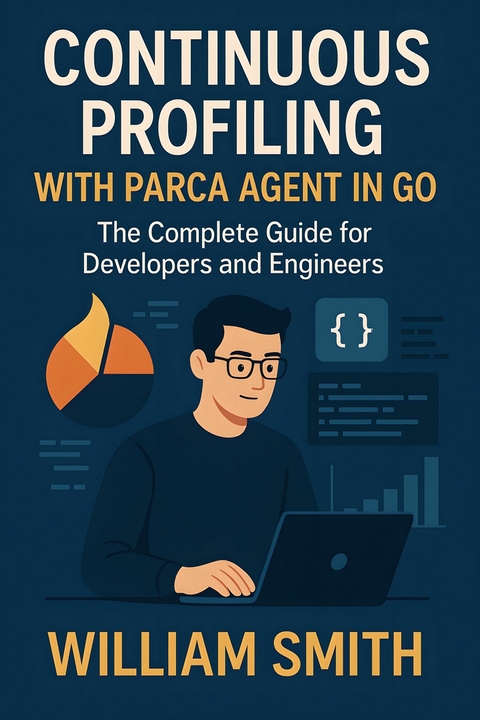
Continuous Profiling with Parca Agent in Go (eBook)
250 Seiten
HiTeX Press (Verlag)
978-0-00-102390-1 (ISBN)
'Continuous Profiling with Parca Agent in Go'
In 'Continuous Profiling with Parca Agent in Go,' readers are guided through the evolution of performance observability in modern, distributed systems. This comprehensive resource explores the necessity of profiling in complex Go applications, discusses the contrasts between continuous and traditional ad-hoc profiling approaches, and examines the architectural challenges unique to cloud-native and containerized environments. It foregrounds the essential role profiling plays alongside tracing and logging, while also addressing the critical concerns of privacy and data security during live-system analysis.
Moving beyond fundamentals, the book provides a deep dive into the architecture of Parca Agent, a cutting-edge open-source suite for continuous profiling. With clear technical explanations, it covers the agent's core process model, sampling strategies, and dynamic attachment to Go workloads. Readers gain practical insights into effective deployment at scale, resource management, and seamless integration with popular observability platforms such as Grafana and Prometheus. Real-world operational considerations, including CI/CD automation, health monitoring, and incident response, ensure that performance engineering practices translate smoothly into production.
The latter chapters empower engineers with advanced techniques for Go profiling, data lifecycle management, and actionable visualization through flamegraphs, dashboards, and automated insights. The book delves into data integrity, regulatory compliance, and cross-instance aggregation, providing a solid foundation for collaborative debugging, anomaly detection, and effective postmortem analysis. Concluding with guidance on extending Parca Agent's capabilities, fostering a culture of continuous improvement, and tracking emerging trends, this book is an indispensable reference for engineering teams seeking to elevate their performance observability and unlock the full potential of continuous profiling in Go systems.
Chapter 2
Parca Agent: Architecture and Design
Beneath the surface of seamless, low-overhead continuous profiling lies a sophisticated orchestration of components, protocols, and safeguards. This chapter delves into the internals of the Parca Agent, unwrapping the strategies that allow it to profile complex, distributed Go workloads with minimal intrusion and high fidelity. Explore the architectural ingenuity that powers adaptive sampling, dynamic target discovery, secure operation, and resilient multi-tenant deployments-equipping you to both operate and extend the most advanced profiling agents in the field.
2.1 Open Source Parca Ecosystem Overview
The Parca ecosystem is an open-source performance profiling platform architected to provide efficient, continuous, and scalable observability for cloud-native environments. It comprises several core components designed around modularity and extensibility: the Parca server, the Parca agent, and an array of supporting services. Together, these components form a cohesive system that facilitates detailed application profiling with minimal operational overhead, enabling developers and operators to obtain granular insights into software behavior at runtime.
At the heart of the ecosystem lies the Parca server, a highly performant backend service responsible for data ingestion, storage, and query processing. The server employs innovative storage optimizations tailored for time-series profiling data, often collected at high frequency and volume. It organizes this data into profiles mapped against source code locations and call stacks, allowing rich querying capabilities via integrated APIs. The server’s design emphasizes horizontal scalability and fault tolerance, ensuring reliable operation across distributed environments. Internally, it leverages effective compression techniques and efficient indexing to manage large-scale profile datasets with minimal resource consumption.
Complementing the server is the Parca agent, a lightweight client deployed alongside application instances. The agent’s primary responsibility is continuous data collection through low-overhead mechanisms such as eBPF (extended Berkeley Packet Filter) for kernel-level profiling or via language-specific runtime hooks where applicable. This direct integration into the runtime environment facilitates accurate sampling of CPU, memory, and latency metrics without significant impact on application performance. The agent periodically transfers collected profiling data to the Parca server, adhering to configurable sampling intervals and retention policies. Its modular architecture allows seamless adaptation to new runtime environments and evolving collection methods.
Supporting these core components are auxiliary services and tools designed to enhance the overall user experience and integration capabilities. These include intuitive graphical user interfaces for visualizing flame graphs and call trees, alerting systems for anomaly detection in profiling metrics, and exporters compatible with existing observability tools such as Prometheus and Grafana. Importantly, the ecosystem supports open standards for telemetry and profile formats, fostering interoperability within heterogeneous monitoring stacks.
Fundamental to Parca’s architecture is the adoption of an open-source philosophy that encourages community collaboration, transparency, and innovation. This approach manifests through publicly accessible repositories, well-defined contribution guidelines, and extensive documentation that empower users to extend functionality or tailor deployments to specific requirements. The modular design facilitates independent evolution of components, allowing contributions that enhance any part of the system- from improved profiling agents to optimized storage algorithms- without destabilizing the entire platform.
A notable advantage of Parca’s modularity is its support for flexible deployment models. The agent-server communication can be adapted for on-premises, hybrid, or cloud-native infrastructures without tightly coupled dependencies. For example, lightweight agents can be deployed as sidecars in Kubernetes pods or as standalone daemons on virtual machines, reporting to centralized servers that aggregate and analyze data at scale. Such flexibility enables a wide range of use cases, from profiling single services in development environments to monitoring large-scale microservice architectures in production.
The ecosystem’s extensibility also encourages integration with diverse profiling modalities and languages. While the core focuses on CPU and heap profiling primarily for compiled languages, plugin interfaces provide hooks for new data sources, enabling support for interpreted languages, specialized hardware counters, or domain-specific metrics. This community-driven extensibility has fostered an ecosystem of adapters and converters that enrich profiling data quality and coverage.
Inter-component interactions within Parca are deliberately minimalistic yet robust. The agent communicates asynchronously with the server using efficient APIs optimized for batch data transfer, reducing network overhead and smoothing spikes in load. The server consolidates profile streams into coherent timelines, enabling temporal analysis of application performance trends and regressions. Supporting services query stored profiles to render detailed visualizations or trigger automated responses based on profile-derived insights, closing the observability loop.
Summarizing the interactions schematically, the Parca agent continuously samples runtime state, preprocesses profile data locally to reduce volume, and securely transmits it to the Parca server. The server assimilates these streams into a unified backend that supports querying, aggregation, and long-term retention. Visualization and alerting tools then operate on this backend to provide actionable intelligence. This loosely coupled yet integrated workflow exemplifies modern observability design principles adapted for the unique challenges of profiling.
The Parca ecosystem embodies a comprehensive, open-source approach to continuous profiling that balances performance, scalability, and usability. Its core components-the Parca server, agent, and supporting services-work in concert to deliver rich profiling capabilities while enabling flexible deployment and extensibility. The community-centric, modular architecture ensures that Parca evolves alongside the evolving landscape of software observability, meeting diverse profiling needs with agility and robustness.
2.2 Agent Process Model and Internals
The Parca Agent operates as a highly concurrent process engineered to perform continuous profiling on shared host systems with minimal overhead. Its internal architecture is characterized by a modular lifecycle consisting of initialization, task scheduling, resource management, and self-supervision components. Together, these subsystems enable the Agent to maintain robustness and efficiency while adapting dynamically to heterogeneous runtime environments.
Upon startup, the Agent undergoes a rigorous initialization phase designed to establish a deterministic baseline environment. This involves loading configuration parameters, establishing secure authentication channels to the Parca server, detecting available system resources, and initializing critical data structures for profiling and storage. Central to this phase is the initialization of concurrency primitives, such as mutexes and condition variables, that guarantee thread-safe operations across parallel execution paths. These primitives leverage Linux futexes for lightweight locking, minimizing kernel transitions and contention on highly utilized hosts.
The Agent’s core operational model is an event-driven scheduler responsible for orchestrating profiling tasks and data export activities. It employs a hybrid scheduling heuristic combining rate-based sampling intervals with adaptive backoff algorithms to dynamically modulate workload intensity. Sampling timers are wrapped in high-resolution monotonic clocks, enabling precise coordination of CPU profiling cycles without drift or jitter over extended periods. Internally, profiling tasks are encapsulated as discrete units of work submitted to a work-stealing queue. This queue structure facilitates efficient load balancing among worker threads, reducing latency and avoiding scheduler bottlenecks.
Resource management within the Agent process is orchestrated through layered isolation mechanisms designed to mitigate interference with host applications and other co-located processes. The Agent employs cgroup integration on Linux to restrict CPU and memory usage dynamically, enabling proportional resource consumption commensurate with configured priorities. In addition, the Agent utilizes seccomp-bpf filters to constrain system call exposure, thereby minimizing attack vectors and elevating process security. Memory allocation further leverages custom arenas and slab allocators engineered to reduce fragmentation and support concurrent access patterns predominant in high-frequency sampling scenarios.
Concurrency primitives underpin the core stability of the Agent, facilitating fine-grained parallelism without incurring significant synchronization overhead....
| Erscheint lt. Verlag | 19.8.2025 |
|---|---|
| Sprache | englisch |
| Themenwelt | Mathematik / Informatik ► Informatik ► Programmiersprachen / -werkzeuge |
| ISBN-10 | 0-00-102390-X / 000102390X |
| ISBN-13 | 978-0-00-102390-1 / 9780001023901 |
| Informationen gemäß Produktsicherheitsverordnung (GPSR) | |
| Haben Sie eine Frage zum Produkt? |
 EPUB (Adobe DRM)
Größe: 558 KB
Kopierschutz: Adobe-DRM
Adobe-DRM ist ein Kopierschutz, der das eBook vor Mißbrauch schützen soll. Dabei wird das eBook bereits beim Download auf Ihre persönliche Adobe-ID autorisiert. Lesen können Sie das eBook dann nur auf den Geräten, welche ebenfalls auf Ihre Adobe-ID registriert sind.
Details zum Adobe-DRM
Dateiformat: EPUB (Electronic Publication)
EPUB ist ein offener Standard für eBooks und eignet sich besonders zur Darstellung von Belletristik und Sachbüchern. Der Fließtext wird dynamisch an die Display- und Schriftgröße angepasst. Auch für mobile Lesegeräte ist EPUB daher gut geeignet.
Systemvoraussetzungen:
PC/Mac: Mit einem PC oder Mac können Sie dieses eBook lesen. Sie benötigen eine
eReader: Dieses eBook kann mit (fast) allen eBook-Readern gelesen werden. Mit dem amazon-Kindle ist es aber nicht kompatibel.
Smartphone/Tablet: Egal ob Apple oder Android, dieses eBook können Sie lesen. Sie benötigen eine
Geräteliste und zusätzliche Hinweise
Buying eBooks from abroad
For tax law reasons we can sell eBooks just within Germany and Switzerland. Regrettably we cannot fulfill eBook-orders from other countries.
aus dem Bereich


