


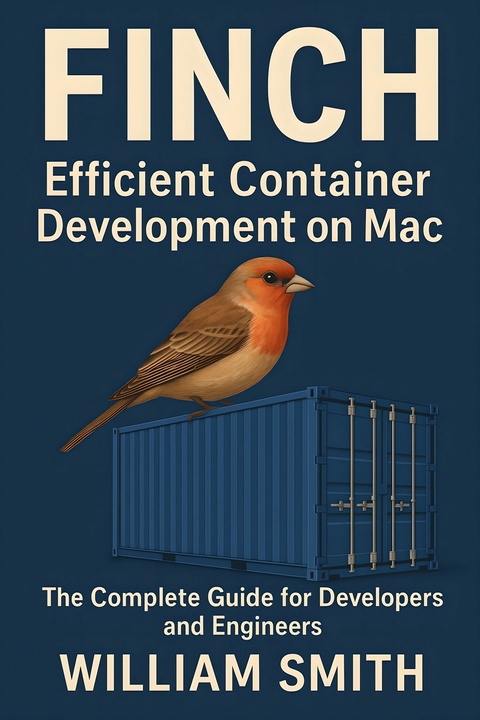
Finch (eBook)
250 Seiten
HiTeX Press (Verlag)
978-0-00-102379-6 (ISBN)
'Finch: Efficient Container Development on Mac'
'Finch: Efficient Container Development on Mac' is an authoritative guide for developers and DevOps professionals seeking to master modern container workflows on Apple hardware. The book opens by unraveling the foundational principles and specific constraints of containerization on macOS, including the nuances of virtualization versus containers, filesystem semantics, networking paradigms, and robust security practices tailored for the Mac environment. It presents a comparative analysis of leading solutions such as Docker, Colima, and Finch, empowering readers to make informed decisions for their unique development scenarios.
Diving deep into Finch's architecture and ecosystem, the book offers a meticulous exploration of its inner workings-covering key integrations with Lima, QEMU, and the OCI runtime, advanced networking and storage strategies, as well as extensibility through plugins. Readers benefit from step-by-step installation and configuration instructions for both Intel and Apple Silicon Macs, along with comprehensive guidance on lifecycle management, diagnostics, scripting, and custom automation. With practical chapters on streamlining development workflows, toolchain integration, and maintaining environment parity, the book ensures readers can build, debug, and orchestrate multi-container setups with speed and confidence.
Addressing advanced topics, the book guides users through performance optimization, security and compliance, persistent storage, and sophisticated networking setups-including virtual topologies and hardware offload. Exclusive sections on developing custom Finch plugins, automating workflows, and leveraging Apple services ensure maximum adaptability and innovation. Concluding with a forward-looking analysis of evolving trends-such as Arm64 containerization, cloud integration, and research frontiers-this volume stands as an indispensable reference for harnessing the full power of containers on macOS, both today and in the rapidly transforming future of development.
Chapter 2
Deep Dive into Finch: Architecture, Internals, and Ecosystem
Finch brings a new paradigm for container development on macOS-purpose-built to exploit modern hardware and adapt to the constraints of the platform. This chapter opens the hood on Finch’s internal workings: how its modular architecture, integrations, and extensibility provide advanced users with a transparent, soup-to-nuts container engine that rivals any native Linux solution. Whether optimising workflows or extending functionality, understanding Finch’s internals will empower you to push the limits of containerized development on Mac.
2.1 Finch Architecture Overview
The Finch container management ecosystem is architected to balance a triad of key design principles: usability, reliability, and composability, targeting advanced containerization workflows. At its core, Finch integrates several modular components that cooperate to deliver a seamless user experience while harnessing the underlying power of container runtime technologies. This section delineates the primary architectural planes of Finch, progressing from user interfaces through lifecycle management, down to the concrete execution layers and system services.
The top layer comprises the user-facing interfaces, most prominently the Finch Command Line Interface (CLI). The CLI acts as the principal interaction point for operators and developers, encapsulating complex container management primitives into a uniform, intuitive command set. Rather than exposing low-level runtime mechanics directly, it provides a declarative interface abstracting configuration, orchestration, and resource management. This design choice enhances usability by offering clear semantic commands, scripting capabilities, and comprehensive feedback mechanisms, thereby reducing operational errors and facilitating automation.
Beneath the CLI lies the Virtual Machine (VM) Lifecycle Controller, an orchestrator responsible for managing the VM instances that isolate container workloads. Finch’s choice of a VM boundary addresses critical reliability and security requirements, adding a robust containment layer superior to traditional container-only isolation. The VM Lifecycle Controller maintains VM states, coordinating initialization, teardown, snapshotting, and migration processes with atomicity guarantees. This ensures fault-tolerant operation and efficient resource utilization even under erratic system conditions. State reconciliation protocols embedded within the controller continuously verify VM health and synchronize lifecycle events with system-level controllers, thereby upholding consistency across distributed environments.
The transition from VM lifecycle management to container execution is mediated through closures interfacing with Open Container Initiative (OCI) compatible runtimes. Finch delegates actual container instantiation and resource allocation to standardized OCI runtimes such as runc or crun. This architectural separation underpins extensibility and composability: the VM Lifecycle Controller governs the environment lifecycle, while OCI runtimes specialize in precise container creation, namespaces, cgroups, and execution. This division also allows Finch to remain agnostic to low-level container implementation details, facilitating future runtime substitutions or enhancements without extensive architectural modifications.
Integral to this stack, system services undergird both VM and container layers. These include components for networking, storage, logging, and monitoring. Finch adopts a service-oriented model in which each system service operates independently yet in coordination through well-defined APIs and event-driven communication channels. For instance, the networking service configures virtual network interfaces and overlays necessary for intra-VM and inter-VM container connectivity, employing technologies such as virtual switches and namespace-aware routing. The storage service manages persistent volumes, snapshotting, and layered filesystem constructs, providing consistent volume semantics across container and VM boundaries. Logging and monitoring services collect telemetry data streamed back to the CLI or external observability platforms, ensuring operational transparency and rapid diagnostics.
Each architectural decision reflected in Finch’s design addresses critical trade-offs. The CLI modularizes user interaction and error handling, abstracting complexity without sacrificing control. The VM lifecycle abstraction facilitates strong isolation and fault isolation while preserving performance by optimizing VM startup times and resource reclamation. Delegating container operations to OCI runtimes benefits from industry standards and avoids reinventing container execution primitives, enhancing interoperability. Finally, decoupling system services enables independent scaling and upgrade paths, fostering a resilient and maintainable system architecture.
The comprehensive interplay between these components creates a layered, loosely coupled architecture that excels in composability. Advanced use cases such as multi-tenant deployments, hybrid cloud workloads, and multi-runtime orchestration become feasible through Finch’s design. For example, VM-level isolation allows safe co-location of workloads with varying security requirements, while container runtimes ensure environment consistency and portability. Moreover, the CLI facilitates complex workflows by orchestrating underlying VM and container lifecycle operations transparently, streamlining developer velocity and operational automation.
Finch’s architecture exemplifies a deliberate fusion of modular design and standardization. The CLI abstracts container complexity while empowering control; the VM lifecycle controller assures robust environment management; OCI runtimes provide standardized container execution; and system services offer essential auxiliary functions. This architectural synergy achieves a coherent platform optimized for usability, reliability, and composability, thereby advancing the state of container orchestration frameworks tailored for sophisticated deployment paradigms.
2.2 Lima and QEMU Integration
Finch leverages Lima and QEMU to establish lightweight, performant Linux virtual machines (VMs) that act as container hosts, enabling containerized workloads to run efficiently on macOS and similar non-Linux platforms. The integration focuses on minimal overhead and user-transparent orchestration, providing an almost native container experience while carefully abstracting complex kernel functionalities.
The orchestration lifecycle within Finch begins with the initialization of Lima VMs using QEMU’s virtualization capabilities. Lima serves as a higher-level orchestration layer that configures and manages QEMU instances optimized for container workloads. This process begins by generating VM configurations which specify CPU, memory, disk, networking, and GPU passthrough parameters tailored to the host’s resources. Unlike traditional VM setups, Finch automates this generation in response to container runtime demands, reducing manual intervention while maintaining fine-grained control over VM resources.
Once a VM configuration is established, Finch invokes QEMU with parameters that balance the VM’s performance and isolation. Essential kernel modules and Linux features are preloaded to prepare a container-optimized environment. The Linux kernel running inside the VM is typically a custom configuration with features disabled or enabled explicitly to support containerization, such as namespaces, control groups (cgroups), and overlay filesystems. This kernel tuning plays a critical role by limiting unnecessary subsystems that increase boot time or resource consumption, thereby enhancing container startup efficiency.
Image management in Finch leverages container image distribution best practices with optimizations for virtualized environments. Storage overhead is minimized by using copy-on-write (CoW) filesystem layers within the VM, supported by mainline kernel overlayfs. Finch fetches container images outside the VM and injects them as shared or delegated mounts, reducing duplication and network bandwidth usage. The VM’s root filesystem is often an immutable image, while container layers are mounted dynamically, striking a balance between image immutability and runtime flexibility.
Dynamic performance tuning in Finch relies heavily on QEMU’s capabilities to adjust VM behavior in real-time, such as tweaking CPU pinning, memory ballooning, and I/O thread allocation. Finch implements heuristics informed by actual container workload profiles to manage these parameters, ensuring resource contention is minimized to prevent QoS degradation. For example, networking relies on virtio-net drivers configured for minimal latency and throughput overhead. Memory management exploits hugepages when available, lowering Translation Lookaside Buffer (TLB) misses that significantly affect containerized application performance.
One of the major challenges in Finch’s integration involves abstraction of the Linux kernel features that are critical for container operations yet potentially complex to expose transparently. Containers depend on namespaces for process isolation, cgroups for resource control, and seccomp for syscall...
| Erscheint lt. Verlag | 19.8.2025 |
|---|---|
| Sprache | englisch |
| Themenwelt | Mathematik / Informatik ► Informatik ► Programmiersprachen / -werkzeuge |
| ISBN-10 | 0-00-102379-9 / 0001023799 |
| ISBN-13 | 978-0-00-102379-6 / 9780001023796 |
| Informationen gemäß Produktsicherheitsverordnung (GPSR) | |
| Haben Sie eine Frage zum Produkt? |
 EPUB (Adobe DRM)
Größe: 811 KB
Kopierschutz: Adobe-DRM
Adobe-DRM ist ein Kopierschutz, der das eBook vor Mißbrauch schützen soll. Dabei wird das eBook bereits beim Download auf Ihre persönliche Adobe-ID autorisiert. Lesen können Sie das eBook dann nur auf den Geräten, welche ebenfalls auf Ihre Adobe-ID registriert sind.
Details zum Adobe-DRM
Dateiformat: EPUB (Electronic Publication)
EPUB ist ein offener Standard für eBooks und eignet sich besonders zur Darstellung von Belletristik und Sachbüchern. Der Fließtext wird dynamisch an die Display- und Schriftgröße angepasst. Auch für mobile Lesegeräte ist EPUB daher gut geeignet.
Systemvoraussetzungen:
PC/Mac: Mit einem PC oder Mac können Sie dieses eBook lesen. Sie benötigen eine
eReader: Dieses eBook kann mit (fast) allen eBook-Readern gelesen werden. Mit dem amazon-Kindle ist es aber nicht kompatibel.
Smartphone/Tablet: Egal ob Apple oder Android, dieses eBook können Sie lesen. Sie benötigen eine
Geräteliste und zusätzliche Hinweise
Buying eBooks from abroad
For tax law reasons we can sell eBooks just within Germany and Switzerland. Regrettably we cannot fulfill eBook-orders from other countries.
aus dem Bereich


