


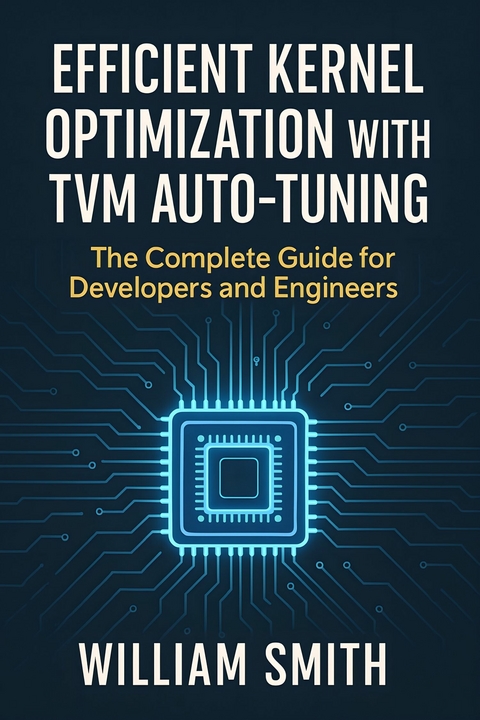
Efficient Kernel Optimization with TVM Auto-tuning (eBook)
250 Seiten
HiTeX Press (Verlag)
978-0-00-102378-9 (ISBN)
'Efficient Kernel Optimization with TVM Auto-tuning'
'Efficient Kernel Optimization with TVM Auto-tuning' is a comprehensive, authoritative guide to boosting computational efficiency at the kernel level using TVM's powerful auto-tuning capabilities. This book establishes a rigorous foundation in both the theoretical and practical aspects of kernel optimization, beginning with the significance of performance for deep learning, high-performance computing, and edge deployments. Readers are introduced to the architecture and modular design of TVM, the challenges of manual kernel tuning, and the evolution of auto-tuning methodologies, making it ideal for advanced practitioners and researchers seeking an in-depth understanding of this rapidly advancing field.
Diving deeper, the text navigates through TVM's intermediate representation and scheduling primitives, unpacks the theory behind auto-tuning search spaces and cost modeling, and illuminates the decision-making processes that drive efficient code generation on heterogeneous hardware. With hands-on chapters detailing the configuration and orchestration of TVM's auto-scheduler, the book guides readers through advanced scheduling, memory transformation techniques, and performance modeling with cutting-edge machine learning approaches. Rich case studies demonstrate auto-tuning pipelines for popular deep learning kernels-including matrix multiplications, convolutions, and attention mechanisms-while also addressing optimization for sparse, quantized, or custom operators.
Beyond technical mastery, this volume is a practical companion for engineers and researchers scaling their workflows to new domains and hardware. It covers integration with third-party compilers, cross-compilation, distributed and cloud-based tuning, and concludes with best practices, pitfalls, and a look at emerging research frontiers. Both a reference and a roadmap, 'Efficient Kernel Optimization with TVM Auto-tuning' is essential reading for those striving for state-of-the-art performance and reliability in modern computational workloads.
Chapter 2
TVM Intermediate Representation and Scheduling Primitives
Beneath TVM’s user-facing APIs lie expressive representations and powerful scheduling abstractions that enable portable, fine-grained control over compute kernels. In this chapter, we reveal how TVM models computation, navigates the subtleties of diverse hardware, and empowers practitioners to craft performant code through explicit, programmable scheduling. This journey through tensor languages, IR anatomy, and hardware-conscious scheduling exposes TVM’s inner workings-a toolkit for bending performance to your will.
2.1 Tensor Expression Language in TVM
The Tensor Expression (TE) language in TVM serves as a domain-specific abstraction designed to express tensor computations at a high level without binding directly to hardware-specific implementation details. By modeling operators and kernels as compositions of symbolic tensor operations, TE encapsulates the computational intent while deferring the concrete execution strategy, which enables flexible, targeted optimizations across diverse hardware backends.
At its core, TE abstracts computations as tensor expressions formulated over symbolic iteration variables (itervars). These itervars represent the indices over the dimensions of output and intermediate tensors, allowing comprehensive manipulation of multi-dimensional data through mathematical constructs rather than imperative loops. This symbolic approach enables the construction of computation graphs in a concise and declarative manner, which lie at the foundation of subsequent lowering and scheduling transformations.
A typical tensor expression in TE is defined using the te.compute primitive, which specifies the output tensor shape and a computation rule expressed as a function over itervars. Formally, consider an output tensor C ∈ ℝN×M derived from input tensors A ∈ ℝN×K and B ∈ ℝK×M. The matrix multiplication operation can be expressed as:
Within the TE framework, this is represented symbolically by defining the reduction axis k as an itervar with a specified range and then constructing the output tensor via te.compute with an explicit reduction over k. This expression captures the algebraic nature of the operation without prescribing the iteration order or parallelization strategy.
The decoupling of algorithmic description from execution schedule is a pivotal design choice in TVM’s TE model. The initial tensor expression specifies what to compute, while the execution schedule delineates how to realize the computation on hardware. Schedules contain transformations such as loop tiling, unrolling, vectorization, memory hierarchy management, and parallelization directives. By separating these concerns, it becomes feasible to experiment with numerous schedules for the same tensor expression, thereby tailoring performance optimizations adaptively for CPUs, GPUs, or specialized accelerators.
The symbolic nature of TE expressions facilitates automated analysis and transformation. Since all tensors and computations are represented as symbolic expressions, dependency graphs can be statically analyzed to detect opportunities for fusion, inlining, and simplification. The explicit definition of reduction axes also supports optimization techniques like reduction factorization and cross-thread communication on parallel architectures. These abstractions not only reduce programmer burden but enable TVM’s compiler passes to explore optimization spaces systematically.
Moreover, the TE language enhances modularity and composability. Complex operators can be constructed by composing simpler tensor expressions, progressively building kernels that integrate multiple stages of computation. This compositionality benefits the design of operator libraries and custom kernels, which can be later scheduled independently for optimization purposes. TVM provides primitives to manipulate buffers, storage scopes, and tensor shapes at the TE level, allowing fine-grained control over memory access patterns essential for high-performance implementations.
In addition to standard element-wise and reduction operations, TE supports indexing functions that allow arbitrary affine or non-affine access patterns within tensor expressions. This capability is critical for expressing a wide spectrum of algorithms, including convolutions, pooling, and sparse computations, in a uniform symbolic framework. For example, the im2col transformation used in convolutional networks can be modeled through reindexing within TE, enabling consistent handling across different operators.
The adoption of TE also simplifies integration with autotuning frameworks. Since TE expressions abstract computation semantics independently of execution details, tuning efforts can focus exclusively on schedules without redefining algorithmic logic. This separation has proven instrumental for TVM’s automatic search strategies to identify schedules that maximize hardware utilization and minimize resource contention.
In summary, the Tensor Expression language in TVM constitutes a robust and expressive abstraction for defining computation in a hardware-agnostic manner. By explicitly modeling kernels as symbolic tensor operations and isolating algorithm from execution schedule, TE lays a versatile foundation for optimizing tensor programs across diverse architectural targets. This abstraction empowers both compiler engineers and domain experts to collaborate efficiently in advancing state-of-the-art performance, while preserving clarity and modularity in tensor operator specification.
2.2 Intermediate Representation Anatomy
TVM’s intermediate representation (IR) architecture is designed as a layered framework, adept at capturing progressively detailed levels of computation semantics while enabling flexible manipulation and optimization. At the core of this design lie two pivotal abstractions: dataflow graphs and abstract syntax trees (ASTs). These IR forms collectively underpin the transformation pipeline that lowers high-level algorithmic descriptions into device-specific executable code.
The uppermost layer of IR in TVM represents computations principally as functional abstractions and pure expressions, typically structured as ASTs. The syntax trees are composed of nodes representing operations, function calls, and control flow constructs—for instance, loops and conditionals—all encoded in a rich but uniform manner. This design favors clarity and formal tractability, enabling powerful static analyses, pattern matching, and transformations. Within this layer, each node maintains explicit typed information, shape constraints, and tensor indexing expressions, which preserve the semantics of tensor computations while abstracting away from hardware-specific details.
Transitioning downward, TVM introduces dataflow graphs that capture computation as a network of interconnected operators and data dependencies. These graphs expose the intrinsic parallelism and scheduling opportunities through the explicit representation of data movement and producer-consumer relationships. Nodes in these dataflow graphs correspond to computational primitives, such as element-wise operations or reductions, and edges encode tensors flowing between operations. The dataflow abstraction is intrinsically amenable to graph rewriting and fusion strategies, as it naturally expresses locality and synchronization points within computations.
The IR transformation pipeline in TVM systematically lowers computation from these high-level, hardware-agnostic ASTs through progressively more concrete IR forms. This process involves multiple staged conversions:
- High-Level Relay IR: Serves as the functional AST, emphasizing operator composition and enabling type inference, shape analysis, and algebraic simplification.
- Tensor Expression (TE) IR: Represents computations as nested loops or tensor comprehensions, making loop structures and indexing explicit yet still abstracting from low-level control-flow details.
- Schedule IR: Encodes transformation directives such as loop tiling, unrolling, vectorization, and memory scope assignments, bridging computational intent and hardware-aware optimization.
- Lowered IR: A representation closer to the target machine’s instruction set, exposing explicit memory accesses, synchronization primitives, and low-level control flow.
At each level, the IR maintains a well-defined interface that supports both introspection—querying properties like tensor shapes, data types, and dependency graphs—and extensibility through user-defined operators and transformation passes. TVM’s design encourages the injection of custom passes that can analyze or mutate IR nodes to optimize performance or adapt to novel hardware features without compromising correctness.
The layered IR architecture also supports sophisticated analysis techniques by decomposing complex computations into...
| Erscheint lt. Verlag | 19.8.2025 |
|---|---|
| Sprache | englisch |
| Themenwelt | Mathematik / Informatik ► Informatik ► Programmiersprachen / -werkzeuge |
| ISBN-10 | 0-00-102378-0 / 0001023780 |
| ISBN-13 | 978-0-00-102378-9 / 9780001023789 |
| Informationen gemäß Produktsicherheitsverordnung (GPSR) | |
| Haben Sie eine Frage zum Produkt? |
 EPUB (Adobe DRM)
Größe: 943 KB
Kopierschutz: Adobe-DRM
Adobe-DRM ist ein Kopierschutz, der das eBook vor Mißbrauch schützen soll. Dabei wird das eBook bereits beim Download auf Ihre persönliche Adobe-ID autorisiert. Lesen können Sie das eBook dann nur auf den Geräten, welche ebenfalls auf Ihre Adobe-ID registriert sind.
Details zum Adobe-DRM
Dateiformat: EPUB (Electronic Publication)
EPUB ist ein offener Standard für eBooks und eignet sich besonders zur Darstellung von Belletristik und Sachbüchern. Der Fließtext wird dynamisch an die Display- und Schriftgröße angepasst. Auch für mobile Lesegeräte ist EPUB daher gut geeignet.
Systemvoraussetzungen:
PC/Mac: Mit einem PC oder Mac können Sie dieses eBook lesen. Sie benötigen eine
eReader: Dieses eBook kann mit (fast) allen eBook-Readern gelesen werden. Mit dem amazon-Kindle ist es aber nicht kompatibel.
Smartphone/Tablet: Egal ob Apple oder Android, dieses eBook können Sie lesen. Sie benötigen eine
Geräteliste und zusätzliche Hinweise
Buying eBooks from abroad
For tax law reasons we can sell eBooks just within Germany and Switzerland. Regrettably we cannot fulfill eBook-orders from other countries.
aus dem Bereich


