


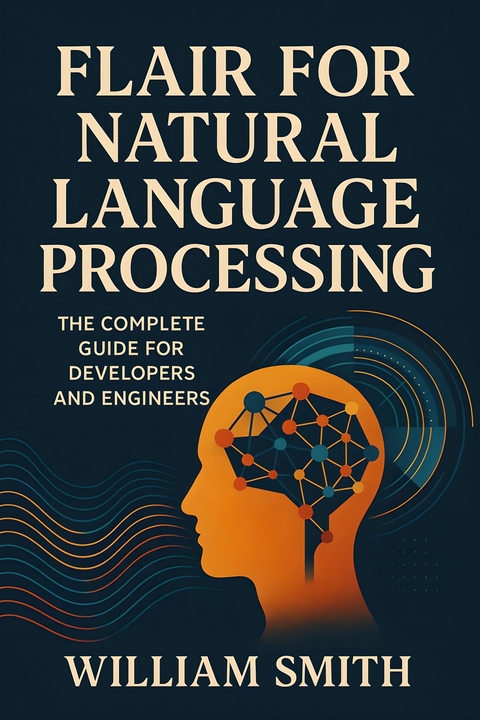
Flair for Natural Language Processing (eBook)
250 Seiten
HiTeX Press (Verlag)
978-0-00-102377-2 (ISBN)
'Flair for Natural Language Processing'
'Flair for Natural Language Processing' presents a comprehensive and authoritative guide to the design, implementation, and deployment of cutting-edge NLP solutions using the Flair framework. Addressing readers ranging from advanced practitioners to curious researchers, this book delves into the architectural foundations of Flair, exploring its modular design, extensibility, and robust workflow orchestration. Detailed expositions of data abstractions, performance optimization, and plugin integration provide all the necessary tools for building bespoke solutions tailored to research or production environments.
Spanning sequence labeling, document classification, and information extraction, the text offers an in-depth analysis of modern embedding architectures-including contextual, static, character-level, and transformer-based methods. The reader is guided through advanced sequence modeling, multi-task learning, and cross-lingual adaptation, as well as practical strategies for classifying complex, noisy, and imbalanced datasets. A particular emphasis is placed on constructing, evaluating, and optimizing custom NLP pipelines, with concrete best practices for benchmarking, diagnostics, and explainability.
Recognizing the critical importance of scalability, ethical governance, and operational excellence, the book covers every facet of deploying NLP systems at scale-from distributed training and cloud-native deployment, to security, privacy, and responsible AI considerations. It concludes with a forward-looking exploration of emerging trends such as large language model integration, green NLP, and interactive human-in-the-loop systems. For those seeking a rigorous yet accessible resource on the application of contemporary NLP, 'Flair for Natural Language Processing' stands as a definitive reference.
Chapter 2
Advanced Embedding Architectures
At the heart of modern NLP success lies the art of encoding language in ways machines can reason about. This chapter ventures deep into the realm of embeddings, unraveling the innovative architectures-static, contextual, hybrid, and beyond-that power state-of-the-art models in Flair. Examine how masterful composition, fine-tuning, and rigorous evaluation of these representations create the foundation for unparalleled linguistic intelligence.
2.1 Static and Contextual Embeddings in Flair
Static and contextual word embeddings represent two fundamental paradigms in natural language representation learning, each serving distinct purposes in the Flair framework. Static embeddings, such as GloVe and FastText, assign a fixed vector representation to each word irrespective of the sentence context. In contrast, contextual embeddings, exemplified by ELMo and transformer-based models like BERT, dynamically generate word vectors influenced by the surrounding text, enabling nuanced semantic and syntactic disambiguation. Flair provides an integrated platform that harmonizes these embedding types, permitting flexible and effective representation learning in downstream tasks.
Static embeddings are grounded in distributional semantics derived from large corpora, capturing global word co-occurrence statistics. For instance, GloVe constructs word vectors by factorizing a matrix of word-word co-occurrence counts, resulting in embeddings that encode frequent collocations and semantic similarity. FastText extends this approach by representing words as the sum of character n-gram vectors, thereby accommodating subword information and enhancing robustness to out-of-vocabulary (OOV) terms and morphological variation. Within Flair, these embeddings are implemented as pre-trained vectors loaded via the WordEmbeddings class:
glove_embedding = WordEmbeddings(’glove’)
fasttext_embedding = WordEmbeddings(’crawl’)
These static embeddings are highly efficient, as each word’s vector is computed once and reused, lending themselves well to resource-constrained environments and tasks where contextual nuance is less critical, such as topic classification or keyword extraction.
Contextual embeddings in Flair leverage recurrent or transformer architectures to generate word representations dependent on the input sequence. ELMo embeddings, based on bi-directional LSTMs, exploit deep contextual modeling by training language models to predict words given their context. Flair’s hallmark is its Flair embeddings, which use character-level language models trained forward and backward, capturing both local and long-range dependencies. Transformer-based embeddings, such as those from BERT, utilize self-attention mechanisms to directly model relationships across all positions simultaneously, yielding context-aware vectors that excel in complex tasks like named entity recognition or coreference resolution.
Implementation of Flair’s contextual embeddings involves the FlairEmbeddings and TransformerWordEmbeddings classes, respectively. The former allows loading of pre-trained forward and backward context models:
flair_forward = FlairEmbeddings(’news-forward’)
flair_backward = FlairEmbeddings(’news-backward’)
bert_embedding = TransformerWordEmbeddings(’bert-base-uncased’)
Integration of these embeddings in Flair pipelines generally requires their concatenation to form rich word representations:
stacked_embeddings = StackedEmbeddings([
glove_embedding,
flair_forward,
flair_backward,
bert_embedding
])
This stacking mechanism enhances model performance by combining the general semantic knowledge of static embeddings with the fine-grained, contextualized information of dynamic embeddings. However, the resulting increase in computational cost and memory consumption introduces trade-offs that must be carefully balanced against task requirements.
Selection of embeddings in Flair should be guided by linguistic and task-specific considerations. Static embeddings suffice for applications where word sense disambiguation or syntactic variation is minimal and where interpretability and efficiency are paramount. For example, large-scale document classification or systems with real-time constraints may rely primarily on GloVe or FastText embeddings. Conversely, tasks demanding sensitivity to word context, such as relation extraction, question answering, or entity linking, benefit significantly from contextual embeddings. The ability of transformer-based models to capture sophisticated linguistic phenomena often translates into substantial empirical gains, albeit at higher resource expenditure.
Moreover, domain specificity plays a pivotal role. Flair provides domain-adapted embeddings, for instance, biomedical or legal Flair embeddings, which improve performance by capturing specialized vocabulary and usage patterns. Such embeddings can be integrated seamlessly by specifying appropriate model identifiers:
...
| Erscheint lt. Verlag | 19.8.2025 |
|---|---|
| Sprache | englisch |
| Themenwelt | Mathematik / Informatik ► Informatik ► Programmiersprachen / -werkzeuge |
| ISBN-10 | 0-00-102377-2 / 0001023772 |
| ISBN-13 | 978-0-00-102377-2 / 9780001023772 |
| Informationen gemäß Produktsicherheitsverordnung (GPSR) | |
| Haben Sie eine Frage zum Produkt? |
 EPUB (Adobe DRM)
Größe: 1,1 MB
Kopierschutz: Adobe-DRM
Adobe-DRM ist ein Kopierschutz, der das eBook vor Mißbrauch schützen soll. Dabei wird das eBook bereits beim Download auf Ihre persönliche Adobe-ID autorisiert. Lesen können Sie das eBook dann nur auf den Geräten, welche ebenfalls auf Ihre Adobe-ID registriert sind.
Details zum Adobe-DRM
Dateiformat: EPUB (Electronic Publication)
EPUB ist ein offener Standard für eBooks und eignet sich besonders zur Darstellung von Belletristik und Sachbüchern. Der Fließtext wird dynamisch an die Display- und Schriftgröße angepasst. Auch für mobile Lesegeräte ist EPUB daher gut geeignet.
Systemvoraussetzungen:
PC/Mac: Mit einem PC oder Mac können Sie dieses eBook lesen. Sie benötigen eine
eReader: Dieses eBook kann mit (fast) allen eBook-Readern gelesen werden. Mit dem amazon-Kindle ist es aber nicht kompatibel.
Smartphone/Tablet: Egal ob Apple oder Android, dieses eBook können Sie lesen. Sie benötigen eine
Geräteliste und zusätzliche Hinweise
Buying eBooks from abroad
For tax law reasons we can sell eBooks just within Germany and Switzerland. Regrettably we cannot fulfill eBook-orders from other countries.
aus dem Bereich


