


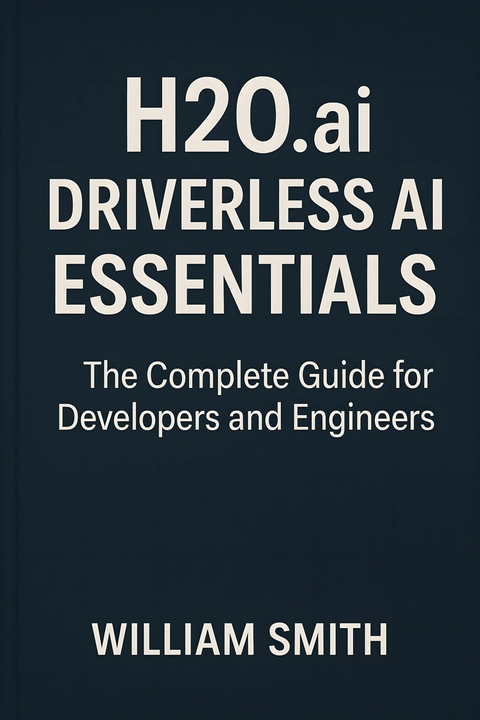
H2O.ai Driverless AI Essentials (eBook)
250 Seiten
HiTeX Press (Verlag)
978-0-00-102370-3 (ISBN)
'H2O.ai Driverless AI Essentials'
'H2O.ai Driverless AI Essentials' offers a comprehensive and authoritative guide to the cutting-edge platform powering automated machine learning at scale. With a deep exploration of Driverless AI's vision, architecture, and position within today's AI/ML landscape, this book meticulously demystifies the core components and workflows that support seamless data science automation. Readers gain foundational understanding of data types, pipeline orchestration, system scalability, and advanced configuration-equipping practitioners to harness the platform's full potential across diverse infrastructural environments.
Beyond architecture, the book navigates the end-to-end automation of the data science lifecycle. It delves into sophisticated techniques for data ingestion, profiling, anomaly detection, and transformation, while emphasizing the crucial pillars of data governance, security, and lineage. From evolutionary algorithms for feature engineering to advanced model selection, ensemble strategies, and hyperparameter optimization, the text elucidates how Driverless AI automates robust model development at enterprise scale. Crucially, it also addresses interpretability tools, fairness and bias mitigation, regulatory compliance, and actionable feature insights that are essential for transparent and responsible AI deployment.
Culminating in real-world operationalization, 'H2O.ai Driverless AI Essentials' guides readers through the intricacies of deployment, integration, workflow automation, and scaling production systems-including advanced topics in monitoring, CI/CD, high availability, and multi-tenancy. Practical sections on security, compliance, resource management, and cost optimization ensure enterprises can adopt Driverless AI with confidence. Peppered with best practices, detailed case studies, and forward-looking strategies, this essential resource enables data scientists, MLOps professionals, and technology leaders to elevate their AI initiatives with efficiency, transparency, and enterprise-grade reliability.
Chapter 2
Advanced Data Handling and Preprocessing
At the heart of every high-performing AI model lies the discipline of data mastery. This chapter ventures into the sophisticated mechanisms Driverless AI leverages to ingest, profile, transform, and safeguard enterprise-scale datasets. Discover how automation harmonizes complexity-enabling rapid and reliable data preparation, anomaly detection, and governance without compromising control or transparency.
2.1 Data Ingestion: Batch, Streaming, and Connectors
Driverless AI’s data ingestion framework is engineered to facilitate seamless integration across a variety of disparate sources, supporting workflows that range from traditional batch loads to sophisticated real-time streaming pipelines. This multimodal ingestion capability enables advanced machine learning workflows to access consistent and timely data irrespective of format or source topology, thereby meeting the stringent demands of modern high-frequency, high-volume environments.
At the core of Driverless AI’s ingestion strategy lies an extensible connector architecture that abstracts over physical data stores while providing rich, schema-aware interfaces. Batch ingestion connectors support common enterprise file systems such as HDFS and NFS, cloud-based object stores including Amazon S3, Azure Blob Storage, and Google Cloud Storage, as well as relational and NoSQL databases like PostgreSQL, MySQL, and MongoDB. These connectors implement optimized data retrieval techniques, including predicate pushdown and column pruning, minimizing network I/O and reducing the data footprint transferred for model training. Integration with extensive metadata catalogs allows schema discovery and evolution tracking, ensuring that schema drift or format inconsistencies are proactively managed.
Streaming ingestion achieves low-latency data capture by interfacing with industrial-strength stream platforms such as Apache Kafka, Amazon Kinesis, and Azure Event Hubs. Driverless AI leverages these connectors to consume continuous event streams in near real time, employing windowing, watermarking, and checkpointing strategies to handle out-of-order events and to guarantee exactly-once processing semantics. The framework’s ability to maintain stateful computations across streams is paramount for time-sensitive feature extraction and for training models that require fresh data inputs continuously. Moreover, integration with stream-processing engines like Apache Flink and Apache Spark Structured Streaming further enhances the platform’s scalability and resilience.
Schema handling within Driverless AI’s ingestion system is inherently robust and adaptive. Connector modules are designed with automated schema inference mechanisms that detect and propagate data type changes, nested structure variations, and new attribute introductions without interrupting running pipelines. A schema registry service maintains a canonical schema version repository, enabling alignment between ingestion processes, feature engineering, and downstream model training components. In incremental ingestion scenarios, Driverless AI supports watermark-based and change-data-capture (CDC) strategies that selectively retrieve only new or modified records since the last extraction. This incremental approach not only accelerates training cycles but also reduces computational overhead and storage costs.
A critical dimension of data ingestion is resiliency, especially when operating under volatile network conditions or with unreliable sources. Driverless AI implements at-least-once delivery guarantees through persistent checkpointing and idempotent write operations. Connectors maintain built-in retry mechanisms with exponential backoff and jitter to avoid cascading failures and facilitate graceful degradation. Buffering and local caching enable connectors to absorb bursts or temporary connectivity loss, ensuring uninterrupted data availability for downstream processes. Furthermore, monitoring hooks and alerting systems provide visibility into ingestion health metrics such as latency, throughput, error rates, and backpressure indicators, empowering data engineers to diagnose and remediate ingestion bottlenecks promptly.
Consider an enterprise use case involving predictive maintenance across a distributed manufacturing environment. Sensor-generated time series data streams flow into Driverless AI via Kafka connectors, while equipment metadata and historical failure logs reside in relational databases accessed through JDBC connectors. Driverless AI’s ingestion layer harmonizes these heterogeneous data feeds by applying schema alignment, synchronizing incremental updates from the databases, and continuously capturing streaming sensor data. The resulting unified feature store supports both batch-based retraining schedules and streaming model updates that adapt to evolving operational conditions, exemplifying the platform’s proficiency in accommodating both batch and streaming paradigms within a single ingestion ecosystem.
Driverless AI’s ingestion capabilities are distinguished by their versatility, schema intelligence, incremental processing sophistication, and operational resiliency. By abstracting complex data integration challenges through an evolving set of connectors and providing fault-tolerant streaming ingestion mechanisms, the platform enables users to manage high-frequency, high-volume pipelines with precision and agility, a prerequisite for successful deployment of AI-driven solutions in complex production environments.
kafka_config = {
’bootstrap_servers’: ’kafka-broker1:9092,kafka-broker2:9092’,
’topic’: ’sensor_data’,
’group_id’: ’driverless_ai_consumer_group’,
’auto_offset_reset’: ’earliest’,
’enable_auto_commit’: False
}
connector = KafkaConnector(config=kafka_config)
stream = connector.consume_stream(batch_size=1000, timeout_ms=5000)
for batch in stream:
...
| Erscheint lt. Verlag | 19.8.2025 |
|---|---|
| Sprache | englisch |
| Themenwelt | Mathematik / Informatik ► Informatik ► Programmiersprachen / -werkzeuge |
| ISBN-10 | 0-00-102370-5 / 0001023705 |
| ISBN-13 | 978-0-00-102370-3 / 9780001023703 |
| Informationen gemäß Produktsicherheitsverordnung (GPSR) | |
| Haben Sie eine Frage zum Produkt? |
 EPUB (Adobe DRM)
Größe: 969 KB
Kopierschutz: Adobe-DRM
Adobe-DRM ist ein Kopierschutz, der das eBook vor Mißbrauch schützen soll. Dabei wird das eBook bereits beim Download auf Ihre persönliche Adobe-ID autorisiert. Lesen können Sie das eBook dann nur auf den Geräten, welche ebenfalls auf Ihre Adobe-ID registriert sind.
Details zum Adobe-DRM
Dateiformat: EPUB (Electronic Publication)
EPUB ist ein offener Standard für eBooks und eignet sich besonders zur Darstellung von Belletristik und Sachbüchern. Der Fließtext wird dynamisch an die Display- und Schriftgröße angepasst. Auch für mobile Lesegeräte ist EPUB daher gut geeignet.
Systemvoraussetzungen:
PC/Mac: Mit einem PC oder Mac können Sie dieses eBook lesen. Sie benötigen eine
eReader: Dieses eBook kann mit (fast) allen eBook-Readern gelesen werden. Mit dem amazon-Kindle ist es aber nicht kompatibel.
Smartphone/Tablet: Egal ob Apple oder Android, dieses eBook können Sie lesen. Sie benötigen eine
Geräteliste und zusätzliche Hinweise
Buying eBooks from abroad
For tax law reasons we can sell eBooks just within Germany and Switzerland. Regrettably we cannot fulfill eBook-orders from other countries.
aus dem Bereich


