


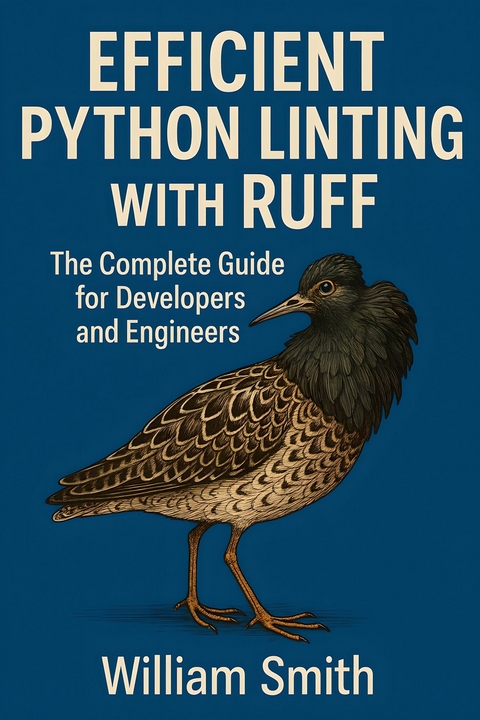
Efficient Python Linting with Ruff (eBook)
250 Seiten
HiTeX Press (Verlag)
9780001023697 (ISBN)
'Efficient Python Linting with Ruff'
'Efficient Python Linting with Ruff' is a comprehensive guide to modernizing and optimizing Python code quality workflows through Ruff, a cutting-edge linting tool distinguished by its speed, extensibility, and robust feature set. The book begins with an in-depth exploration of Python linting's evolution, contrasting established tools such as Flake8, pylint, and black while analyzing their respective strengths, weaknesses, and pain points. By contextualizing Ruff's unique position-architected for performance with Rust, designed for seamless integration into CI/CD systems, and supported by a vibrant community-readers are equipped to understand both its technical and strategic advantages in modern development environments.
Delving into Ruff's architecture, configuration, and rule engine, the book demystifies its modular design, concurrency capabilities, and security-minded execution. Readers gain actionable insights on customizing linting flows for diverse project needs, from granular rule inclusion and per-directory overrides to authoring custom plugins and automating fixes. The text offers pragmatic guidance for integrating Ruff into editor workflows, large monorepos, and complex polyglot environments, bolstered by thorough sections on enterprise-scale performance tuning, compatibility with existing toolchains, and strategies for organization-wide adoption.
Beyond operational concerns, this book illuminates the future of automated linting-exploring Ruff's roadmap, emerging use cases in scientific Python and machine learning, as well as the potential for AI-assisted code correction. Supported by detailed appendices, reference charts, and integration recipes, 'Efficient Python Linting with Ruff' is an indispensable reference for Python engineers, DevOps practitioners, and technology leaders intent on elevating code health, compliance, and developer productivity at any scale.
Chapter 1
The Evolution of Python Linting
From humble beginnings as script-based static checks to today’s high-performance, intelligent code analysis engines, the story of Python linting reflects the broader evolution of software engineering best practices. This chapter invites you to look beneath the surface of familiar tools and workflows, tracing the breakthroughs, the friction points, and the paradigm shifts that continue to shape how developers write robust, maintainable Python code. By understanding this nuanced history, seasoned engineers and technical architects will be prepared not only to choose the right tools, but also to anticipate and influence the future direction of code quality automation in Python.
1.1 Historical Overview of Linting in Python
The practice of linting, or static code analysis, predates modern integrated development environments and has roots extending to early Unix utility programs such as lint for C code. Python, evolving since the early 1990s, inherited this imperative for ensuring code quality through automated checks, but its approach was shaped by unique community and language characteristics. Initial Python code checking emerged pragmatically from the needs of an expanding user base cognizant of the language’s design philosophy emphasizing readability and explicitness.
Early efforts to formalize Python-specific code checking were informal and localized, consisting mainly of community-generated scripts aimed at detecting simple errors and enforcing rudimentary style rules. During the late 1990s and early 2000s, tools like PyChecker emerged as pioneering attempts to address the limitations of syntax-based error detection. PyChecker performed deeper static analysis by evaluating control flow and potential semantic pitfalls such as variable usage errors, unreachable code blocks, and incorrect argument counts in function calls. It was instrumental in indicating that static analysis could extend beyond superficial checks to identify probable runtime issues without executing code.
Subsequently, the advent of PEP 8 in 2001 codified a community-agreed style guide, crystallizing a shared vision of Pythonic code aesthetics and conventions. PEP 8 not only facilitated consistent code formatting but also created a foundation for automated style enforcement. The impact of PEP 8 was profound, explicitly linking source code style with readability-a core tenet of Python’s design ethos. It galvanized both educators and tool developers to align their efforts, transforming style enforcement from optional guidance into a semi-standardized practice.
Tools like pyflakes and pycodestyle (originally named pep8) in the late 2000s and early 2010s represent the next generation of Python linters, each building upon earlier experiences. pyflakes adopted a philosophy centered on performance and simplicity-performing fast syntactic checks to detect errors such as undefined names, redefined variables, and unused imports with minimal overhead. Unlike PyChecker’s heavier semantic analyses, pyflakes prioritized immediate feedback during development, facilitating quick iterations in editing cycles.
Conversely, pycodestyle focused exclusively on ensuring strict adherence to PEP 8 style rules, separating concerns between correctness and style enforcement. This modularization allowed users to combine tools in configurable pipelines according to their individual or organizational needs, fostering flexible workflows that could scale from casual scripting to enterprise-grade software engineering.
The continuous interaction between open source toolmakers and the broader Python community cultivated a positive feedback loop that drove iterative improvements in linting tools and practice. Educators incorporated linting checks into curricula to reinforce programming best practices, while professional teams integrated linters into continuous integration pipelines, highlighting the importance of automated quality gates. This synergy tightened feedback cycles, where field experience informed tool refinements and vice versa.
Python’s open development model ensured transparency, enabling the community to contribute to evolving linting standards and implementations. Discussions surrounding false positives, configuration complexity, and extensibility echoed widely in mailing lists and issue trackers, nurturing enhanced usability and accuracy in tools. The design choices of contemporary linters-trade-offs between comprehensiveness and speed, ease of integration, and configurability-reflect lessons learned from over two decades of community experimentation and feedback.
Despite these advancements, linters still wrestle with inherent limitations. Python’s dynamic typing and runtime introspection capabilities render fully sound static analysis a challenging problem. Consequently, linting tools strike a balance between catching common errors and avoiding excessive false alarms. Understanding the historical trajectory behind these tools elucidates why they emphasize certain patterns and overlook others, rooted in pragmatic compromises devised to serve diverse real-world development scenarios efficiently.
The evolution of Python linting tools charts a path from sporadic, handcrafted scripts to sophisticated, modular systems tightly aligned with community standards like PEP 8. This history highlights the interplay among technical constraints, cultural values, and open collaboration that has shaped the modern landscape of Python code quality assurance.
1.2 Comparative Analysis: Flake8, pylint, black, and Others
An effective Python development workflow relies heavily on tools that enforce code quality, consistency, and maintainability. The landscape of such tools can be broadly categorized into linters, formatters, and hybrid analyzers, each addressing distinct facets of code inspection and style enforcement. This comparative analysis focuses on four prominent tools—Flake8, pylint, black, and several notable alternatives—evaluating them along six critical dimensions: feature set, rule coverage, extensibility, performance, plug-in architecture, and configurability. This granular examination facilitates optimized tool selection and integration strategies, particularly in complex code bases or organizational settings requiring nuanced coding standards.
Feature Set and Rule Coverage
Flake8 functions primarily as a linting framework, aggregating the capabilities of pyflakes and pycodestyle to detect syntactic errors, undefined names, import issues, and adherence to PEP 8 style guidelines. Its strength lies in lightweight, focused checks predominantly centered on style and basic static analysis. The default rule set, however, does not deeply analyze code semantics or complex design anti-patterns.
Conversely, pylint presents a comprehensive static analysis apparatus. It incorporates over 500 distinct checks, including style violations, code smells, design defects, and refactor recommendations. It performs type inference and symbolic analysis, enabling detection of subtle logical inconsistencies such as unreachable code, redefined variables, and violation of coding conventions at a granular level. Thus, pylint is more suitable for thorough quality assurance, albeit with potentially higher configuration overhead.
black diverges from traditional linters by functioning solely as an uncompromising code formatter. It removes subjective style debates by enforcing a consistent, deterministic formatting regimen with minimal configurability. Its functionality is restricted to syntactic layout—such as line wrapping, indentation, and spacing—without performing linting or semantic analysis.
Other tools such as isort specialize in import sorting, complementing formatters and linters. Tools like mypy introduce static type checking, filling gaps in semantic verification left unaddressed by flake8 or pylint. Integration of these tools is common in advanced pipelines to achieve comprehensive code quality coverage.
Extensibility and Plug-in Ecosystem
Flake8 distinguishes itself by a mature, robust plugin system enabling extensive augmentation. Over 100 plugins extend its baseline functionality, including complexity metrics (e.g., flake8-cognitive-complexity), security checks (e.g., flake8-bandit), and docstring validation (e.g., flake8-docstrings). Plugins seamlessly integrate via entry points, allowing real-time rule expansion without modifying core logic.
pylint provides a powerful extensibility mechanism through custom checkers and reporters, written in Python, that access and modify Abstract Syntax Tree (AST) traversals. While rich, this API requires deeper tool-specific expertise to implement effectively. The ecosystem is smaller compared to flake8, but custom rules for domain-specific semantics can be precisely formulated.
black deliberately limits extensibility to preserve opinionated formatting. It offers minimal configuration and no plugin interface,...
| Erscheint lt. Verlag | 19.8.2025 |
|---|---|
| Sprache | englisch |
| Themenwelt | Mathematik / Informatik ► Informatik ► Programmiersprachen / -werkzeuge |
| ISBN-13 | 9780001023697 / 9780001023697 |
| Informationen gemäß Produktsicherheitsverordnung (GPSR) | |
| Haben Sie eine Frage zum Produkt? |
 EPUB (Adobe DRM)
Größe: 798 KB
Kopierschutz: Adobe-DRM
Adobe-DRM ist ein Kopierschutz, der das eBook vor Mißbrauch schützen soll. Dabei wird das eBook bereits beim Download auf Ihre persönliche Adobe-ID autorisiert. Lesen können Sie das eBook dann nur auf den Geräten, welche ebenfalls auf Ihre Adobe-ID registriert sind.
Details zum Adobe-DRM
Dateiformat: EPUB (Electronic Publication)
EPUB ist ein offener Standard für eBooks und eignet sich besonders zur Darstellung von Belletristik und Sachbüchern. Der Fließtext wird dynamisch an die Display- und Schriftgröße angepasst. Auch für mobile Lesegeräte ist EPUB daher gut geeignet.
Systemvoraussetzungen:
PC/Mac: Mit einem PC oder Mac können Sie dieses eBook lesen. Sie benötigen eine
eReader: Dieses eBook kann mit (fast) allen eBook-Readern gelesen werden. Mit dem amazon-Kindle ist es aber nicht kompatibel.
Smartphone/Tablet: Egal ob Apple oder Android, dieses eBook können Sie lesen. Sie benötigen eine
Geräteliste und zusätzliche Hinweise
Buying eBooks from abroad
For tax law reasons we can sell eBooks just within Germany and Switzerland. Regrettably we cannot fulfill eBook-orders from other countries.
aus dem Bereich


