


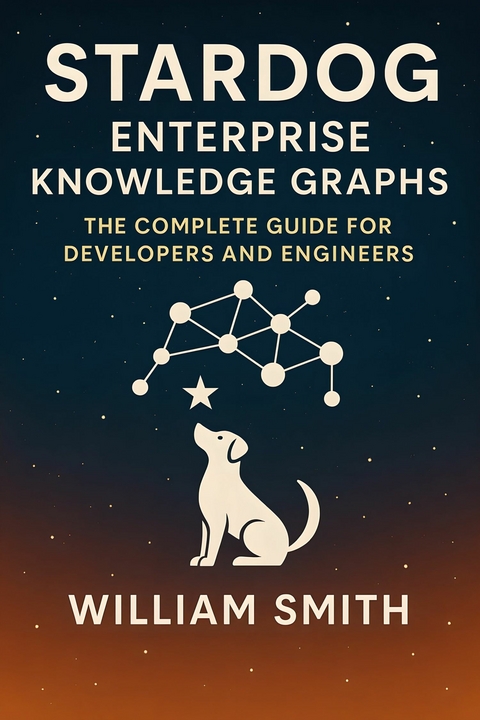
Stardog Enterprise Knowledge Graphs (eBook)
250 Seiten
HiTeX Press (Verlag)
978-0-00-102359-8 (ISBN)
'Stardog Enterprise Knowledge Graphs'
'Stardog Enterprise Knowledge Graphs' is a definitive guide for architects, engineers, and data professionals seeking to understand and deploy knowledge graphs at scale within the enterprise. Beginning with essential principles of semantic data and knowledge representation, the book provides a comprehensive overview of how knowledge graphs drive value by enabling advanced integration, analytics, and business insights. Readers are introduced to foundational industry standards, robust data modeling techniques, and best practices for architecting flexible, reusable semantic schemas and ontologies.
The book expertly navigates the technical landscape of the Stardog platform, uncovering its core architecture, high-availability strategies, enterprise-grade security, and nuanced identity management. Practical guidance is provided on deploying Stardog in complex environments-whether on-premises, in the cloud, or hybrid-alongside advanced topics in data governance, compliance, and lifecycle management for sensitive and regulated industries. Readers will find in-depth discussions on ontology engineering, schema lifecycle management, SHACL-driven validation, and the art of semantic alignment and inference.
Beyond the foundations, 'Stardog Enterprise Knowledge Graphs' bridges operational excellence with innovation. Detailed coverage is given to DevOps practices, CI/CD for knowledge graph pipelines, high-performance data integration, federated querying across diverse data sources, and extending Stardog to integrate with modern enterprise stacks, AI/ML workflows, and automation platforms. The final sections illuminate cutting-edge use cases, including semantic data fabrics, data mesh strategies, digital twins, and conversational AI, rounding off with a forward-looking view of emerging standards and the evolving future of enterprise knowledge graphs. This book stands as an invaluable resource for organizations determined to harness the full power of semantic technologies and Stardog in their digital transformation journey.
Chapter 1
Enterprise Knowledge Graph Fundamentals
How do organizations transform vast, siloed data landscapes into actionable intelligence? This chapter explores the foundations of enterprise knowledge graphs-the dynamic architecture that maps context, meaning, and relationships across disparate business information. Journey from core semantic concepts to enterprise-ready graph deployments, and discover why knowledge graphs are transforming the future of enterprise data strategy.
1.1 Semantic Data: Concepts and Principles
The foundation of semantic data lies in the recognition that data alone, devoid of context and interpretation, is insufficient for sophisticated information processing. Semantic data extends beyond raw values or syntactic structures to embody meaning that can be systematically understood and manipulated by computational systems. Central to this framework is the use of graph-based structures, formal ontologies, and rigorous semantic formalisms that together facilitate the creation of intelligent data systems.
Graphs form the most natural and flexible representation for semantic data. A graph is formally defined as a pair G = (V,E), where V is a set of vertices (or nodes), and E ⊆ V × V is a set of edges (or arcs) representing relationships among those vertices. In the context of semantic data, V corresponds to entities or concepts, while E encodes the relationships or associations between them. Unlike tabular or tree-structured data, graphs inherently support multivariate, heterogeneous, and non-hierarchical relationships, enabling rich interconnections without predefined schema rigidity.
A key distinction is drawn between data and knowledge. Data is often viewed as raw symbols or measurements, lacking intrinsic interpretive frameworks. Knowledge, in contrast, integrates this data within structured conceptual frameworks enriched by semantics, enabling inference and reasoning. Semantic data, by design, bridges this gap by embodying data within a knowledge representation system, such that implicit information can be explicitly extracted. This transformation depends critically on the availability of ontologies-formal specifications that define domain concepts, properties, and the constraints governing their use.
Ontologies serve as the cornerstone for imbuing data with explicit meaning. Formally, an ontology can be described as a tuple
where
- C denotes a set of classes (concepts),
- R a set of relationships or properties linking concepts,
- A axioms defining constraints or rules, and
- I a set of individuals (instances).
By rigorously specifying this vocabulary and its interrelations, ontologies render the semantics of data machine-interpretable. This enables applications to perform logical inference, consistency checking, and semantic querying. Ontology languages such as the Web Ontology Language (OWL) employ Description Logics foundations to balance expressive power with computational tractability.
Knowledge representation, in this context, is the discipline concerned with how to formalize and encode relevant information and its meaning. It embraces formalisms such as triples in the Resource Description Framework (RDF), where statements are structured as (subject, predicate, object), corresponding naturally to edges in a graph. These triples express atomic facts, which collectively build complex knowledge graphs. Formal semantics assigns precise meaning to these statements, grounding them in model-theoretic interpretations that support sound reasoning processes. The interplay between syntax (data encoding), semantics (meaning), and pragmatics (use and context) forms a triadic framework essential for semantic data systems.
An indispensable aspect of semantic data is the role of connections-the relational links that contextualize individual concepts within a broader framework. Without connections, isolated data points cannot support emergent understanding. Connections enable traversal, aggregation, and pattern detection that underpin advanced analytic and reasoning tasks. Furthermore, context enriches these connections by situating them within temporal, spatial, or domain-specific parameters, elucidating the circumstances under which data is valid or relevant. Semantic technologies capture context through provenance metadata, temporal annotations, or situational qualifiers, thereby enhancing interpretability and trustworthiness.
Metadata-data describing other data-serves as a pivotal mechanism for encoding supplementary information about provenance, quality, and usage policies. In semantic systems, metadata itself is represented semantically, often linked hierarchically or associatively with core data entities. This explicit representation enables meta-reasoning: systems can reason about their own data management, enforce access controls based on provenance, or adapt processing according to quality indicators. Metadata thus transcends passive documentation and becomes an active participant in semantic interpretation.
Formal semantics underpinning semantic data ensure that the specified meaning is unambiguous and computationally actionable. Model-theoretic semantics, commonly employed in description logics and RDF Schema, provide denotational frameworks that relate syntactic expressions to elements in abstract domains. These semantics guarantee that reasoning engines derive conclusions consistent with interpretations, supporting tasks such as subsumption checking, satisfiability, and query answering. This rigor is indispensable for avoiding logical inconsistencies and enabling scalable interoperability among heterogeneous data sources.
Semantic data integrates the structural flexibility of graphs, the interpretive precision of ontologies, and the inferential power of formal semantics to embody meaning explicitly. Knowledge representation formalizes concepts and relationships, while connections, context, and metadata enhance the data’s relevance and reliability. Together, these principles facilitate intelligent systems capable of interpreting, reasoning about, and acting upon complex information in dynamic environments.
1.2 Role of Knowledge Graphs in the Enterprise
Enterprises face a complex array of challenges arising from data silos, heterogeneous systems, and rapidly evolving market conditions. Knowledge graphs (KGs) offer a transformative approach by representing entities and their intricate interrelationships explicitly. This semantic foundation underpins unique business drivers that motivate large-scale adoption of knowledge graph technologies.
A primary driver is the imperative for comprehensive cross-domain integration. Modern organizations operate diverse functions—finance, supply chain, customer relations, R&D, compliance—often managed by disparate legacy systems and data repositories. Traditional integration techniques rely on rigid schemas and one-to-one mappings that fail to capture the nuanced connections across domains. Knowledge graphs, by contrast, use flexible ontologies and standardized semantic vocabularies to unify heterogeneous data sources into a single coherent model. This harmonization enables seamless querying, navigation, and contextualization of enterprise information. For example, a global manufacturing company may link product design data with supplier quality records, regulatory requirements, and customer feedback within a knowledge graph, enabling root-cause analysis of quality issues that spans multiple departments. Such cross-functional visibility would be prohibitively complex with conventional relational or document-centric methods.
Another significant motivator is the acceleration of advanced analytics and machine learning workflows. Knowledge graphs enrich raw data with rich contextual metadata and explicitly expressed relationships, which serve as a powerful substrate for graph analytics, reasoning, and inferencing. Graph embeddings derived from KGs can enhance predictive models by incorporating domain knowledge and relational patterns. For instance, financial institutions utilize knowledge graphs to detect fraud by analyzing anomalous connections between accounts, transactions, and entities that are obscured in tabular data alone. In pharmaceutical research, integrating gene-protein-disease relationships within a genomic knowledge graph expedites drug target discovery by facilitating hypothesis generation across multiple biological layers. By embedding domain semantics into analytic pipelines, knowledge graphs reduce the need for manual feature engineering and foster explainable AI outputs.
The increasing complexity of regulatory landscapes catalyzes another vital use case: streamlining compliance management. Regulations such as GDPR, HIPAA, or Sarbanes-Oxley impose stringent rules on data usage, provenance, and reporting obligations. Knowledge graphs readily model compliance frameworks by codifying policies, data lineage, consent records, and audit trails as...
| Erscheint lt. Verlag | 19.8.2025 |
|---|---|
| Sprache | englisch |
| Themenwelt | Mathematik / Informatik ► Informatik ► Programmiersprachen / -werkzeuge |
| ISBN-10 | 0-00-102359-4 / 0001023594 |
| ISBN-13 | 978-0-00-102359-8 / 9780001023598 |
| Informationen gemäß Produktsicherheitsverordnung (GPSR) | |
| Haben Sie eine Frage zum Produkt? |
 EPUB (Adobe DRM)
Größe: 980 KB
Kopierschutz: Adobe-DRM
Adobe-DRM ist ein Kopierschutz, der das eBook vor Mißbrauch schützen soll. Dabei wird das eBook bereits beim Download auf Ihre persönliche Adobe-ID autorisiert. Lesen können Sie das eBook dann nur auf den Geräten, welche ebenfalls auf Ihre Adobe-ID registriert sind.
Details zum Adobe-DRM
Dateiformat: EPUB (Electronic Publication)
EPUB ist ein offener Standard für eBooks und eignet sich besonders zur Darstellung von Belletristik und Sachbüchern. Der Fließtext wird dynamisch an die Display- und Schriftgröße angepasst. Auch für mobile Lesegeräte ist EPUB daher gut geeignet.
Systemvoraussetzungen:
PC/Mac: Mit einem PC oder Mac können Sie dieses eBook lesen. Sie benötigen eine
eReader: Dieses eBook kann mit (fast) allen eBook-Readern gelesen werden. Mit dem amazon-Kindle ist es aber nicht kompatibel.
Smartphone/Tablet: Egal ob Apple oder Android, dieses eBook können Sie lesen. Sie benötigen eine
Geräteliste und zusätzliche Hinweise
Buying eBooks from abroad
For tax law reasons we can sell eBooks just within Germany and Switzerland. Regrettably we cannot fulfill eBook-orders from other countries.
aus dem Bereich


