


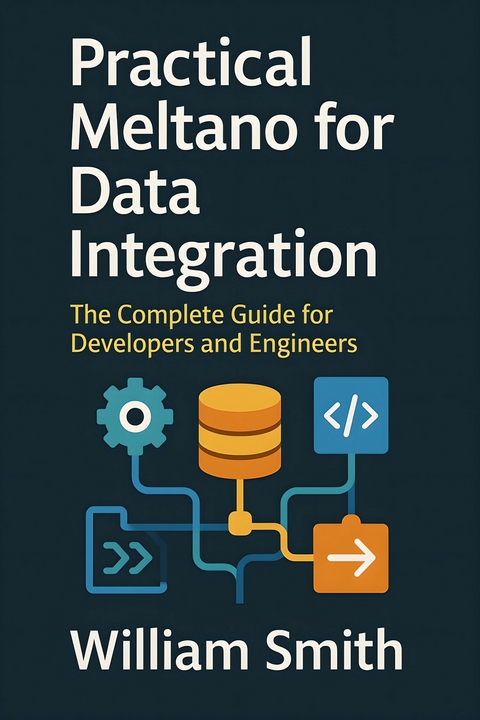
Practical Meltano for Data Integration (eBook)
250 Seiten
HiTeX Press (Verlag)
978-0-00-102358-1 (ISBN)
'Practical Meltano for Data Integration'
'Practical Meltano for Data Integration' offers a comprehensive, hands-on guide to mastering modern data integration using the open-source Meltano platform. With a clear-eyed exploration of data integration challenges-such as siloed data sources, latency, and rapidly evolving architectures-the book grounds the reader in the core tenets of ELT versus ETL and demonstrates how Meltano, leveraging the Singer specification, rises to meet the rigorous needs of enterprise data teams. Through detailed analyses of Meltano's architecture, project structuring, and best practices, the book equips professionals with the knowledge needed to architect scalable, maintainable, and collaborative data pipelines.
Covering advanced extraction with TAPs, robust data loading with TARGETs, and end-to-end pipeline orchestration, the book guides the reader through every phase of the data lifecycle. Rich technical discussions illuminate how to engineer custom components, from authentication and error handling in TAPs to sophisticated schema evolution and performance tuning in TARGETs. The orchestration chapters navigate scheduling, dependencies, and resilience, while practical integration with dbt and industry-standard orchestrators like Airflow and Prefect ensures seamless transformation and workflow management across heterogeneous environments.
Beyond technical implementation, 'Practical Meltano for Data Integration' addresses critical aspects such as containerization, cloud deployment, security, governance, and monitoring-empowering practitioners to deliver reliable and auditable data systems at scale. Real-world case studies, operational lessons, and future-oriented chapters on data mesh, streaming, and the evolving Meltano ecosystem provide lasting insight. Whether you are building your organization's first Meltano pipeline or scaling mission-critical data platforms, this book is an indispensable resource for data engineers, architects, and analytics leaders seeking to leverage the full potential of modern ELT.
Chapter 1
Data Integration Principles and Meltano Fundamentals
In a world driven by relentless data growth and ever-evolving sources, mastering data integration is no longer optional-it’s essential to driving analytics, automation, and innovation at any scale. This chapter sets the stage with a rigorous exploration of the systemic challenges and paradigm shifts defining modern data architecture, then reveals how Meltano’s open core, modular design, and strong open-source practices can elegantly transform complexity into maintainable, adaptable pipelines. Whether you’re evaluating Meltano for enterprise adoption or aiming to deepen your technical roots, this foundational chapter bridges concepts with actionable strategies.
1.1 Modern Data Integration Challenges
Data integration in contemporary enterprises presents a complex matrix of challenges stemming from the exponential growth of data sources, increasing heterogeneity, and the evolving technical landscape. At its core, the aggregation and harmonization of data from disparate, siloed systems confront obstacles that are both technical and organizational, requiring nuanced strategies beyond conventional methodologies.
One fundamental challenge is the volume and velocity of data generated across business units and third-party platforms. Modern systems, including IoT devices, social media feeds, and transactional databases, produce data in volumes and at speeds that overwhelm traditional extract-transform-load (ETL) pipelines designed for batch processing. For example, real-time analytics platforms necessitate near-instantaneous ingestion and processing of streaming data, rendering legacy batch-oriented approaches inefficient. This evolution demands architectures capable of elastic scaling and real-time data handling, such as event-driven microservices and stream processing frameworks, which fundamentally alter the integration paradigm.
Concurrent with volume and velocity issues is the phenomenon of schema drift-continuous, often uncoordinated changes in data schemas across source systems. Schema drift complicates the integration process by causing frequent mismatches between source data structures and consolidated targets. Such mismatches may lead to data loss, misinterpretation, or pipeline failures. Traditional schema-on-write approaches are brittle under these circumstances, whereas schema-on-read strategies utilized in modern data lakes provide greater flexibility but shift complexity downstream to data consumers, necessitating sophisticated metadata management and adaptive parsing algorithms.
Security and compliance requirements increasingly govern data integration practices due to heightened regulatory scrutiny, such as GDPR, HIPAA, and CCPA. Integrating data across domains requires ensuring proper access controls, encryption, and auditability throughout the data lifecycle. Complexities arise when data is moved from on-premises silos to multi-cloud environments or shared with external partners, necessitating federated identity management and dynamic policy enforcement. Legacy systems often lack the native capabilities to support such governance demands, thus impeding seamless and compliant data integration without extensive middleware or bespoke solutions.
Data quality assurance stands as a crucial pillar in effective integration, as the reliability of consolidated data directly influences operational decisions and analytical outcomes. Integrating heterogeneous sources exacerbates inconsistencies in completeness, accuracy, timeliness, and validity. Traditional manual or semi-automated cleansing techniques struggle to scale under the velocity and variety of modern datasets. Emerging integration frameworks incorporate advanced profiling, anomaly detection, and AI-driven cleansing methodologies to mitigate data quality degradation. For instance, automated tagging of anomalous records during real-time ingestion enables early detection of data integrity issues, facilitating proactive resolution.
Latency minimization is another imperative, particularly in scenarios requiring up-to-the-second insights, such as fraud detection or dynamic pricing. Integrations must be architected to reduce end-to-end delays spanning data extraction, transformation, transmission, and loading. Approaches leveraging in-memory computing, change data capture (CDC), and distributed messaging systems such as Apache Kafka have become essential. By capturing incremental changes and streaming updates continuously, these technologies reduce the synchronization lag that traditional batch ETL processes incur. However, the implementation of such low-latency systems introduces complexity in maintaining consistency and fault tolerance across distributed components.
The pervasive adoption of cloud-native architectures further compounds integration challenges but also offers novel solutions. Cloud-native platforms embrace containerization, orchestration, and serverless functions, enabling modular, scalable, and resilient integration pipelines. Nonetheless, organizations transitioning from monolithic or on-premises systems face difficulties in refactoring existing data flows to fit ephemeral, stateless execution models. Data gravity within cloud environments sometimes necessitates hybrid integration techniques combining edge processing, data mesh architectures, and distributed governance to balance flexibility with control. Moreover, multi-cloud strategies introduce additional complexity in ensuring data interoperability and unified metadata management across heterogeneous environments.
Traditional data integration solutions often falter in these modern contexts due to their rigid design assumptions. For example, legacy ETL tools predicated on fixed schemas and scheduled batch windows struggle with the dynamism and scale of real-time, schema-flexible data. Similarly, point-to-point integration approaches become brittle and unmanageable as the number of sources proliferate. The shift towards centralized data warehouses is also being challenged by decentralized paradigms such as data fabrics and data meshes, which distribute responsibility for data products across domains, demanding more federated integration capabilities.
In practice, organizations encountering these challenges may observe integration failures manifest as delayed reporting, data inconsistencies, security vulnerabilities, or inability to comply with data regulations. Consider a multinational financial institution aggregating transactional data from regional banking systems. The rapid introduction of new products and regional regulatory changes causes frequent schema updates, while regulatory requirements mandate strict encryption and audit trail preservation. Traditional integration pipelines built on rigid batch workflows and static schemas often fail to keep pace, resulting in compliance risks and operational disruptions. Modern solutions leverage continuous data ingestion with adaptive schema validation, encryption-at-rest and in-transit, and automated auditing mechanisms to address these issues effectively.
Addressing modern data integration challenges thus requires a holistic approach encompassing scalable architecture design, flexible schema handling, robust security and governance frameworks, advanced data quality tools, and latency-conscious processing strategies, all adapted to the realities of cloud-native environments. Without such adaptations, organizations risk underutilizing their data assets and impeding their digital transformation initiatives.
1.2 ELT versus ETL: Paradigm Shifts
The Extract-Transform-Load (ETL) paradigm has long been the backbone of data integration workflows, originating from an era dominated by on-premises data warehouses with limited computational resources. Traditional ETL pipelines emphasize extracting data from source systems, applying comprehensive transformations in dedicated extract-transform servers or appliance layers, and subsequently loading the cleansed, integrated data into analytic repositories. This approach was engineered to optimize query performance and data quality by pre-processing data before it reached the warehouse, thereby minimizing computational overhead upon query execution.
The advent of scalable, high-performance analytics platforms and the migration to cloud-native data warehousing precipitated a fundamental re-evaluation of this sequence, birthing the Extract-Load-Transform (ELT) paradigm. ELT inverts the ETL process by prioritizing the ingestion of raw or minimally processed data directly into the data lake or cloud data warehouse, deferring transformation steps until after loading. This shift leverages the elastic compute power and storage separation characteristic of modern analytic platforms, especially those based on massively parallel processing (MPP) engines and distributed file systems. Consequently, ELT facilitates more agile, iterative, and analytics-driven workflows by enabling transformations to be executed on demand within the data warehouse environment itself.
Historically, ETL was constrained by the performance bottlenecks of the transformation layer, often requiring specialized ETL engines or middleware. Data transformation enforced before loading was advantageous because data warehouses lacked the processing agility to handle raw, heterogeneous data formats or...
| Erscheint lt. Verlag | 19.8.2025 |
|---|---|
| Sprache | englisch |
| Themenwelt | Mathematik / Informatik ► Informatik ► Programmiersprachen / -werkzeuge |
| ISBN-10 | 0-00-102358-6 / 0001023586 |
| ISBN-13 | 978-0-00-102358-1 / 9780001023581 |
| Informationen gemäß Produktsicherheitsverordnung (GPSR) | |
| Haben Sie eine Frage zum Produkt? |
 EPUB (Adobe DRM)
Größe: 558 KB
Kopierschutz: Adobe-DRM
Adobe-DRM ist ein Kopierschutz, der das eBook vor Mißbrauch schützen soll. Dabei wird das eBook bereits beim Download auf Ihre persönliche Adobe-ID autorisiert. Lesen können Sie das eBook dann nur auf den Geräten, welche ebenfalls auf Ihre Adobe-ID registriert sind.
Details zum Adobe-DRM
Dateiformat: EPUB (Electronic Publication)
EPUB ist ein offener Standard für eBooks und eignet sich besonders zur Darstellung von Belletristik und Sachbüchern. Der Fließtext wird dynamisch an die Display- und Schriftgröße angepasst. Auch für mobile Lesegeräte ist EPUB daher gut geeignet.
Systemvoraussetzungen:
PC/Mac: Mit einem PC oder Mac können Sie dieses eBook lesen. Sie benötigen eine
eReader: Dieses eBook kann mit (fast) allen eBook-Readern gelesen werden. Mit dem amazon-Kindle ist es aber nicht kompatibel.
Smartphone/Tablet: Egal ob Apple oder Android, dieses eBook können Sie lesen. Sie benötigen eine
Geräteliste und zusätzliche Hinweise
Buying eBooks from abroad
For tax law reasons we can sell eBooks just within Germany and Switzerland. Regrettably we cannot fulfill eBook-orders from other countries.
aus dem Bereich


