


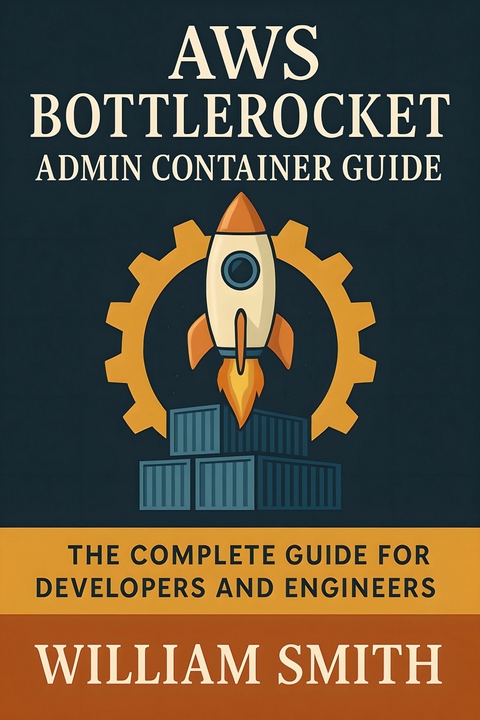
AWS Bottlerocket Admin Container Guide (eBook)
250 Seiten
HiTeX Press (Verlag)
978-0-00-102350-5 (ISBN)
'AWS Bottlerocket Admin Container Guide'
The **AWS Bottlerocket Admin Container Guide** is a definitive resource for cloud professionals seeking to master the management, security, and automation of AWS Bottlerocket OS environments using the admin container pattern. This guide offers a comprehensive exploration of Bottlerocket's architecture, emphasizing its immutable design, secure-by-default configuration, and the unique role played by the ephemeral admin container. With detailed comparisons to traditional host management paradigms, readers gain essential context around Bottlerocket's modern approach to minimizing attack surface and streamlining operational workflows.
Every aspect of provisioning, hardening, and accessing the admin container is covered with technical precision, from bootstrapping methods and IAM integration to fine-grained session isolation, logging, and advanced access control mechanisms. Dedicated chapters walk through security architecture, hardening strategies, and the integration of secrets management and auditing, providing readers with actionable best practices for meeting stringent compliance and security standards. Deep operations topics-including diagnostics, forensic investigations, and performance profiling-empower platform engineers to troubleshoot, remediate, and optimize Bottlerocket hosts with confidence.
In addition to robust operational guidance, this book addresses fleet-scale workflow automation, custom admin image creation, and advanced monitoring pipelines. Guidance extends to enterprise and hybrid-cloud integrations, compliance automation, and endpoint security agent deployment. The guide candidly reviews operational pitfalls, secure supply chain practices, and emerging trends in immutable infrastructure, concluding with practical advice for engaging with the Bottlerocket community. Whether you are building robust container platforms or managing large-scale Kubernetes and ECS fleets, this guide is your essential companion for secure and efficient admin container operations in AWS Bottlerocket environments.
Chapter 1
Introduction to AWS Bottlerocket and the Admin Container
Bottlerocket reimagines cloud-native OS design with an emphasis on security, immutability, and high-scale automation. This chapter explores the core tenets and architectural choices behind Bottlerocket and its innovative admin container. Understanding these foundations sheds light on why Bottlerocket is quickly becoming the preferred operating system for orchestrated container infrastructure-and equips you to harness its power securely and efficiently.
1.1 Bottlerocket OS Architecture Overview
Bottlerocket represents a paradigm shift in operating system design tailored specifically for containerized environments, diverging notably from traditional Linux distributions. Central to its architectural philosophy is the adoption of an immutable root filesystem, coupled with an atomic update mechanism, both engineered to streamline operations and enhance system reliability in large-scale container deployments.
At the foundation of Bottlerocket’s design is the immutable root filesystem, which is a read-only image encompassing all core system binaries, libraries, and configurations. Unlike conventional Linux distributions where the root filesystem is mutable and susceptible to configuration drift, Bottlerocket’s approach enforces a static baseline system. This immutable layer ensures that local system state changes occur only in designated writable partitions, typically limited to container runtime state and ephemeral data. Such strict separation minimizes unintended modifications, reduces configuration inconsistencies, and simplifies compliance verification, yielding enhanced operational predictability.
The atomic update mechanism in Bottlerocket is intricately tied to its immutable filesystem. Updates are delivered as complete, signed filesystem images that replace the entire root partition in a transactional manner. This design contrasts markedly with traditional package managers that apply incremental changes to installed files, which can be error-prone and leave the system in partially updated states. With Bottlerocket, the update process involves downloading a new root filesystem image, mounting it alongside the existing one to verify integrity, and then swapping the system boot target to the new image in a subsequent reboot. This guarantees that the system either boots into a fully updated, consistent state or reverts seamlessly to a previous working version, effectively eliminating half-applied updates and reducing downtime.
A critical aspect of Bottlerocket’s reduced complexity stems from its minimization of moving parts in the operating system. The OS intentionally avoids including unnecessary services, daemons, and package managers that are typical in desktop or general-purpose Linux distributions. Instead, Bottlerocket is purpose-built with a minimal set of components optimized for running container workloads: primarily the container runtime (such as containerd), a small init system, and a control plane agent responsible for system lifecycle events and update orchestration. Absent are common Linux utilities and shells, which are replaced by containerized management tools executed externally. This lean approach substantially decreases the OS’s runtime overhead and limits the potential vectors for errors and security vulnerabilities.
The design principle of minimizing the attack surface is embedded throughout Bottlerocket’s architecture. By reducing the number of included packages and services, the OS inherently lowers the quantity of exploitable software components, thereby reducing the overall attack surface of the host. The immutable root filesystem guards against unauthorized or unintended modifications to system binaries, further enforcing system integrity. Moreover, the update mechanism leverages cryptographic signing and verification of images to prevent tampering and to ensure authenticity and integrity of software delivered to the nodes.
Integration with container orchestration platforms, especially Kubernetes, is another architectural cornerstone. Bottlerocket includes a specialized control agent that interfaces with the Kubernetes API server, listening for update commands and lifecycle instructions. This enables cluster operators to declaratively manage host operating system updates using native Kubernetes tools, facilitating seamless integration into existing DevOps pipelines and infrastructure-as-code frameworks. The atomic update capability supports the orchestration of rolling OS updates with minimal disruption to the container workloads, directly addressing the challenges of maintaining a large fleet of host nodes.
By departing from the traditional Linux distribution model, Bottlerocket eliminates many sources of operational friction inherent in mutable, package-based systems. Its immutable image-based approach provides an auditable, reproducible host environment that can be rapidly updated and rolled back. The minimal trusted computing base and the shrinkage of runtime complexity foster a more secure platform that aligns with the principle of least privilege, critical for multi-tenant container deployments.
This architectural philosophy enables Bottlerocket to act as a specialized host OS that is both robust and scalable. Its focus on delivering a stable, consistent, and secure foundation throughout vast clusters makes it ideal for orchestrated environments demanding high availability and predictable behavior. The combination of immutability, atomic updates, reduced components, and minimized attack surfaces collectively enhances operational confidence, security posture, and manageability in container-centric infrastructure.
1.2 Role and Purpose of the Admin Container
In Bottlerocket’s architectural model, the design philosophy deliberately excludes direct shell access on host instances, a marked departure from traditional operating systems. This elimination of conventional root access is a foundational security measure aimed at minimizing the host’s attack surface, reducing the potential for persistent compromise, and promoting immutable infrastructure principles. The exclusion fundamentally addresses risks associated with interactive logins, including privilege escalation, lateral movement, and unauthorized modification of system components.
The admin container emerges as a critical construct to reconcile the need for host-level diagnostics and management with stringent security imperatives. Instead of exposing a persistent shell session directly on the host, Bottlerocket encapsulates administrative capabilities within a containerized environment that runs with ephemeral lifetimes, scoped permissions, and tightly controlled network and filesystem access. This container is orchestrated independently and can be spawned on demand, providing a controlled interface for operational tasks without undermining the host’s integrity.
From a security perspective, the admin container operates with a minimal attack surface. Its ephemeral nature means that any changes made inside the container do not persist across reboots, effectively restoring a known-good state and mitigating the risk of configuration drift or malware persistence. Furthermore, by containerizing administrative utilities and shells, Bottlerocket leverages container isolation boundaries enforced by the underlying kernel, kernel namespaces, and cgroups, which constrict the possible impact of compromised or misused administrative processes. Access control policies bind the administrative container’s operations to explicit, auditable channels, reducing reliance on generalized, all-powerful root access credentials.
Operational agility is enhanced by this model in several dimensions. First, administrators gain flexible access to diagnostic tools and command-line interfaces as required, without permanently exposing interactive shells. This approach supports real-time troubleshooting and configuration adjustments without incurring the risks traditionally associated with enabling root SSH or serial console access. Second, the admin container concept aligns with cloud-native paradigms, allowing automation systems to invoke management workflows programmatically by launching ephemeral containers under controlled conditions, rather than depending on manual intervention or static credentials. Third, containerized administrative sessions can be instrumented with logging and monitoring hooks, capturing fine-grained activity trails that comply with compliance and auditing requirements.
The elimination of direct shell access on the host also harmonizes Bottlerocket with minimalistic and specialized OS design approaches, where each system component is narrowly scoped and hardened. The admin container essentially acts as the sole gateway to perform exceptional or maintenance operations that cannot be automated or handled exclusively via APIs or declarative configurations. This encourages architectural discipline by prompting teams to codify routine operational tasks into automated processes rather than ephemeral manual fixes, concurrently fostering repeatability and reducing human error.
The admin container typically includes essential debugging and system analysis tools tailored to...
| Erscheint lt. Verlag | 19.8.2025 |
|---|---|
| Sprache | englisch |
| Themenwelt | Mathematik / Informatik ► Informatik ► Programmiersprachen / -werkzeuge |
| ISBN-10 | 0-00-102350-0 / 0001023500 |
| ISBN-13 | 978-0-00-102350-5 / 9780001023505 |
| Informationen gemäß Produktsicherheitsverordnung (GPSR) | |
| Haben Sie eine Frage zum Produkt? |
 EPUB (Adobe DRM)
Größe: 872 KB
Kopierschutz: Adobe-DRM
Adobe-DRM ist ein Kopierschutz, der das eBook vor Mißbrauch schützen soll. Dabei wird das eBook bereits beim Download auf Ihre persönliche Adobe-ID autorisiert. Lesen können Sie das eBook dann nur auf den Geräten, welche ebenfalls auf Ihre Adobe-ID registriert sind.
Details zum Adobe-DRM
Dateiformat: EPUB (Electronic Publication)
EPUB ist ein offener Standard für eBooks und eignet sich besonders zur Darstellung von Belletristik und Sachbüchern. Der Fließtext wird dynamisch an die Display- und Schriftgröße angepasst. Auch für mobile Lesegeräte ist EPUB daher gut geeignet.
Systemvoraussetzungen:
PC/Mac: Mit einem PC oder Mac können Sie dieses eBook lesen. Sie benötigen eine
eReader: Dieses eBook kann mit (fast) allen eBook-Readern gelesen werden. Mit dem amazon-Kindle ist es aber nicht kompatibel.
Smartphone/Tablet: Egal ob Apple oder Android, dieses eBook können Sie lesen. Sie benötigen eine
Geräteliste und zusätzliche Hinweise
Buying eBooks from abroad
For tax law reasons we can sell eBooks just within Germany and Switzerland. Regrettably we cannot fulfill eBook-orders from other countries.
aus dem Bereich


