


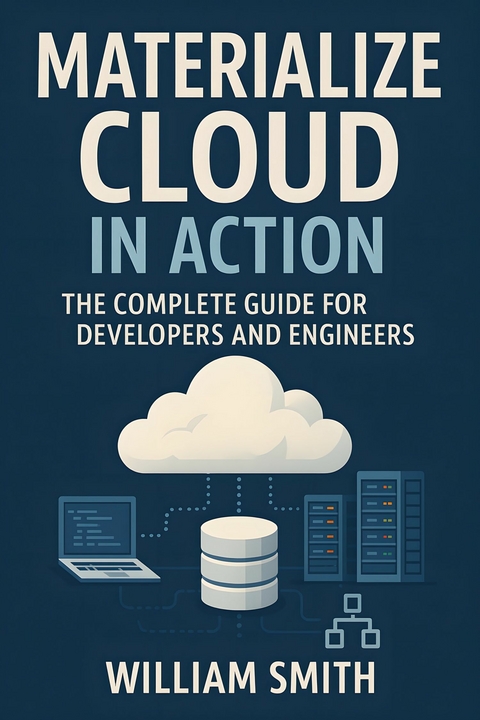
Materialize Cloud in Action (eBook)
250 Seiten
HiTeX Press (Verlag)
978-0-00-102332-1 (ISBN)
'Materialize Cloud in Action'
'Materialize Cloud in Action' is the definitive guide for architects, engineers, and data professionals embracing the future of real-time analytics with cloud-native streaming SQL. Drawing from Materialize's innovative architecture, this comprehensive resource unpacks how decoupled compute and storage, multi-version concurrency control, and robust security combine to deliver consistent, scalable analytics on live data. Readers will find both theoretical foundations and hands-on insights into orchestrating Materialize in managed infrastructures, leveraging the expressiveness of SQL over unbounded streams, and mastering deployment, monitoring, and isolation best practices.
The book expertly navigates the end-to-end pipeline of real-time data integration, from connector setup for Kafka, S3, and CDC sources to advanced query design over continuous event streams. With detailed explorations of schema evolution, state management, and operational analytics, it serves as both a field manual and a design handbook. Critical topics such as autoscaling, high availability, governance, compliance, and disaster recovery are addressed with clarity and pragmatism, ensuring data teams can scale securely and cost-efficiently in production environments.
Bringing practical use cases to the forefront, 'Materialize Cloud in Action' illustrates operational patterns across SaaS, B2B analytics, IoT, personalization engines, and legacy system modernization, complemented by in-depth industry case studies. The closing chapters empower readers to troubleshoot and optimize complex deployments, embrace DevOps and CI/CD integration, and stay ahead of the curve as Materialize and streaming SQL shape the future of real-time data on the cloud. Whether deploying mission-critical pipelines or exploring emerging patterns, this book is an essential companion for thriving in the evolving landscape of cloud data infrastructure.
Chapter 2
Source Ingestion and Data Integration
Data flows are the lifeblood of modern analytics, but harnessing the torrent of real-time events from diverse sources requires finesse and deep architectural insight. In this chapter, discover how Materialize Cloud connects seamlessly to enterprise data streams, gracefully adapts to evolving schemas, and provides the plumbing for robust end-to-end integration in even the most demanding environments. Explore how data of all shapes, rates, and complexities becomes actionable-fueling live analytics and automation at scale.
2.1 Connectors: Streaming Data from Kafka, S3, and Beyond
Source connectors serve as the foundational components that enable Materialize to ingest live data streams from diverse systems such as Kafka, Amazon S3, and other external sources. These connectors implement efficient, protocol-aware mechanisms that transform data at ingestion time and maintain precise consistency guarantees throughout the streaming pipeline.
Kafka Source Connectors
Kafka stands as a ubiquitous streaming platform featuring partitioned logs with ordered, immutable event sequences. Materialize utilizes Kafka’s consumer protocol to leverage this partitioned log abstraction for parallelized data ingestion. Each Kafka topic partition maps directly to a Materialize source partition, preserving Kafka’s inherent ordering semantics within the partition and enabling scalable, distributed state maintenance across workers.
The connector’s configuration involves specifying bootstrap servers, topic patterns or explicit topic lists, consumer group IDs, and optional security credentials such as TLS or SASL parameters. Materialize’s Kafka connector supports consuming from the earliest or latest offset and allows precise offset control to enable replay or catch-up scenarios.
Offset Management and Semantics
Materialize maintains a checkpointed offset for each Kafka partition, committing these offsets atomically with the progress of streaming views to ensure fault tolerance. This integration achieves at-least-once delivery semantics when auto-committing offsets, as messages may be processed multiple times upon failure recovery, but never lost.
To approach exactly-once processing, Materialize employs idempotent and deterministic transformations, avoiding side effects and external state mutations during ingestion and view computation. The combination of transactional offset commits and replayable computation guarantees strong consistency, even in the face of process restarts.
Partitioning and Parallelism
Materialize relies on Kafka’s partitioned architecture for concurrency. Incoming partitions are distributed among Materialize workers, with each worker responsible for processing updates from assigned partitions. This design preserves partition-level ordering and maximizes parallelism, ensuring low-latency ingestion and efficient resource utilization.
Advanced configuration options permit fine-tuning of batch sizes, poll intervals, and queueing thresholds to balance throughput and latency based on workload characteristics. Furthermore, Kafka’s support for topic compaction enables efficient ingestion of changelog streams by retaining only the latest state per key.
S3 Source Connectors
Ingesting data from object storage presents distinct technical challenges relative to streaming systems like Kafka. Amazon S3 and compatible stores are inherently eventually consistent and operate on immutable objects rather than append-only logs. Materialize handles these characteristics by implementing connectors that monitor object state and ingest data incrementally through formats such as Parquet or Avro.
The connector periodically scans configured bucket prefixes, detecting new or updated objects via metadata polling or integration with event notification services such as AWS SNS/SQS or EventBridge. Objects are then ingested as bounded batches, parsed, and converted into streaming updates within Materialize.
Checkpointing and Offset Semantics
Unlike continuous logs, object stores require carefully engineered offset semantics based on object versions, keys, or timestamps. Materialize tracks ingestion progress by recording the latest ingested object identifiers or modification timestamps, ensuring incremental processing without redundant re-ingestion.
This mechanism inherently provides exactly-once ingestion at the granularity of complete objects under stable versioning assumptions. However, to maintain consistency amid possible object rewrites or overwrite events, the connector must implement conflict detection and reconciliation logic, often by leveraging S3 object versioning.
Performance Considerations
Batch-oriented ingestion from S3 involves higher latency compared to streaming connectors. To mitigate this, Materialize enables configuration of scanning intervals, parallel object fetching, and schema inference caching, optimizing throughput and resource consumption. For large datasets, Materialize supports partition pruning based on predicates and incremental snapshotting, reducing I/O overhead and enabling near-real-time updates.
Extensible Connector Architecture
Beyond Kafka and S3, Materialize’s connector framework is architected for extensibility, accommodating myriad source systems such as file systems, databases, and cloud services. Each connector adheres to a unified ingestion interface, ensuring consistent progress tracking, fault tolerance, and data transformation semantics.
Connectors implement protocol-specific clients that transform native data representations into Materialize’s internal update format, typically differential dataflow inputs. Common connector features include:
- Schema discovery and evolution management, enabling dynamic column handling and type conversions without system downtime.
- Backpressure signaling to align ingestion rate with downstream processing capacity.
- Security integration supporting authentication, encryption, and access control aligned with source protocols.
- Robust error handling and retry logic to tolerate transient network failures and data inconsistencies.
Production-Grade Integration Recommendations
Deploying connectors in production environments demands careful consideration of operational characteristics and reliability guarantees:
- Idempotent and Deterministic Processing: Always design ingestion and transformation logic to be repeatable and side-effect free. This practice enables recovery from failures by simply replaying source data without risking inconsistency or duplication.
- Consistent Offset Checkpointing: Employ atomic checkpoint commits tied closely to Materialize’s transaction boundaries to maintain tight coupling between source progress and view state.
- Fault-Tolerant Networking: Utilize connectors supporting automatic retries with exponential backoff, comprehensive logging, and alerting mechanisms to swiftly detect and resolve ingestion disruptions.
- Load Balancing and Partition Management: Configure Kafka consumer groups and S3 parallelism thoughtfully to balance ingestion load, avoid hot partitions, and maintain high throughput under fluctuating workloads.
- Schema Evolution Handling: Prepare for changing upstream schemas by leveraging Materialize’s flexible schema evolution features and incorporating validation and drift detection in ingestion pipelines.
Through these principles, Materialize connectors provide robust, scalable, and consistent streaming ingestion capabilities, enabling real-time analytics and materialized views over continuously evolving data sources such as Kafka topics, S3 object repositories, and beyond.
2.2 Change Data Capture (CDC) and Relational Sources
Change Data Capture (CDC) serves as the foundational technique to ingest data modifications from Online Transaction Processing (OLTP) systems such as PostgreSQL and MySQL, facilitating near real-time data integration without impact on source system performance. The core principle of CDC is to capture and propagate incremental changes—insertions, updates, and deletions—as they occur in the transactional database, thereby supporting streaming pipelines that maintain consistency with the evolving data state.
Capturing changes from relational sources involves interacting with database transaction logs or utilizing triggers, but modern CDC solutions typically rely on log-based capture to guarantee transactional ordering and non-intrusiveness. In PostgreSQL, this is achieved using logical decoding features, while MySQL relies on binlog (binary log) parsing. Log-based CDC extracts changes directly from the source transaction log, ensuring that the sequence of events respects commit order and atomicity, which is crucial for downstream consistency.
High-volume streaming environments impose strict requirements on...
| Erscheint lt. Verlag | 19.8.2025 |
|---|---|
| Sprache | englisch |
| Themenwelt | Mathematik / Informatik ► Informatik ► Programmiersprachen / -werkzeuge |
| ISBN-10 | 0-00-102332-2 / 0001023322 |
| ISBN-13 | 978-0-00-102332-1 / 9780001023321 |
| Informationen gemäß Produktsicherheitsverordnung (GPSR) | |
| Haben Sie eine Frage zum Produkt? |
 EPUB (Adobe DRM)
Größe: 626 KB
Kopierschutz: Adobe-DRM
Adobe-DRM ist ein Kopierschutz, der das eBook vor Mißbrauch schützen soll. Dabei wird das eBook bereits beim Download auf Ihre persönliche Adobe-ID autorisiert. Lesen können Sie das eBook dann nur auf den Geräten, welche ebenfalls auf Ihre Adobe-ID registriert sind.
Details zum Adobe-DRM
Dateiformat: EPUB (Electronic Publication)
EPUB ist ein offener Standard für eBooks und eignet sich besonders zur Darstellung von Belletristik und Sachbüchern. Der Fließtext wird dynamisch an die Display- und Schriftgröße angepasst. Auch für mobile Lesegeräte ist EPUB daher gut geeignet.
Systemvoraussetzungen:
PC/Mac: Mit einem PC oder Mac können Sie dieses eBook lesen. Sie benötigen eine
eReader: Dieses eBook kann mit (fast) allen eBook-Readern gelesen werden. Mit dem amazon-Kindle ist es aber nicht kompatibel.
Smartphone/Tablet: Egal ob Apple oder Android, dieses eBook können Sie lesen. Sie benötigen eine
Geräteliste und zusätzliche Hinweise
Buying eBooks from abroad
For tax law reasons we can sell eBooks just within Germany and Switzerland. Regrettably we cannot fulfill eBook-orders from other countries.
aus dem Bereich


