


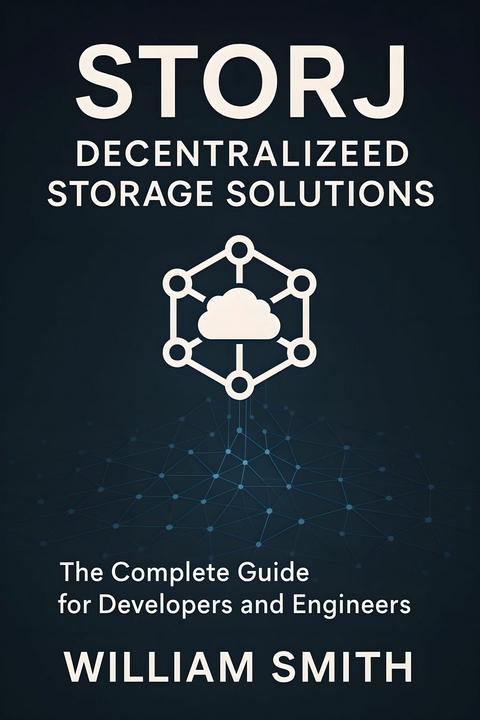
Storj Decentralized Storage Solutions (eBook)
250 Seiten
HiTeX Press (Verlag)
978-0-00-102329-1 (ISBN)
'Storj Decentralized Storage Solutions'
In 'Storj Decentralized Storage Solutions,' readers are expertly guided through the transformative landscape of decentralized cloud storage. The book opens with foundational perspectives, tracing the evolution from traditional centralized models to emerging peer-to-peer architectures, and offering an informed analysis of the core principles, advantages, and trade-offs associated with distributed data environments. Security, privacy, and resilience are examined in-depth, providing a modern understanding of cryptographic safeguards, threat mitigation, and the economic paradigms shaping decentralized storage's future.
The heart of the book delves into the sophisticated architecture of the Storj platform, detailing its protocol design, token-based marketplace, and network operations. Through comprehensive technical discussions-spanning client-side encryption, sharding, erasure coding, metadata services, and adaptive algorithms-readers gain a clear view of how Storj ensures high performance, data integrity, and robust scalability. Practical chapters guide node operators in optimizing infrastructure, managing maintenance at scale, and aligning incentives for healthy ecosystem participation, reinforced by case studies and benchmarking methodologies.
Developers, enterprises, and technology leaders will find actionable insights on integrating Storj into cloud workflows, building secure multi-tenant applications, and bridging decentralized storage with diverse platforms, including IoT and Web3 environments. The book concludes by mapping out future directions, from protocol enhancements and decentralized governance to sustainability, regulatory frameworks, and community-driven innovation-equipping readers with the knowledge to participate in the ongoing evolution of secure, efficient, and open cloud storage.
Chapter 2
Storj Architecture and Protocols
Beneath the surface of everyday cloud storage lies a radical design: Storj dismantles the central data monolith, weaving together a self-healing mesh of globally distributed nodes. In this chapter, you’ll journey through the sophisticated architecture and breakthrough protocols that allow terabytes to be reliably, privately, and economically stored across thousands of untrusted machines. We’ll illuminate the cryptography, economic incentives, and engineering choices that distinguish Storj as a premier decentralized solution.
2.1 Storj Ecosystem Overview
The Storj ecosystem constitutes a decentralized cloud storage network that fundamentally redefines conventional approaches to data storage by leveraging peer-to-peer resources and blockchain-driven incentives. At its core, the network is composed of four principal entities: Satellites, Storage Nodes, Clients, and the STORJ token. Each entity fulfills distinct operational roles while establishing a trust framework that ensures security, reliability, and transparency throughout the storage and retrieval processes.
Satellites: Coordination and Trust Anchors
Satellites function as the control planes within the Storj network. They act as orchestrators, managing metadata, coordinating data movement, auditing node behaviors, and enforcing compliance with network policies. Satellites neither store user data nor maintain any centralized repository of the data chunks. Instead, they maintain cryptographically verifiable records of file storage contracts and retrieval instructions.
From a trust perspective, satellites serve as partially trusted authorities—trusted not with the confidentiality or integrity of the user data itself, but with operational governance. They authenticate Storage Nodes and Clients and facilitate cryptoeconomic mechanisms to incentivize correct behavior. Each Satellite operates independently or as part of a multi-satellite infrastructure, enabling redundancy and mitigating single points of failure.
Storage Nodes: Distributed Data Custodians
Storage Nodes constitute the decentralized fabric of the Storj network. These are the physical or virtual servers contributed by independent operators who provide disk space and bandwidth in exchange for compensation. Nodes are responsible for securely storing encrypted data shards, responding to retrieval requests, and producing cryptographic proofs to demonstrate ongoing data availability.
Data uploaded by Clients is split into multiple shards using erasure coding algorithms and distributed across a diverse set of Storage Nodes. The decentralization and redundancy ensure high durability and availability. Storage Nodes operate under a zero-knowledge model: they neither possess the keys to decrypt stored data nor the metadata that reveals its content. Instead, they rely on cryptographic proofs, specifically proofs of retrievability and audits, to validate data storage without exposing actual data.
Clients: Data Owners and Access Initiators
Clients represent the end-users or applications leveraging the Storj network to store and retrieve data. They interact with Satellites and Storage Nodes through secure APIs, managing file uploads, downloads, and permissions. The Client software handles local encryption, segmentation of files into shards, and negotiates contracts with Satellites to store shards on appropriate Storage Nodes.
Because Clients retain full control over encryption keys, the system guarantees data confidentiality from all other network participants, including Satellites and Storage Nodes. The Client’s role includes tracking storage contracts, managing payments using the STORJ token, and verifying that data remains accessible and intact by interpreting audit results.
The STORJ Token: Incentivization and Payment Medium
Integral to the economic viability of the Storj network is the STORJ token, an ERC-20 compliant cryptocurrency utilized to monetize storage services and incentivize honest participation. Clients pay Storage Nodes for data storage and bandwidth using STORJ tokens, which are escrowed and released based on successful proof of storage and transfer performance.
The token system aligns incentives by penalizing malicious actors or nodes that fail to maintain agreed service levels while rewarding nodes providing reliable, high-quality service. This cryptoeconomic model enables a trustless marketplace: Storage Node operators compete fairly to provide competitive storage offerings, and Clients benefit from cost-effective, transparent pricing without dependencies on centralized providers.
Interactions and Trust Boundaries Between Entities
The interaction model in Storj follows a well-defined aggregation of trust domains and data flows:
- Client–Satellite Interaction: Clients submit storage requests and contracts to Satellites, which validate and allocate shards to Storage Nodes. Satellites authenticate Clients cryptographically but do not gain access to decrypted data.
- Satellite–Storage Node Interaction: Satellites assign storage contracts to Nodes and request regular storage proofs. They also facilitate audit challenges designed to confirm Nodes maintain data availability without exposing the actual content.
- Client–Storage Node Interaction: Direct interactions for data upload and retrieval occur through a secure, encrypted protocol. Clients encrypt data locally before transmission, ensuring that Nodes only ever handle ciphertext.
- Token Transactions: Clients fund storage contracts using STORJ tokens, which are managed by Satellites and disbursed to Storage Nodes upon verified service delivery.
Each interaction boundary emphasizes cryptographic assurances, zero-knowledge principles, and incentives that collectively prevent single points of failure, censorship, or data compromise. By requiring multiple independent entities to collaborate yet remain compartmentalized in their knowledge and capabilities, Storj establishes a resilient ecosystem that supports privacy-preserving, censorship-resistant cloud storage.
Architectural Context
Understanding these entities and their interplay establishes the foundational context needed for deeper architectural exploration. Subsequent sections will dissect the internals of Satellites’ consensus algorithms, the data chunking and erasure coding schemes employed by Client software, the auditing mechanisms Storage Nodes implement to prove compliance, and the economic models governing STORJ token flows. Together, these components form a modular, interoperable design that enables Storj’s secure, decentralized storage paradigm.
2.2 Client-Side Encryption and Sharding
Client-side encryption and sharding constitute a cornerstone in the architecture of secure distributed systems, ensuring data confidentiality, integrity, and availability before data propagation beyond the client environment. The security premise mandates that sensitive information is transformed via encryption and partitioned into multiple fragments, or shards, prior to transmission or storage. This paradigm not only heightens privacy guarantees but also leverages inherent parallelism in distributed infrastructures.
At the cryptographic level, the process begins with robust symmetric encryption employing algorithms such as AES-256 in Galois/Counter Mode (GCM). GCM offers authenticated encryption, guaranteeing both confidentiality and integrity of the plaintext. The encryption key is held exclusively by the client, never exposed outside its trust boundary, which aligns with a zero-trust security model. Asymmetric encryption techniques can complement this approach during key exchange or management, utilizing elliptic curve cryptography (ECC) like Curve25519 for establishing secure communication channels without compromising performance.
Following encryption, sharding involves splitting the ciphertext into discrete pieces, each stored or processed independently. This fragmentation is achieved through secret sharing schemes or erasure codes, which not only mitigate single points of failure but also prevent unauthorized reconstruction. A widely adopted method is Shamir’s Secret Sharing, where data is mathematically divided into n shares such that any k ≤ n can reconstruct the original, but fewer than k yield no meaningful information. Formally, for a secret S, Shamir’s scheme constructs a random polynomial f(x) of degree k − 1 with
and distributes the points (xi,f(xi)) as shares. Threshold parameters k and n are configurable to balance fault tolerance against redundancy and storage overhead.
Alternatively, dispersal through erasure coding techniques such as Reed-Solomon codes enables reconstruction from any subset of...
| Erscheint lt. Verlag | 19.8.2025 |
|---|---|
| Sprache | englisch |
| Themenwelt | Mathematik / Informatik ► Informatik ► Programmiersprachen / -werkzeuge |
| ISBN-10 | 0-00-102329-2 / 0001023292 |
| ISBN-13 | 978-0-00-102329-1 / 9780001023291 |
| Informationen gemäß Produktsicherheitsverordnung (GPSR) | |
| Haben Sie eine Frage zum Produkt? |
 EPUB (Adobe DRM)
Größe: 712 KB
Kopierschutz: Adobe-DRM
Adobe-DRM ist ein Kopierschutz, der das eBook vor Mißbrauch schützen soll. Dabei wird das eBook bereits beim Download auf Ihre persönliche Adobe-ID autorisiert. Lesen können Sie das eBook dann nur auf den Geräten, welche ebenfalls auf Ihre Adobe-ID registriert sind.
Details zum Adobe-DRM
Dateiformat: EPUB (Electronic Publication)
EPUB ist ein offener Standard für eBooks und eignet sich besonders zur Darstellung von Belletristik und Sachbüchern. Der Fließtext wird dynamisch an die Display- und Schriftgröße angepasst. Auch für mobile Lesegeräte ist EPUB daher gut geeignet.
Systemvoraussetzungen:
PC/Mac: Mit einem PC oder Mac können Sie dieses eBook lesen. Sie benötigen eine
eReader: Dieses eBook kann mit (fast) allen eBook-Readern gelesen werden. Mit dem amazon-Kindle ist es aber nicht kompatibel.
Smartphone/Tablet: Egal ob Apple oder Android, dieses eBook können Sie lesen. Sie benötigen eine
Geräteliste und zusätzliche Hinweise
Buying eBooks from abroad
For tax law reasons we can sell eBooks just within Germany and Switzerland. Regrettably we cannot fulfill eBook-orders from other countries.
aus dem Bereich


