


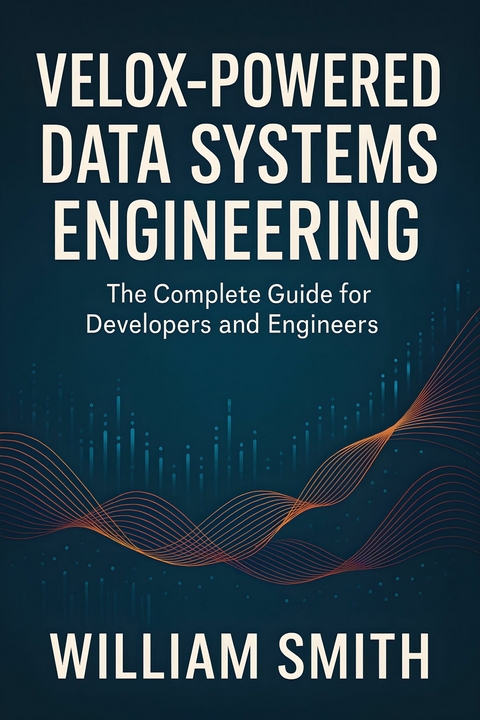
Velox-Powered Data Systems Engineering (eBook)
250 Seiten
HiTeX Press (Verlag)
978-0-00-102322-2 (ISBN)
'Velox-Powered Data Systems Engineering'
'Velox-Powered Data Systems Engineering' is a comprehensive guide to the principles, architecture, and practical deployment of Velox, a unified execution engine designed for high-performance, scalable data platforms. From foundational concepts such as execution models, memory management, and fault tolerance to advanced topics like vectorized execution, plugin architecture, and cost-based query optimization, this book offers an in-depth exploration of Velox's capabilities. It unpacks the engine's extensible core and details how Velox pushes the boundaries of modern data processing through plugin systems, threading strategies, and robust fault isolation.
The text traverses the real-world integration of Velox with diverse data platforms, including Presto, Trino, Spark, and various columnar formats like Parquet and Arrow. Readers will find detailed guidelines for hybrid and federated query processing, streaming data architectures, distributed deployments, and cloud-native operations. Comprehensive sections on security, compliance, and data governance ensure that best practices for authentication, authorization, encryption, and regulatory requirements are thoroughly addressed for mission-critical environments.
Designed for engineers, data architects, and technology leaders, the book combines hands-on engineering techniques-such as profiling, debugging, production monitoring, and chaos testing-with advanced analytics and machine learning pipelines powered by Velox. Closing chapters highlight scalable DevOps processes, compliance-driven observability, emerging architectural patterns, and future innovation in the data ecosystem. Through case studies and in-depth research, 'Velox-Powered Data Systems Engineering' equips readers with the knowledge to architect, optimize, and future-proof next-generation data systems built on Velox.
Chapter 2
Advanced Data Processing with Velox
Venture beyond foundational concepts and discover how Velox transforms advanced data processing into an arena of high-performance innovation. This chapter reveals the sophisticated internals and optimization strategies that power Velox’s top-tier analytical capabilities. Explore how cutting-edge techniques-from SIMD vectorization to lazy evaluation and operator extensibility-enable practitioners to build robust, efficient, and customizable pipelines. Engage with the mechanisms that propel Velox to the forefront of data-intensive computation.
2.1 Vectorized Execution Internals
Velox’s vectorized execution engine is architected to harness the full computational potential of modern CPUs by employing advanced low-level optimizations. The core premise hinges on processing multiple data elements simultaneously within a vectorized context, thus transcending the limitations inherent in traditional tuple-at-a-time execution models. This section delves into the fundamental design principles and engineering trade-offs underpinning Velox’s vectorized approach, emphasizing SIMD acceleration, cache-aware algorithm design, and the strategic grouping of data into large batches to maximize throughput.
At the heart of Velox’s execution engine lies the adoption of SIMD (Single Instruction, Multiple Data) capabilities, which allow a single CPU instruction to operate on multiple data points concurrently. Modern processors expose SIMD via instruction sets such as SSE, AVX, and AVX-512, enabling execution units to perform arithmetic, logical, or memory operations across wide registers-typically 128 to 512 bits. By aligning data structures and computations accordingly, Velox vectorizes common operators such as scans, filters, projections, and aggregations, effectively achieving data-level parallelism within a single core.
The application of SIMD in Velox necessitates careful data layout decisions. To maximize SIMD width utilization, the engine employs a columnar memory layout, storing each attribute as a contiguous array of primitive values. This arrangement facilitates loading wide vectors of homogeneous data into SIMD registers in a single operation, minimizing memory access overhead and aligning precisely with the vector processing units. Contrarily, a row-oriented layout would hinder SIMD efficiency due to scattered attribute locations, resulting in inefficient gather/scatter memory operations.
Vectorized execution also imposes requirements on branch handling and control flow. Velox uses predication and masking techniques to convert conditional branches within operators into data-parallel operations. For example, filtering predicates produce boolean masks that enable SIMD instructions to selectively process or ignore elements in a vector without branching, thereby mitigating pipeline stalls and branch misprediction penalties. The resultant control flow is flatter and amenable to compiler auto-vectorization and hand-crafted SIMD intrinsics alike.
Beyond SIMD, Velox’s engineers have prioritized cache-aware algorithm design, recognizing that memory latency and bandwidth dominate performance in throughput-oriented workloads. The engine organizes data access patterns to maximize temporal and spatial locality within the CPU cache hierarchy. Operators are implemented to process data in cache-resident chunks, often matching or sub-multiplying the size of L1 and L2 cache lines, to minimize costly cache misses. Moreover, Velox employs prefetching heuristics, either software-directed or hardware-assisted, to proactively load data into caches before it is needed, thus overlapping computation with memory fetch latency.
Particular attention is given to blocking strategies, wherein large data inputs are subdivided into blocks or batches sized to fit comfortably within cache boundaries. This minimizes data reuse penalties and avoids thrashing the cache with larger working sets than it can accommodate. For example, in vectorized join or aggregation operations, input relations or grouping keys are partitioned into cache-sized slabs processed individually to sustain high cache hit rates. The alignment of batch sizes with SIMD register widths and cache sizes forms a triad of design parameters, calibrated during runtime or compile-time for optimal performance.
Handling large data batches is a pivotal feature of Velox’s vectorized engine, enabling superior throughput while balancing latency constraints. Batches typically consist of thousands to tens of thousands of rows of columnar data, providing ample granularity to amortize fixed costs such as function call overhead and SIMD setup. Larger batches maximize SIMD occupancy-the degree to which vector lanes are actively processed-thereby increasing instruction-level parallelism without incurring excessive memory overhead.
However, processing large batches presents trade-offs. Excessively large batches may exacerbate latency for real-time queries and can strain memory caches, provoking increased cache evictions and memory bandwidth contention. Velox addresses this by tuning batch sizes dynamically based on workload characteristics and resource availability, occasionally reducing vector sizes to benefit latency-sensitive operators or queries. Additionally, the runtime employs adaptive feedback between operators to propagate preferred batch sizes and maintain pipeline balance, preventing stalls and backpressure that degrade throughput.
The choice of batch sizes also impacts the complexity of vectorized operator implementations. For instance, during filter or projection operators, batch processing enables straightforward SIMD application through seamless vector loads and stores. Nevertheless, for operations like hash joins and group-by aggregations, vectorization introduces challenges related to random memory access and synchronization. Velox integrates specialized vector-friendly hash table designs that exploit open addressing with linear probing, coupled with vectorized hash computation and SIMD gather/scatter operations that are carefully tuned to minimize cache misses and contention.
In sum, Velox’s vectorized execution engine is a holistic architecture that intertwines SIMD acceleration, cache-aware data management, and large-batch processing into an optimized whole. By exploiting SIMD instructions through columnar data layout and mask-based control flow, compressing working sets to the most relevant cache levels, and dynamically sizing large batches for throughput versus latency balance, the engine achieves significant performance gains over conventional execution models. The engineering trade-offs, such as the potential for increased complexity in operator implementation and the nuanced balance between batch size and memory hierarchy utilization, are addressed through adaptive runtime mechanisms and meticulous algorithmic design, making Velox a leading example of modern vectorized query execution frameworks.
2.2 Materialization and Lazy Evaluation
Velox employs a sophisticated approach to computation deferral and data materialization designed to optimize resource usage while preserving computational correctness. At the core of these strategies lies the principle of lazy evaluation, which postpones the execution of expressions and the allocation of resources until their results are strictly necessary. This approach is particularly beneficial in large-scale, iterative, and interactive machine learning workflows where premature computation and materialization can lead to excessive memory consumption and redundant processing.
The deferred computation model in Velox decouples the definition of computational tasks from their execution. Instead of eagerly computing intermediate results, Velox constructs a directed acyclic graph (DAG) of logical operations representing the workflow. Nodes in this graph correspond to transformations or data access patterns, while edges capture data dependencies. This abstraction allows Velox to reason about the entire computation holistically, reordering and optimizing tasks before performing any actual data movement or transformation.
Materialization only occurs when a terminal operation explicitly demands concrete output, such as writing results to persistent storage, invoking visualization, or triggering a blocking action like model evaluation. Until such a demand arises, intermediate nodes remain in symbolic form: their computation is defined but not carried out. This deferral mechanism not only minimizes memory footprint but also enables aggregation of multiple transformations into composite operations, reducing overhead and latency.
Velox minimizes unnecessary materialization through several key mechanisms:
- Predicate Pushdown and Projection Pruning: By propagating filters and column selections down the DAG, Velox limits data loading to only the relevant subsets, thereby reducing memory and I/O costs.
- Incremental Materialization: In iterative algorithms or streaming contexts, Velox retains minimal state by materializing only deltas or summaries necessary for subsequent steps, avoiding full recomputation or full dataset...
| Erscheint lt. Verlag | 19.8.2025 |
|---|---|
| Sprache | englisch |
| Themenwelt | Mathematik / Informatik ► Informatik ► Programmiersprachen / -werkzeuge |
| ISBN-10 | 0-00-102322-5 / 0001023225 |
| ISBN-13 | 978-0-00-102322-2 / 9780001023222 |
| Informationen gemäß Produktsicherheitsverordnung (GPSR) | |
| Haben Sie eine Frage zum Produkt? |
 EPUB (Adobe DRM)
Größe: 673 KB
Kopierschutz: Adobe-DRM
Adobe-DRM ist ein Kopierschutz, der das eBook vor Mißbrauch schützen soll. Dabei wird das eBook bereits beim Download auf Ihre persönliche Adobe-ID autorisiert. Lesen können Sie das eBook dann nur auf den Geräten, welche ebenfalls auf Ihre Adobe-ID registriert sind.
Details zum Adobe-DRM
Dateiformat: EPUB (Electronic Publication)
EPUB ist ein offener Standard für eBooks und eignet sich besonders zur Darstellung von Belletristik und Sachbüchern. Der Fließtext wird dynamisch an die Display- und Schriftgröße angepasst. Auch für mobile Lesegeräte ist EPUB daher gut geeignet.
Systemvoraussetzungen:
PC/Mac: Mit einem PC oder Mac können Sie dieses eBook lesen. Sie benötigen eine
eReader: Dieses eBook kann mit (fast) allen eBook-Readern gelesen werden. Mit dem amazon-Kindle ist es aber nicht kompatibel.
Smartphone/Tablet: Egal ob Apple oder Android, dieses eBook können Sie lesen. Sie benötigen eine
Geräteliste und zusätzliche Hinweise
Buying eBooks from abroad
For tax law reasons we can sell eBooks just within Germany and Switzerland. Regrettably we cannot fulfill eBook-orders from other countries.
aus dem Bereich


