


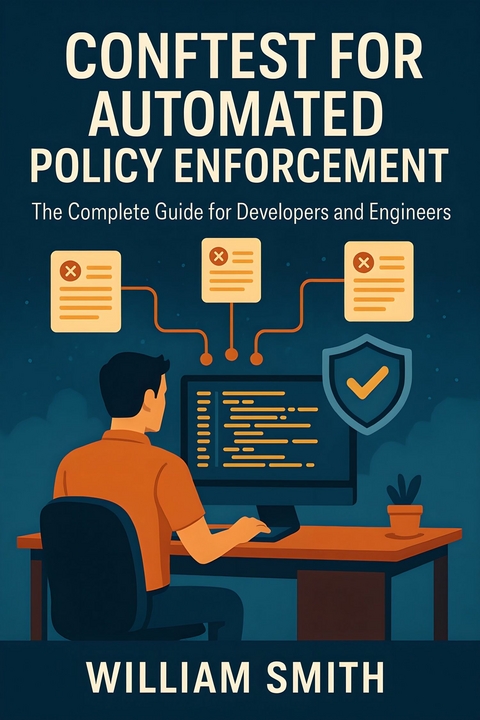
Conftest for Automated Policy Enforcement (eBook)
250 Seiten
HiTeX Press (Verlag)
978-0-00-102318-5 (ISBN)
'Conftest for Automated Policy Enforcement'
'Conftest for Automated Policy Enforcement' is a comprehensive guide to the principles, architecture, and best practices of automated policy enforcement in modern software development. Addressing the industry's transition from manual to programmatic policy management, this book establishes a robust foundation built on policy as code. It examines core requirements for scalable policy engines, contextualizes the role of declarative languages like Rego, and provides an in-depth comparative analysis of Conftest within the policy enforcement landscape. Detailed coverage extends to the various integration points throughout the software development lifecycle-development, CI/CD, and deployment-highlighting the growing necessity for automated, traceable, and auditable policy checks.
The book delves into Conftest's internals, offering clear explanations of its system architecture, evaluation pipeline, and extensibility features. Readers gain practical guidance for authoring policies with the Rego language, from fundamental constructs to advanced optimization and parametric techniques. Step-by-step instructions walk users through policy testing, debugging, and the efficient management of both input artifacts and complex policy bundles. Configuration, operationalization, and security are explored with actionable strategies for installation, fine-tuning, and safeguarding policy artifacts, tailored to the varied demands of real-world infrastructures.
Designed for practitioners in DevOps, security, compliance, and cloud-native operations, the text bridges theory and implementation by demonstrating how to embed Conftest-driven policy enforcement into CI/CD pipelines, Infrastructure as Code, and at runtime. Advanced scenarios illustrate policy orchestration across distributed systems, auditing for compliance, and extending policies beyond security to operational and financial controls. Completed by forward-looking chapters on industry trends, interoperability, and the impact of AI/ML, 'Conftest for Automated Policy Enforcement' serves as an authoritative resource for both newcomers and experienced professionals seeking to fortify software delivery with robust, automated policy governance.
Chapter 1
Foundations of Automated Policy Enforcement
Automation is disrupting how organizations define, enforce, and audit policies amidst rapid technological and regulatory change. This chapter peels back the layers of automated policy enforcement, tracing its evolution and dissecting the demands of scalable, robust, and reliable policy engines. Through a critical lens, it frames Conftest in the contemporary landscape and demonstrates why a rigorous policy-as-code approach is indispensable for modern infrastructure, security, and compliance.
1.1 The Evolution of Policy as Code
The landscape of security and compliance enforcement has undergone a profound transformation, evolving from brittle, manually managed controls to the dynamic, automated paradigm known as policy as code. Early governance models relied heavily on static documentation, manual reviews, and checklist-driven audits, which severely limited the responsiveness and scalability of security practices. These legacy approaches typically manifested as siloed, paper-based policies enforced through offline processes and human intervention. Such methods were inherently error-prone, slow to adapt, and difficult to track, frequently leading to compliance gaps and inconsistent security postures.
The catalyst for this transformation was the widespread adoption of cloud computing and the increasing complexity of modern software delivery pipelines. Traditional perimeter-based defenses and manual control gates could not keep pace with rapid infrastructure provisioning, ephemeral resources, and multi-cloud environments. The need to enforce consistent policy across diverse and dynamic platforms became paramount. Concurrently, regulatory landscapes intensified, demanding demonstrable compliance with industry standards and legal mandates on a continuous basis rather than through sporadic, labor-intensive audits.
Policy as code emerged as a response to these challenges by converting governance rules and compliance requirements into machine-interpretable, executable artifacts. Rather than being static prose, policies are now expressed in formal languages and stored alongside application and infrastructure code in version control systems. This transition offered several fundamental advantages. First, policy definitions became inherently testable, enabling automated verification that security prerequisites are met prior to deployment. Second, versioning and change tracking enhanced auditability and traceability, ensuring that modifications to security controls were logged, reviewed, and reversible. Third, automation pipelines could integrate policy evaluation as a gate, facilitating continuous compliance checks seamlessly within DevOps workflows.
Compared to legacy manual controls, policy as code eliminates numerous pain points and anti-patterns. The manual approach was susceptible to human error, delayed enforcement, and inconsistent interpretations of policy language. Often, policies were only evaluated post-deployment, increasing the risk of non-compliance going undetected for periods of time. Furthermore, disparate teams managing security, operations, and development led to friction and communication overhead. Policies expressed as code consolidate responsibilities under unified tooling, enabling real-time feedback and immediate remediation during the build and deployment phases.
Several prominent real-world issues highlight the efficacy of policy as code. For example, shadow IT and unauthorized resource provisioning posed persistent threats when teams bypassed formal controls for speed. Embedding policy checks directly into infrastructure-as-code templates prevents illicit resource configurations before they materialize. Similarly, security misconfigurations resulting from ambiguous or outdated documentation are dramatically reduced when all controls are codified and validated automatically. Organizations have witnessed significant improvements in compliance posture through continuous policy evaluation integrated with cloud-native CI/CD pipelines, enforcing least privilege, encryption, network segmentation, and runtime protection rules consistently.
This evolution also aligns closely with the principles and practices of DevSecOps. Policy as code enables a cultural and technical shift where security is not an afterthought but an integral part of the development lifecycle. By treating policies as first-class artifacts alongside application and infrastructure code, development teams can own and evolve security requirements collaboratively, supported by automated tooling and continuous feedback loops. The integration of policy evaluation into continuous delivery processes augments deployment velocity while preserving compliance and reducing risk.
To illustrate, consider the transition from manual firewall rule audits performed quarterly to an automated policy engine that continuously validates network policies expressed in a declarative language such as Rego or HashiCorp Sentinel. Violations trigger immediate alerts and pipeline failures, preventing insecure configurations from reaching production. Code reviews and pull requests incorporate policy changes, ensuring rigorous governance through peer collaboration. This tight feedback loop represents a significant departure from error-prone, ad hoc enforcement toward resilient, automated management of security and compliance.
In summary, the evolution from brittle and manual enforcement to policy as code is driven by technological advances, operational needs, and regulatory pressures. It transforms static policy into living artifacts that are executable, testable, and version-controlled, enabling automated, continuous compliance and security assurance at scale. This paradigm is now a foundational enabler for modern DevSecOps practices and continuous delivery pipelines, facilitating secure innovation while reducing operational risk.
1.2 Requirements for Automated Policy Engines
Automated policy engines serve as the backbone of modern governance and compliance frameworks within complex IT ecosystems. Their indispensable role demands that they fulfill a series of stringent technical and operational criteria to maintain trustworthiness, reliability, and effective organizational integration. Principal among these are scalability, extensibility, traceability, auditability, conflict resolution, deterministic execution, and seamless infrastructure integration. This section elaborates on each attribute, highlighting their pivotal importance and interplay.
Scalability is paramount due to the sheer volume of policy evaluations required in contemporary distributed environments. An effective policy engine must handle tens of thousands of policy checks per minute without degradation in performance. This necessitates architectural designs that leverage horizontal scaling, stateless processing units, and efficient caching mechanisms. Load balancing strategies should be employed to distribute evaluation workloads dynamically, ensuring responsiveness and availability. Additionally, asynchronous execution models can reduce bottlenecks when policies involve extensive data retrieval or computationally heavy logic.
Extensibility addresses the inevitability of evolving regulatory landscapes and organizational requirements. Policy engines must support the addition, modification, and removal of policies without necessitating downtime or rearchitecture. This often translates to modular rule repositories, domain-specific language (DSL) support for policy authoring, and well-defined extension points for custom evaluation functions. Moreover, integration with emerging data sources and analytic tools must be facilitated by well-documented APIs, enabling policy logic to remain current and context-aware.
Traceability ensures that each policy decision is accompanied by a transparent, explainable path from input conditions to output outcomes. Traceability demands comprehensive logging of input parameters, intermediate decision states, and rationale produced during evaluation. This is critical not only for debugging and fine-tuning policies but also for establishing operational confidence. Structured decision trees or provenance models within the engine allow for reconstruction of decision pathways, fostering accountability and facilitating compliance verification.
Auditability extends traceability by providing immutable records suitable for external review. Auditability requires policy engines to maintain tamper-resistant logs that capture the context, timing, and agents involved in policy execution. These logs must be stored securely, preferably with cryptographic integrity checks, to provide verifiable evidence during compliance audits or forensic investigations. Support for standardized audit formats and integration with Security Information and Event Management (SIEM) systems enhances the practical usability of these records.
Conflict resolution is essential in scenarios where multiple policies apply simultaneously, potentially yielding contradictory directives. Effective automated policy engines employ sophisticated conflict resolution mechanisms that prioritize policies based on predefined precedence rules, contextual relevance, or severity levels. Formal policy composition methods, including...
| Erscheint lt. Verlag | 19.8.2025 |
|---|---|
| Sprache | englisch |
| Themenwelt | Mathematik / Informatik ► Informatik ► Programmiersprachen / -werkzeuge |
| ISBN-10 | 0-00-102318-7 / 0001023187 |
| ISBN-13 | 978-0-00-102318-5 / 9780001023185 |
| Informationen gemäß Produktsicherheitsverordnung (GPSR) | |
| Haben Sie eine Frage zum Produkt? |
 EPUB (Adobe DRM)
Größe: 810 KB
Kopierschutz: Adobe-DRM
Adobe-DRM ist ein Kopierschutz, der das eBook vor Mißbrauch schützen soll. Dabei wird das eBook bereits beim Download auf Ihre persönliche Adobe-ID autorisiert. Lesen können Sie das eBook dann nur auf den Geräten, welche ebenfalls auf Ihre Adobe-ID registriert sind.
Details zum Adobe-DRM
Dateiformat: EPUB (Electronic Publication)
EPUB ist ein offener Standard für eBooks und eignet sich besonders zur Darstellung von Belletristik und Sachbüchern. Der Fließtext wird dynamisch an die Display- und Schriftgröße angepasst. Auch für mobile Lesegeräte ist EPUB daher gut geeignet.
Systemvoraussetzungen:
PC/Mac: Mit einem PC oder Mac können Sie dieses eBook lesen. Sie benötigen eine
eReader: Dieses eBook kann mit (fast) allen eBook-Readern gelesen werden. Mit dem amazon-Kindle ist es aber nicht kompatibel.
Smartphone/Tablet: Egal ob Apple oder Android, dieses eBook können Sie lesen. Sie benötigen eine
Geräteliste und zusätzliche Hinweise
Buying eBooks from abroad
For tax law reasons we can sell eBooks just within Germany and Switzerland. Regrettably we cannot fulfill eBook-orders from other countries.
aus dem Bereich


