


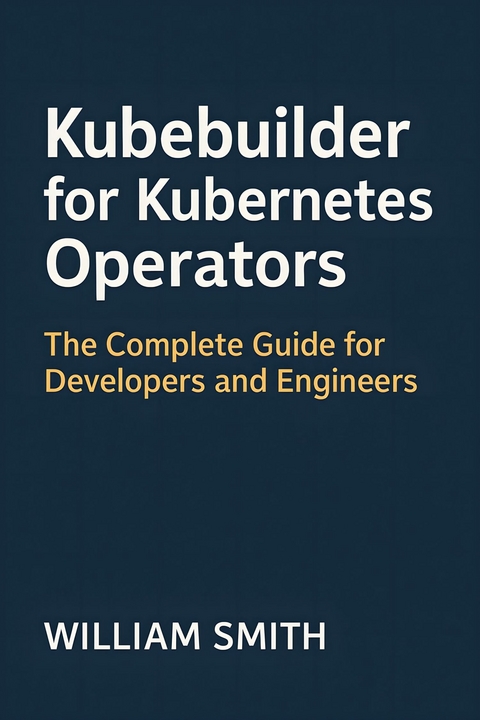
Kubebuilder for Kubernetes Operators (eBook)
250 Seiten
HiTeX Press (Verlag)
9780001023161 (ISBN)
'Kubebuilder for Kubernetes Operators'
'Kubebuilder for Kubernetes Operators' is a comprehensive guide designed for engineers, architects, and DevOps professionals eager to master the design, development, and operation of advanced Kubernetes Operators. Beginning with a thorough exploration of the Operator pattern, extensionality of Kubernetes APIs, and controller reconciliation models, the book grounds the reader in foundational concepts while emphasizing real-world use cases and robust design principles. Each section demystifies the complexities underlying operator lifecycle management, custom resource definitions, and security, providing a solid base upon which to build production-grade automation.
Progressing from foundational knowledge, the book delivers a hands-on approach to Kubebuilder, the leading toolkit for creating Kubernetes-native APIs and controllers. Readers are taken through Kubebuilder's architecture, environment setup, project scaffolding, code generation, and integration with essential Kubernetes tooling. Practical chapters cover advanced API design, CRD schema evolution, webhooks for resource validation and mutation, and best practices for testing, debugging, and observability. The book's pragmatic focus ensures effective operator development at every phase, from initial coding to seamless upgrades and integration with sophisticated CI/CD pipelines.
The final chapters tackle operational realities and advanced architecture: multi-cluster deployments, scaling and disaster recovery, security and compliance, and multi-tenancy. Rich case studies and community perspectives illuminate complex operator patterns-from distributed databases to hybrid cloud scenarios-highlighting lessons learned in real-world deployments. With insights into reusable libraries, ecosystem contributions, and a visionary look at future directions, 'Kubebuilder for Kubernetes Operators' is an essential resource for those seeking to unlock the full power of cloud native automation with professionalism and confidence.
Chapter 2
Getting Started with Kubebuilder
Kubebuilder is the scaffolding powerhouse that unlocks Kubernetes operator development at scale, blending code generation with design best-practices. This chapter immerses you in Kubebuilder’s architecture, setup, and foundational workflows-equipping you to model custom APIs and controllers with both precision and velocity. Journey from zero to a fully structured, testable, and extensible operator project, demystifying the engineering patterns that power the Kubernetes ecosystem.
2.1 Kubebuilder Architecture and Principles
Kubebuilder is a comprehensive framework designed to facilitate the construction of Kubernetes APIs using idiomatic Go, with a primary focus on developer productivity, reliability, and compliance with upstream Kubernetes conventions. Its architecture embodies key principles that enforce a clear separation of concerns, leverage automated code generation, and integrate deeply with Kubernetes SIG (Special Interest Group) standards, enabling developers to build extensible, type-safe, and maintainable operators and controllers.
At the core of Kubebuilder’s design lies a modular architecture that distinctly separates API definitions, controller logic, and runtime scaffolding. This division manifests in three primary layers: the API layer, the controller-runtime layer, and the code generation layer. The API layer encapsulates Kubernetes Custom Resource Definitions (CRDs) and their associated Go types, providing a strongly typed interface that guarantees compile-time validation and seamless integration with Kubernetes API machinery. The controller-runtime layer abstracts common Kubernetes control loop patterns, such as reconciliation loops, event handling, and client interactions with the Kubernetes API server. The code generation layer automates the production of boilerplate code essential for CRD manifests, deepcopy utilities, conversion webhooks, and clientsets, aligning strictly with Kubernetes API conventions.
Kubebuilder’s code generation mechanism operates through a sophisticated set of annotations embedded within the API Go structs. These annotations, interpreted during the build process, drive the generation of Kubernetes manifests and deep-copy methods crucial for CRD operation. This logic is powered by controller-tools, a suite of utilities that parse Go source code, synthesize OpenAPI validation schemas, and produce controller scaffolds adhering to Kubernetes best practices. The annotation-driven approach enforces declarative API design, minimizing manual errors and providing a declarative bridge between Go source definitions and their Kubernetes resource specifications.
Integral to Kubebuilder’s architecture is its strict adherence to Kubernetes SIG API Machinery conventions, which ensures that generated APIs are indistinguishable from native Kubernetes resources. It incorporates upstream conventions such as API versioning through versioned packages, usage of TypeMeta and ObjectMeta embedded structs, and adherence to Kubernetes resource naming and validation standards. This deep integration fosters compatibility and future-proofing by enabling native Kubernetes clients and tooling to operate seamlessly with custom controllers and resources generated by Kubebuilder.
The controller-runtime scaffolding built by Kubebuilder orchestrates complex workflows inherent in Kubernetes controllers. It abstracts key control loop components: a reconciler interface implements the reconciliation logic, a manager orchestrates runtime lifecycle and leader election, and client interfaces offer typed access to Kubernetes objects. The scaffolding facilitates event-driven programming models, watches resource changes efficiently, and handles concurrency and error propagation transparently. By automating these workflows, Kubebuilder reduces cognitive overhead and boilerplate, making controller implementations concise and idiomatic.
In addition to runtime utilities, Kubebuilder provides robust support for type-safe API design. It leverages the Go type system extensively, permitting developers to define their CRD schemas with fully typed fields, validation tags, and embedded Kubernetes metadata structs. The generated client-go style clients benefit from compile-time type safety, reducing runtime errors and encouraging idiomatic Kubernetes API usage patterns. This design philosophy aligns closely with Kubernetes upstream goals of maintainability and clarity in API definitions.
Extensibility is a foundational principle within Kubebuilder’s architecture. While the framework generates a full controller scaffold by default, it allows customization at multiple levels. Custom controllers can override the default reconciliation logic or implement additional event handlers. Webhooks for CRD validation and defaulting can be auto-generated and extended with user-provided logic. Furthermore, Kubebuilder templates and plugins support community-driven extensions, enabling specialized scaffolds for domain-specific tasks or cloud provider integrations. This extensibility ensures that Kubebuilder remains flexible and adaptable to diverse operator needs without compromising its adherence to upstream standards.
Crucially, Kubebuilder embeds upstream Kubernetes tooling and conventions as first-class components rather than as afterthoughts. By relying on controller-runtime and leveraging Kubernetes-style code generation, Kubebuilder bridges the gap between raw API machinery and the operator framework, embodying best-of-breed practices refined by the Kubernetes SIGs. This ensures that the operator code generated and managed by Kubebuilder can evolve alongside Kubernetes itself, maintaining tight compatibility and benefiting from continuous upstream improvements.
Kubebuilder’s architecture is predicated on a careful modular decomposition that isolates API definition, controller scaffolding, and code generation. Its annotation-driven generation pipeline and strong Kubernetes SIG integration promote the creation of idiomatic, type-safe Kubernetes APIs and controllers. By abstracting complex reconciliation and event-driven workflows while preserving extensibility, Kubebuilder provides a mature, upstream-aligned platform for building robust Kubernetes operators.
2.2 Installation and Environment Setup
Operator engineering necessitates a development environment that is both stable and adaptable to the evolving Kubernetes ecosystem. Ensuring proper installation of tools and adhering to system prerequisites enable reproducible builds and efficient iteration when using Kubebuilder-based workflows. This section elucidates the critical considerations, tooling recommendations, and environment configurations fundamental to establishing a robust operator engineering workspace.
System prerequisites and platform compatibility are essential. Kubebuilder and its dependencies primarily target Unix-like operating systems, with macOS and Linux distributions currently offering the most seamless experiences. Windows support, while feasible through Windows Subsystem for Linux (WSL), requires additional configuration and may introduce subtle discrepancies in file system and networking behaviors. For native Linux environments, distributions such as Ubuntu (18.04 and later), Fedora, and CentOS (8 and onward) are preferential, providing modern kernel versions and package management systems that simplify dependency installation.
Minimum prerequisite versions include:
- Go language: Version 1.19 or higher. This ensures compatibility with Kubebuilder’s code generation tools and controller-runtime libraries.
- kubectl: Version conforming to the target Kubernetes cluster, ideally matching the cluster’s minor version to avoid API incompatibilities.
- Kubernetes cluster: A minimum Kubernetes version 1.22 is recommended, as Kubebuilder-generated code often leverages APIs deprecated in earlier releases.
Hardware constraints typically recommend at least 8 GB of RAM to efficiently run local clusters and controller processes, with additional resources necessary for parallel test environments or complex API controllers.
Installing Kubebuilder and associated tooling follows a structured sequence due to its interdependencies:
- 1.
- Go Toolchain: Obtain the official Go distribution and configure environment variables: wget https://golang.org/dl/go1.20.linux-amd64.tar.gz
...
| Erscheint lt. Verlag | 19.8.2025 |
|---|---|
| Sprache | englisch |
| Themenwelt | Mathematik / Informatik ► Informatik ► Programmiersprachen / -werkzeuge |
| ISBN-13 | 9780001023161 / 9780001023161 |
| Informationen gemäß Produktsicherheitsverordnung (GPSR) | |
| Haben Sie eine Frage zum Produkt? |
 EPUB (Adobe DRM)
Größe: 454 KB
Kopierschutz: Adobe-DRM
Adobe-DRM ist ein Kopierschutz, der das eBook vor Mißbrauch schützen soll. Dabei wird das eBook bereits beim Download auf Ihre persönliche Adobe-ID autorisiert. Lesen können Sie das eBook dann nur auf den Geräten, welche ebenfalls auf Ihre Adobe-ID registriert sind.
Details zum Adobe-DRM
Dateiformat: EPUB (Electronic Publication)
EPUB ist ein offener Standard für eBooks und eignet sich besonders zur Darstellung von Belletristik und Sachbüchern. Der Fließtext wird dynamisch an die Display- und Schriftgröße angepasst. Auch für mobile Lesegeräte ist EPUB daher gut geeignet.
Systemvoraussetzungen:
PC/Mac: Mit einem PC oder Mac können Sie dieses eBook lesen. Sie benötigen eine
eReader: Dieses eBook kann mit (fast) allen eBook-Readern gelesen werden. Mit dem amazon-Kindle ist es aber nicht kompatibel.
Smartphone/Tablet: Egal ob Apple oder Android, dieses eBook können Sie lesen. Sie benötigen eine
Geräteliste und zusätzliche Hinweise
Buying eBooks from abroad
For tax law reasons we can sell eBooks just within Germany and Switzerland. Regrettably we cannot fulfill eBook-orders from other countries.
aus dem Bereich


