


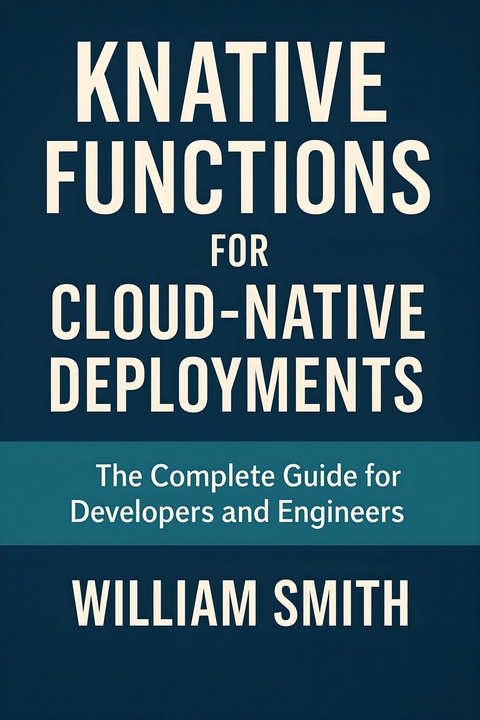
KNative Functions for Cloud-Native Deployments (eBook)
250 Seiten
HiTeX Press (Verlag)
978-0-00-102309-3 (ISBN)
'KNative Functions for Cloud-Native Deployments'
Unlock the full potential of serverless computing with 'KNative Functions for Cloud-Native Deployments,' a comprehensive guide for engineers and architects building next-generation cloud-native applications. Beginning with the fundamentals of cloud-native architecture, this book explores the evolution from monolithic systems to microservices and serverless models, emphasizing the operational and business benefits that KNative brings to the Kubernetes ecosystem. Through a methodical progression, readers are introduced to the strategic motivations for adopting KNative, exploring foundational principles, key components, and the unique capabilities that set it apart in today's dynamic IT landscapes.
Delving deeper, the book offers an in-depth analysis of KNative's architecture, examining core elements like Serving, Eventing, and Build, and their seamless integration with Kubernetes primitives. It addresses advanced topics such as traffic management, revision strategies, networking, service mesh integration, and robust security and policy enforcement. Practical chapters guide readers through efficient CI/CD pipelines, observability, scaling strategies, resilient event-driven architectures, and comprehensive operational monitoring-ensuring high availability, cost efficiency, and compliance in real-world deployments.
With a strong focus on future-proofing applications, 'KNative Functions for Cloud-Native Deployments' presents actionable patterns for authoring, testing, securing, and orchestrating functions within complex enterprise environments. Case studies from finance, healthcare, IoT, and the web illustrate successful industry adoption, while forward-looking discussions examine KNative's positioning alongside emerging technologies like edge computing and AI-driven orchestration. This book serves as an indispensable resource for teams embracing cloud-native paradigms, offering both foundational knowledge and advanced practices to thrive in the evolving world of serverless computing.
Chapter 1
Principles of Cloud-Native Function Deployment
Explore the paradigm shifts that have driven modern application development toward serverless architectures, and discover the core operational, organizational, and technical forces shaping advanced cloud-native function deployment. This chapter lays a critical foundation for understanding why new architectures matter, how they enable agility and scalability, and what key principles underpin their practical adoption in enterprise infrastructures.
1.1 Cloud-Native Architecture Foundations
The trajectory of software architecture has undergone marked transformations, with each phase addressing the limitations and operational challenges of its predecessors. Initially, monolithic architectures dominated, characterized by a single unified codebase where all components-user interface, business logic, and data access-resided within a tightly coupled system. This design presented significant drawbacks, including inflexible scaling, complex deployments, and brittle maintenance processes, hindering rapid innovation and resilience.
To mitigate these impediments, service-oriented architecture (SOA) emerged as the subsequent evolution. SOA decomposed applications into loosely coupled services that communicated over the network, often leveraging enterprise service buses (ESBs) and standardized protocols such as SOAP. While SOA improved modularity and fostered reuse, its heavy dependence on middleware and orchestration introduced operational overhead and limited agility, especially under dynamic workloads or cloud environments.
The limitations of SOA and the rapid expansion of cloud infrastructure catalyzed the adoption of microservices architecture. Microservices further fragment applications into small, independently deployable units focused on single business capabilities. This granularity enables teams to develop, deploy, and scale services autonomously, fostering faster iteration cycles and system robustness through fault isolation. The rise of lightweight communication mechanisms, primarily RESTful APIs and messaging queues, enhanced interoperability and reduced latency between services.
Cloud-native architecture embodies the principles and practices that enable applications to fully exploit cloud environments’ elasticity and distributed nature. Underpinned by microservices, cloud-native systems emphasize statelessness, immutable infrastructure, and declarative APIs. Containerization is pivotal here, encapsulating microservices and their dependencies into portable, isolated units that ensure consistency across development, testing, and production environments. Technologies such as Docker set the precedent by standardizing container formats and runtime environments, thereby simplifying deployment pipelines and resource utilization.
Dynamic orchestration platforms, notably Kubernetes, extend containerization by managing lifecycle operations-scheduling, replication, auto-scaling, and self-healing-across clusters of hosts. These orchestration systems abstract the complexity of distributed deployments, enabling declarative configurations to maintain desired system states while optimizing resource usage and availability. This paradigm shift dispenses with static infrastructure provisioning, allowing continuous adaptation to fluctuating workloads.
Continuous delivery further complements cloud-native principles by integrating automated building, testing, and deployment processes, facilitating rapid, reliable software release cycles. Pipelines constructed with tools such as Jenkins, GitLab CI/CD, or Tekton enforce rigorous validation and versioning requirements, promoting transparency and reproducibility. The cultural transformation accompanying continuous delivery promotes collaboration between development and operations teams-DevOps-and embraces failure as a learning mechanism, improving system resilience and innovation velocity.
Within this ecosystem, function-based abstractions, or serverless computing, arise as a natural progression. By distilling application logic into discrete, ephemeral functions triggered by events, serverless platforms abstract infrastructure management entirely from the developer’s responsibilities. This model provides granular scalability and cost efficiency, as resources are provisioned solely in response to demand. Function-as-a-Service (FaaS) environments integrate seamlessly with event-driven architectures, enabling asynchronous workflows and rapid composition of new capabilities.
Serverless architectures embody the culmination of cloud-native principles by pushing automation, modularity, and scalability to their extremes. Conventional containers and microservices require orchestration and maintenance of always-on services, whereas serverless relinquishes this burden, embracing fine-grained execution aligned with real-time operational needs. This shift necessitates new design patterns, such as idempotency, state externalization, and distributed tracing, to ensure system reliability and observability in highly ephemeral contexts.
The evolution from monolithic systems to serverless platforms reflects both technical and cultural innovations. It encompasses advancements in virtualization, networking, and software engineering paradigms, alongside enhanced collaboration models and automated processes. Each iteration incrementally dismantles the barriers to rapid deployment, horizontal scaling, and fault tolerance, culminating in architectures that leverage the cloud’s full potential.
Foundational elements of cloud-native architecture-containerization, dynamic orchestration, and continuous delivery-establish a scaffold upon which serverless and function-based abstractions are built. These innovations not only optimize resource efficiency but also align organizational practices with modern software delivery demands, fostering resilient, scalable, and maintainable systems shaped for the cloud era.
1.2 Characteristics of Serverless Functions
Serverless functions embody a paradigm shift in cloud computing, distinguished by several intrinsic properties that fundamentally influence their design, deployment, and operational behavior. These properties-statelessness, fine-grained deployment, event-driven execution, and ephemeral compute lifecycles-present unique opportunities and impose distinct constraints that shape how developers architect scalable, maintainable systems.
-
Statelessness
Serverless functions are inherently stateless, meaning that no persistent state is maintained within the function instance between invocations. Each execution is isolated and must rely on external systems, such as databases or caches, to store and retrieve any necessary state information. This characteristic facilitates horizontal scaling and simplifies failure recovery since any instance can handle any request without prior context. However, statelessness imposes challenges related to data consistency, transaction management, and latency due to network calls to external storage. Architectural patterns such as event sourcing or stateful coordinators are often necessary to reconcile application requirements with the stateless execution model.
-
Fine-Grained Deployment
Functions in serverless platforms are typically deployed with fine granularity, encapsulating discrete units of logic often limited to single API endpoints or isolated business capabilities. This granularity enhances modularity, allowing independent development, testing, and scaling of individual components, thereby promoting maintainability and continuous delivery. Furthermore, the deployment model abstracts away infrastructure management, enabling rapid iteration cycles. However, fine-grained deployment may lead to increased system complexity through a proliferation of function artifacts and necessitates careful orchestration and monitoring to achieve coherent end-to-end workflows.
-
Event-Driven Execution
Execution of serverless functions is predominantly event-triggered, responding to stimuli from HTTP requests, message queues, file uploads, timers, or other cloud-native events. This reactive model aligns closely with modern distributed architectures and enables asynchronous, decoupled communication between components. Event-driven execution contributes to elasticity, as functions are invoked precisely in response to demand, optimizing resource utilization and cost efficiency. Conversely, this approach requires meticulous design of event sources and handling mechanisms to ensure reliability, ordering guarantees, and fault tolerance. Event storms or unexpected surges can impose significant pressure on function concurrency limits, potentially impacting system responsiveness.
-
Ephemeral Compute Lifecycles
Serverless compute environments instantiate function containers on demand and terminate them shortly after execution, resulting in ephemeral lifecycles. This evanescence enables aggressive resource...
| Erscheint lt. Verlag | 19.8.2025 |
|---|---|
| Sprache | englisch |
| Themenwelt | Mathematik / Informatik ► Informatik ► Programmiersprachen / -werkzeuge |
| ISBN-10 | 0-00-102309-8 / 0001023098 |
| ISBN-13 | 978-0-00-102309-3 / 9780001023093 |
| Informationen gemäß Produktsicherheitsverordnung (GPSR) | |
| Haben Sie eine Frage zum Produkt? |
 EPUB (Adobe DRM)
Größe: 939 KB
Kopierschutz: Adobe-DRM
Adobe-DRM ist ein Kopierschutz, der das eBook vor Mißbrauch schützen soll. Dabei wird das eBook bereits beim Download auf Ihre persönliche Adobe-ID autorisiert. Lesen können Sie das eBook dann nur auf den Geräten, welche ebenfalls auf Ihre Adobe-ID registriert sind.
Details zum Adobe-DRM
Dateiformat: EPUB (Electronic Publication)
EPUB ist ein offener Standard für eBooks und eignet sich besonders zur Darstellung von Belletristik und Sachbüchern. Der Fließtext wird dynamisch an die Display- und Schriftgröße angepasst. Auch für mobile Lesegeräte ist EPUB daher gut geeignet.
Systemvoraussetzungen:
PC/Mac: Mit einem PC oder Mac können Sie dieses eBook lesen. Sie benötigen eine
eReader: Dieses eBook kann mit (fast) allen eBook-Readern gelesen werden. Mit dem amazon-Kindle ist es aber nicht kompatibel.
Smartphone/Tablet: Egal ob Apple oder Android, dieses eBook können Sie lesen. Sie benötigen eine
Geräteliste und zusätzliche Hinweise
Buying eBooks from abroad
For tax law reasons we can sell eBooks just within Germany and Switzerland. Regrettably we cannot fulfill eBook-orders from other countries.
aus dem Bereich


