


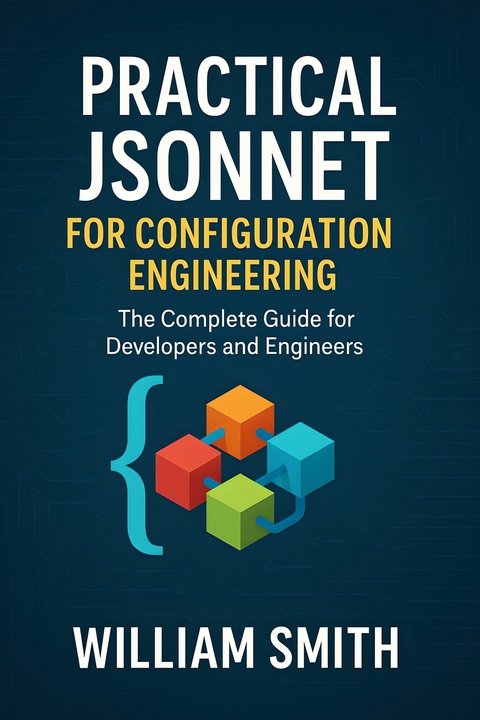
Practical Jsonnet for Configuration Engineering (eBook)
250 Seiten
HiTeX Press (Verlag)
978-0-00-102301-7 (ISBN)
'Practical Jsonnet for Configuration Engineering'
'Practical Jsonnet for Configuration Engineering' is a comprehensive guide to mastering modern configuration management with Jsonnet, the powerful data templating language designed for complex infrastructure and applications. The book opens with an exploration of the paradigm shift toward configuration as code, contrasting Jsonnet's flexible capabilities with conventional tools like YAML and JSON, before guiding readers step-by-step through setup, best practices, and the essential tooling ecosystem. Emphasizing both foundational and advanced language features, it equips engineers to model, generate, and scale robust configuration with clarity and confidence.
Delving into Jsonnet's core constructs, the book expertly covers object-oriented configuration, parameterized modules, overlays for hierarchical environments, and advanced patterns such as comprehensions, imports, and native extensions. It addresses real-world design patterns for reliability and scalability, while also outlining strategies for automated validation, error handling, and modular code organization-practices crucial for maintaining large-scale or enterprise codebases. With dedicated chapters on CI/CD integration, Kubernetes management, secure handling of secrets, and drift detection, the guide empowers practitioners to operationalize Jsonnet in production-ready pipelines.
Beyond the language itself, 'Practical Jsonnet for Configuration Engineering' stands out with its deep dives into extensibility, industry case studies, and the critical aspects of security, governance, and team collaboration. Readers gain insight into auditability and policy-as-code, cross-team workflows, and the demands of large, multi-environment deployments. Concluding with a look at emerging trends and architectural strategies for agility, this book is both a definitive technical manual and a practical playbook for engineers, DevOps professionals, and architects charting the future of configuration management.
Chapter 2
Core Jsonnet Constructs and Advanced Language Features
Dive beneath the surface of Jsonnet to unlock its true expressive power. This chapter reveals the sophisticated building blocks and advanced paradigms that differentiate Jsonnet from mere data formats-showing how code can orchestrate entire fleets of configurations with elegance and precision. Whether you seek deep modularity, composability, or dynamic generation, these are the tools that empower engineers to tame complexity at scale.
2.1 Data Types and Primitives
Jsonnet extends JSON’s foundational data representation by enhancing its data primitives, thereby providing a more expressive and flexible configuration language. At its core, Jsonnet’s data model includes booleans, numbers, strings, arrays, and objects—each refined from their JSON counterparts to support advanced manipulation, evaluation, and composability. Understanding these primitives, their typing nuances, and operational semantics is essential for mastering robust Jsonnet configurations.
Booleans in Jsonnet remain conceptually aligned with standard JSON’s true and false values. They serve as fundamental predicates within expressions and control statements. Notably, Jsonnet maintains strict boolean typing, disallowing implicit coercions that are common in other scripting languages. This preserves clarity and reduces runtime ambiguity. The boolean primitive supports standard logical operations such as && (logical and), || (logical or), and ! (negation), facilitating precise conditional control flow.
Numbers in Jsonnet are represented as double-precision floating-point values, encompassing both integers and real numbers within the same type. Unlike JSON, which treats all numbers as floating point, Jsonnet interprets numeric literals precisely, supporting integral arithmetic without explicit type distinctions. Numeric expressions include standard arithmetic operators (+, -, *, /, and modulo %) as well as exponentiation via the library function std.pow. This unified number type simplifies mathematical computations in configurations; however, users must be aware of floating-point precision limitations inherent in IEEE 754 representation.
Strings in Jsonnet extend JSON strings by supporting escape sequences and UTF-8 encoding, enabling rich text manipulation. They are delimited by either single or double quotes, affording syntactic flexibility, especially when embedding templates or snippet expressions. Jsonnet introduces powerful string interpolation through the ${…} syntax, allowing embedded expressions to evaluate and concatenate seamlessly within string literals. This is a substantial enhancement over JSON, enabling dynamic string generation tied directly to configuration logic.
Arrays in Jsonnet are ordered collections that can hold heterogeneous elements, analogous to JSON arrays. However, Jsonnet arrays support lazy evaluation and can contain expressions, enabling deferred computation of elements. Arrays support high-level operations such as concatenation using the + operator, indexing, slicing with range notation, and comprehensions for constructing arrays from generators. These features allow array composition to be declarative yet computationally expressive. Arrays conform to structural equality semantics: two arrays are equal if they have the same length and each corresponding element is structurally equal.
Objects represent Jsonnet’s most sophisticated primitive, significantly extending JSON objects. While JSON objects are immutable key-value maps with string keys, Jsonnet objects behave as extensible dictionaries with support for inheritance, field overrides, computed fields, and dynamic dispatch. A critical distinction is the capability to define fields using expressions, enabling field values to depend on other fields or external parameters. Moreover, objects can be merged and overridden via comprehensions and operators. Object keys remain strings, but the values can be arbitrary Jsonnet expressions.
Objects also respect structural equality: two objects are equal if they hold the same set of fields and corresponding values are structurally equal. Notably, key ordering in objects is not significant for equality comparisons.
Typing and Structural Equality in Jsonnet lean heavily on dynamic typing yet provide strong guarantees about data shapes and equality. Each primitive type—boolean, number, string, array, and object—is distinct, and operations typically require operands of expected types, raising runtime errors otherwise. Type coercion is explicit via library functions, preventing surprising behaviors.
Structural equality is a cornerstone for reasoning about Jsonnet data. Unlike reference or pointer equality, structural equality compares values recursively: two primitive values are equal if equal in the primitive domain; arrays must match length and ordered elements; objects must match field sets and corresponding field values. This allows Jsonnet programs to functionally reason about configuration data without reference identity concerns, facilitating debugging, caching, and memoization strategies.
Deep Copy Semantics are ensured when manipulating arrays or objects, as Jsonnet operations return new data structures rather than mutating existing ones, preserving immutability semantics. For example, concatenating arrays creates a fresh array combining elements, and object extensions generate new objects with merged fields. This deep copy-like behavior guarantees referential transparency and safe reuse of configuration fragments without unintended side effects. Developers benefit from predictable behavior under transformation sequences, especially in modular and reusable configuration patterns.
Best Practices for Using Jsonnet Primitives
- Prefer expression-based construction: utilize Jsonnet’s powerful expression syntax to generate arrays and objects declaratively. This improves maintainability and reduces manual duplication.
- Exploit immutability: design configurations assuming immutability of arrays and objects, favoring functional composition over in-place mutation.
- Use structural equality in conditionals: where configuration logic branches on data values, employ structural equality to avoid brittle identity-based conditions.
- Minimize floating-point numeric reliance: for indexing or counting, prefer integer-safe operations and explicit rounding to prevent precision errors.
- Use string interpolation for clarity: harness string interpolation for embedding variable expressions within configurations rather than constructing complex concatenations manually.
- Leverage object inheritance: compose complex configurations via object extension and overriding, minimizing redundancy and promoting modular designs.
The synthesis of enhanced primitives with these best practices empowers Jsonnet users to write expressive, concise, and robust configurations that scale from small-scale scripts to complex, layered deployment specifications.
2.2 Expressions and Local Bindings
Jsonnet’s computational model hinges fundamentally on expressions, which provide a versatile mechanism to construct, compute, and compose data structures declaratively. Expressions in Jsonnet are typed, first-class constructs that define values through arithmetic, logical operations, functions, object and array constructions, and comprehensions. Due to Jsonnet’s functional and declarative nature, the evaluation of expressions follows precise rules that promote clarity and modularity.
An expression in Jsonnet can represent primitive values (numbers, strings, booleans, null), compound values (arrays, objects), or functions. Expressions are composed using operators that mirror those found in conventional programming languages, including arithmetic (+, −, ∗, ∕), relational (<, >, ==), logical (∧, ∨, ¬), and conditional (ternary) operators.
Consider the following canonical examples of expressions:
local height = 5;
...
| Erscheint lt. Verlag | 19.8.2025 |
|---|---|
| Sprache | englisch |
| Themenwelt | Mathematik / Informatik ► Informatik ► Programmiersprachen / -werkzeuge |
| ISBN-10 | 0-00-102301-2 / 0001023012 |
| ISBN-13 | 978-0-00-102301-7 / 9780001023017 |
| Informationen gemäß Produktsicherheitsverordnung (GPSR) | |
| Haben Sie eine Frage zum Produkt? |
 EPUB (Adobe DRM)
Größe: 562 KB
Kopierschutz: Adobe-DRM
Adobe-DRM ist ein Kopierschutz, der das eBook vor Mißbrauch schützen soll. Dabei wird das eBook bereits beim Download auf Ihre persönliche Adobe-ID autorisiert. Lesen können Sie das eBook dann nur auf den Geräten, welche ebenfalls auf Ihre Adobe-ID registriert sind.
Details zum Adobe-DRM
Dateiformat: EPUB (Electronic Publication)
EPUB ist ein offener Standard für eBooks und eignet sich besonders zur Darstellung von Belletristik und Sachbüchern. Der Fließtext wird dynamisch an die Display- und Schriftgröße angepasst. Auch für mobile Lesegeräte ist EPUB daher gut geeignet.
Systemvoraussetzungen:
PC/Mac: Mit einem PC oder Mac können Sie dieses eBook lesen. Sie benötigen eine
eReader: Dieses eBook kann mit (fast) allen eBook-Readern gelesen werden. Mit dem amazon-Kindle ist es aber nicht kompatibel.
Smartphone/Tablet: Egal ob Apple oder Android, dieses eBook können Sie lesen. Sie benötigen eine
Geräteliste und zusätzliche Hinweise
Buying eBooks from abroad
For tax law reasons we can sell eBooks just within Germany and Switzerland. Regrettably we cannot fulfill eBook-orders from other countries.
aus dem Bereich


