


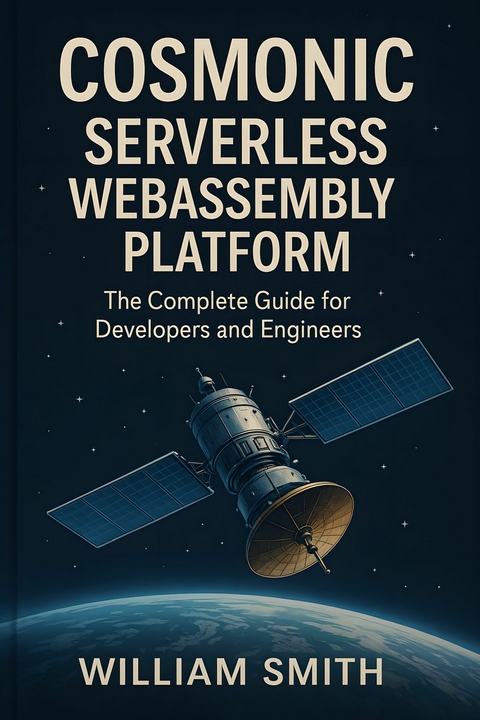
Cosmonic Serverless WebAssembly Platform (eBook)
250 Seiten
HiTeX Press (Verlag)
978-0-00-102297-3 (ISBN)
'Cosmonic Serverless WebAssembly Platform'
Embark on a comprehensive exploration of next-generation cloud computing with 'Cosmonic Serverless WebAssembly Platform.' This authoritative guide charts the evolution of WebAssembly from its groundbreaking role as a universal runtime-transcending browser boundaries-into the foundation of a modern, serverless ecosystem. Readers are introduced to key technical concepts such as distributed execution, the actor model, and the decoupling of business logic from platform capabilities, all while building a solid business case for embracing scalable, secure, and composable WebAssembly-powered architectures.
Delving deep into the Cosmonic platform, the book details its innovative design principles-spanning global distribution, security by default, and seamless federation across cloud, edge, and hybrid environments. Each chapter methodically unpacks the architectural layers underpinning Cosmonic, from its integration with polyglot messaging fabrics like NATS, to robust mechanisms for cryptographic identity, access control, and zero-trust security. Developers and architects alike will find actionable guidance on designing, deploying, and managing distributed actors and capability providers in Rust, AssemblyScript, and other supported languages, supported by best practices in testing, observability, lifecycle management, and high-impact DevOps workflows.
'Cosmonic Serverless WebAssembly Platform' goes beyond foundational instruction to illuminate advanced scenarios and emerging trends-such as event-driven patterns, IoT and edge applications, integration with legacy systems, and serverless ML/AI workloads. The final chapters offer strategic foresight into the future of serverless WebAssembly, discussing evolving standards like WASI, cutting-edge security paradigms, decentralized integration, and the cultivation of an open, resilient, and sustainable ecosystem. Balanced in depth and clarity, this book is an indispensable companion for technology leaders, engineers, and innovators building the future of distributed cloud-native systems.
Chapter 2
Architectural Principles of Cosmonic
Cosmonic’s architecture is a blueprint for resilient, boundaryless, and developer-centric distributed systems. This chapter uncovers the platform’s foundational design tenets: how it harmonizes global scale with granular trust, isolates workloads at the actor level, and reimagines message-driven computing atop a polyglot fabric. Explore how deliberate abstractions transform complexity into compositional power while securing every interaction by design.
2.1 Global Distribution and Federation
Cosmonic’s architectural design adopts a fundamentally topology-agnostic approach to workload placement, enabling seamless operation across a heterogeneous and globally distributed infrastructure. This architecture targets the challenges of spanning public clouds, edge resources, and on-premises environments without imposing restrictive coupling to any single deployment mode.
At the core of this approach lies the abstraction of compute and data plane entities as independent yet federated units. These units, or Cosmonic Nodes, encapsulate a full runtime environment capable of hosting microservices, stateful functions, or event-driven workloads. A global control plane orchestrates these nodes, remaining agnostic regarding their physical or virtual location, thus abstracting away the underlying heterogeneity of cloud providers, geographic regions, and network boundaries.
Topology-Agnostic Workload Placement
A central architectural principle is the decoupling of logical service endpoints from their physical instantiation. This is realized through an identity and service registry mechanism that assigns persistent, location-independent identifiers to workload instances. Such abstraction enables the orchestrator to make placement decisions based on dynamic factors including latency, resource availability, regulatory compliance, and local failure conditions.
The orchestrator leverages real-time telemetry and predictive analytics to adaptively place workloads closer to data sources or end users, enabling edge-native applications while maintaining an operable global mesh. For example, in IoT deployments requiring low-latency interactions, ephemeral runtime replicas may be instantiated at edge nodes, while data-intensive batch analytics could be relegated to centralized public cloud environments favored for their elastic scalability.
Inter-node communication relies on encrypted, multiplexed connections that abstract the physical network topology, effectively enabling service-to-service communication across heterogeneous interconnects such as WAN, VPN, and private links. The abstraction ensures that workload relocation or scaling does not require manual reconfiguration of networking or security policies.
Federation Mechanisms
Cosmonic employs a federated control plane architecture that partitions management responsibilities across multiple administrative domains. Each federation member operates a local control instance managing constituent nodes, policies, and local state, while a set of global coordinators reconcile federation-wide metadata and orchestrate cross-domain transactions.
Federation provides fault containment and autonomy, enabling participants to maintain operational independence while cooperating in a global ecosystem. The system uses consensus protocols optimized for high-latency, unreliable links to maintain consistency where necessary, but relaxes strict consistency requirements elsewhere to improve availability.
Identity federation and mutual authentication underpin security in this decentralized model. They allow nodes and services within different administrative domains to verify each other’s provenance and enforce fine-grained access controls. This zero-trust stance is crucial when workloads traverse multiple environments, reducing the attack surface without impairing the developer experience.
Network Partition Tolerance
Global distribution inherently increases exposure to network partitions and variable latencies. Cosmonic’s architecture integrates partition tolerance by embracing eventual consistency and employing conflict resolution strategies suited to distributed state.
Workloads running in geographically dispersed nodes utilize CRDTs (Conflict-free Replicated Data Types) or operational transformation techniques where applicable to maintain synchronized state without synchronous locking. When strict consistency is mandatory, the system provides conditional strong consistency guarantees within bounded failure domains, leveraging quorum protocols that adapt to network health.
In scenarios of extended partition, workload instances continue operating autonomously, buffering operations and deferring global reconciliation until links are restored. The platform transparently exposes metrics and diagnostics to operators, informing them of partition impacts and recovery progress to facilitate rapid remediation.
Trade-offs in Achieving Global Scalability and Resilience
The pursuit of a globally distributed, federated architecture presents inherent trade-offs between consistency, availability, and partition tolerance, popularly formalized in the CAP theorem. Cosmonic’s design consciously negotiates these trade-offs on a per-workload basis, with declarative policy inputs guiding the orchestration logic.
Strict consistency comes at the cost of increased latency and reduced availability during failures, limiting responsiveness for interactive applications. Conversely, eventual consistency improves availability and scalability but requires designing workloads to handle stale reads and state convergence periods.
Resource heterogeneity also complicates uniform service-level objectives. Edge deployments often offer constrained compute and storage, while public clouds provide elasticity but introduce higher latency and potential regulatory constraints. Federated control introduces management complexity, requiring robust automation and observability to maintain a coherent global state.
Finally, security considerations impose performance and operational overhead, as cross-domain federation necessitates comprehensive identity management, encryption, and auditing. Balancing these requirements with user experience demands careful engineering of control plane protocols and runtime frameworks.
Cosmonic’s solution embraces flexibility, exposing configuration layers that allow developers and operators to define placement strategies, consistency models, and federation policies custom-tailored to their application’s tolerance for latency, failure, and data staleness. This composability ensures that the platform can support a wide spectrum of use cases—from latency-critical edge inference to federated multi-cloud data analytics—while maintaining a unified operational model.
By harmonizing dynamic workload placement, federated control, and adaptive consistency, Cosmonic delivers a robust foundation for global-scale, resilient distributed computing that transcends the limitations of traditional, centralized cloud paradigms.
2.2 The Actor Model: Isolation and Concurrency
The core architectural principle enabling wasmCloud’s approach to cloud-native applications lies in the actor model, a concurrency model predicated on isolated, independent entities called actors. Each actor encapsulates its own state and behavior, interacting exclusively through asynchronous message passing. This foundational principle enforces strict isolation, facilitating concurrency and fault tolerance properties critical to modern distributed systems.
Within wasmCloud, actors are WebAssembly modules running in lightweight runtime instances. The encapsulation of state within an actor ensures that no direct shared memory or mutable global state is accessible, thereby eliminating traditional concurrency hazards such as race conditions and deadlocks. Every state mutation occurs internally and atomically within the actor’s own context, abstracting away complex synchronization concerns typically associated with multithreaded programming.
Communication between actors is exclusively through strictly asynchronous, event-driven message passing. Messages serve as immutable units of information, typically serialized for transmission, decoupling senders and receivers both temporally and spatially. This design enables actors to be located on the same host or distributed across network boundaries without semantic differences in interaction. Asynchronous messaging inherently supports concurrency by allowing actors to process incoming messages independently and in parallel, thereby fostering massive scalability.
The actor model employed by wasmCloud enforces rigorous isolation guarantees that extend beyond mere state encapsulation. When an actor encounters a runtime error or unexpected condition, these fault domains do not propagate uncontrolled failures to other actors. Instead, failure is contained within the affected actor’s boundary, providing a well-defined failure domain. Such localized fault containment improves the overall robustness and resilience of the system, as downstream or neighboring actors continue operating unaffected.
Fault...
| Erscheint lt. Verlag | 19.8.2025 |
|---|---|
| Sprache | englisch |
| Themenwelt | Mathematik / Informatik ► Informatik ► Programmiersprachen / -werkzeuge |
| ISBN-10 | 0-00-102297-0 / 0001022970 |
| ISBN-13 | 978-0-00-102297-3 / 9780001022973 |
| Informationen gemäß Produktsicherheitsverordnung (GPSR) | |
| Haben Sie eine Frage zum Produkt? |
 EPUB (Adobe DRM)
Größe: 648 KB
Kopierschutz: Adobe-DRM
Adobe-DRM ist ein Kopierschutz, der das eBook vor Mißbrauch schützen soll. Dabei wird das eBook bereits beim Download auf Ihre persönliche Adobe-ID autorisiert. Lesen können Sie das eBook dann nur auf den Geräten, welche ebenfalls auf Ihre Adobe-ID registriert sind.
Details zum Adobe-DRM
Dateiformat: EPUB (Electronic Publication)
EPUB ist ein offener Standard für eBooks und eignet sich besonders zur Darstellung von Belletristik und Sachbüchern. Der Fließtext wird dynamisch an die Display- und Schriftgröße angepasst. Auch für mobile Lesegeräte ist EPUB daher gut geeignet.
Systemvoraussetzungen:
PC/Mac: Mit einem PC oder Mac können Sie dieses eBook lesen. Sie benötigen eine
eReader: Dieses eBook kann mit (fast) allen eBook-Readern gelesen werden. Mit dem amazon-Kindle ist es aber nicht kompatibel.
Smartphone/Tablet: Egal ob Apple oder Android, dieses eBook können Sie lesen. Sie benötigen eine
Geräteliste und zusätzliche Hinweise
Buying eBooks from abroad
For tax law reasons we can sell eBooks just within Germany and Switzerland. Regrettably we cannot fulfill eBook-orders from other countries.
aus dem Bereich


