


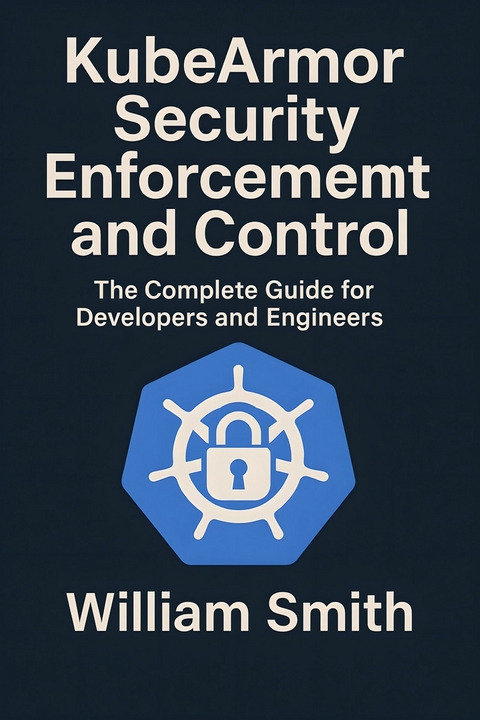
KubeArmor Security Enforcement and Control (eBook)
250 Seiten
HiTeX Press (Verlag)
978-0-00-102295-9 (ISBN)
'KubeArmor Security Enforcement and Control'
'KubeArmor Security Enforcement and Control' offers a comprehensive guide to mastering runtime security enforcement within modern Kubernetes and cloud-native environments. The book begins with an authoritative exploration of KubeArmor's architecture, highlighting its unique capabilities in enforcing granular security policies through deep kernel integration and eBPF instrumentation. Readers will gain foundational knowledge of the necessity for runtime controls, how KubeArmor compares to traditional solutions like SELinux, AppArmor, and seccomp, and the strategies for robust deployment and high availability across clusters of any scale.
Diving deep into practical usage, the book meticulously covers policy language, modeling, and lifecycle management, equipping security professionals and platform engineers with best practices for authoring, auditing, and automating security policies. Detailed chapters provide insights into file, process, and network enforcement, balancing policy granularity with system performance. Advanced sections address observability, telemetry, and forensic data analysis, enabling teams to streamline incident response and real-time threat detection while integrating KubeArmor events into SIEMs and cloud-native monitoring stacks.
Special attention is given to ecosystem integration and operational excellence in large-scale environments. Readers will learn about Kubernetes RBAC, admission controllers, service mesh interoperability, and the challenges of multi-tenancy and hybrid cloud security. The book also delves into performance engineering, automated scaling, and chaos testing to ensure reliability under stress. Forward-looking chapters discuss compliance, real-world incident analyses, automation in DevSecOps workflows, and the evolving future of runtime security, making this work essential for any practitioner responsible for securing cloud-native applications.
Chapter 2
Policy Language, Modeling, and Lifecycle
How expressive can your security controls be, and how easily can they evolve with your cloud-native infrastructure? This chapter dives deep into the sophisticated policy language at the heart of KubeArmor—decoding its syntax, semantics, and administration lifecycle. You’ll discover how precision modeling, dynamic adaptation, and advanced scoping keep your defenses sharp, resilient, and always aligned with both developer intent and operational realities.
2.1 The Structure of KubeArmor Policies
KubeArmor policies define the security posture of containerized workloads by specifying constraints on file operations, process executions, and network communications. These policies are composed of declarative rules expressed in a structured schema, which KubeArmor’s enforcement engine interprets to realize fine-grained control over system behavior. The architecture of a KubeArmor policy centers on a hierarchical organization of metadata, selectors, and permission rules that mediate between the Kubernetes environment and security primitives.
At the highest level, a KubeArmor policy is represented as a YAML manifest that integrates seamlessly within Kubernetes’ declarative configuration paradigm. The top-level fields provide metadata and specification references, essential for identifying the policy’s target scope and enforcement context. Notably, the selector field plays a vital role by filtering the set of pods or containers to which the policy applies based on label matching, ensuring precision in policy application.
The core semantic elements of a KubeArmor policy reside within three principal rule types: file, process, and network rules. Each rule type encapsulates conditions unique to its domain and articulates associated policy actions such as Allow or Block. Below, the formal syntactic constructs and semantic interpretations for these rules are examined in detail.
Selectors and Match Conditions
Selectors in KubeArmor policies determine the policy’s applicability within the cluster environment. They employ label-based matching on Kubernetes objects, most commonly pods and namespaces, to specify the workloads governed by the policy. For example:
matchLabels:
app: frontend
environment: production
Semantically, the selector accepts a pod if its labels include all specified key-value pairs. This form of conjunctive matching is essential for isolating security boundaries at various granularities.
The rules themselves may specify match conditions for files, processes, or network packets. These match conditions predicate the enforcement logic by evaluating attributes such as file paths, process names, syscalls, network protocols, and destination ports. Conditions may specify exact matches or prefix-based matches, broadening expressiveness while maintaining performance efficiency.
File Rules
File rules focus on governing read, write, or execution operations on file system objects by containerized workloads. Their syntax includes fields such as path, operation, and optionally action. For example:
matchPaths:
- path: /etc/passwd
operation: [read, write]
action: Block
- path: /app/config/
operation: [read]
action: Allow
Here, matchPaths defines an array of path-condition mappings. Each entry specifies the target file or directory path and the file operations whose access is regulated. The operation list may contain values such as read, write, append, and execute. The action determines whether matched operations are permitted or denied.
KubeArmor enforces these rules by intercepting system calls (e.g., open, read, write) and comparing the invoked operation against policy conditions. If a match occurs and the action is Block, the system call is denied, effectively isolating workloads from unauthorized file interactions.
Process Rules
Process rules constrain the execution of processes within containers. They specify criteria such as the executable path, command-line arguments, or the user identity under which the process runs. A typical process rule structure is:
matchPaths:
- path: /usr/bin/curl
action: Allow
- path: /bin/bash
action: Block
Here, path references the absolute path of the executable file. By defining a whitelist or blacklist of binaries, operators can enforce strict...
| Erscheint lt. Verlag | 13.7.2025 |
|---|---|
| Sprache | englisch |
| Themenwelt | Mathematik / Informatik ► Informatik ► Programmiersprachen / -werkzeuge |
| ISBN-10 | 0-00-102295-4 / 0001022954 |
| ISBN-13 | 978-0-00-102295-9 / 9780001022959 |
| Informationen gemäß Produktsicherheitsverordnung (GPSR) | |
| Haben Sie eine Frage zum Produkt? |
 EPUB (Adobe DRM)
Größe: 699 KB
Kopierschutz: Adobe-DRM
Adobe-DRM ist ein Kopierschutz, der das eBook vor Mißbrauch schützen soll. Dabei wird das eBook bereits beim Download auf Ihre persönliche Adobe-ID autorisiert. Lesen können Sie das eBook dann nur auf den Geräten, welche ebenfalls auf Ihre Adobe-ID registriert sind.
Details zum Adobe-DRM
Dateiformat: EPUB (Electronic Publication)
EPUB ist ein offener Standard für eBooks und eignet sich besonders zur Darstellung von Belletristik und Sachbüchern. Der Fließtext wird dynamisch an die Display- und Schriftgröße angepasst. Auch für mobile Lesegeräte ist EPUB daher gut geeignet.
Systemvoraussetzungen:
PC/Mac: Mit einem PC oder Mac können Sie dieses eBook lesen. Sie benötigen eine
eReader: Dieses eBook kann mit (fast) allen eBook-Readern gelesen werden. Mit dem amazon-Kindle ist es aber nicht kompatibel.
Smartphone/Tablet: Egal ob Apple oder Android, dieses eBook können Sie lesen. Sie benötigen eine
Geräteliste und zusätzliche Hinweise
Buying eBooks from abroad
For tax law reasons we can sell eBooks just within Germany and Switzerland. Regrettably we cannot fulfill eBook-orders from other countries.
aus dem Bereich


