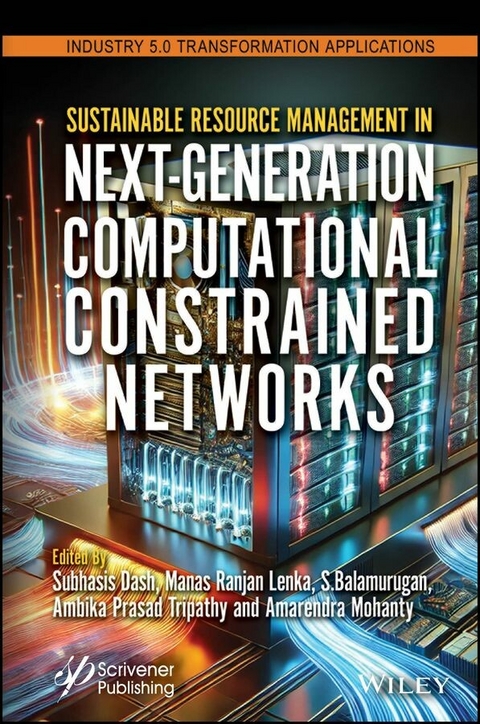
Sustainable Resource Management in Next-Generation Computational Constrained Networks (eBook)
602 Seiten
Wiley-Scrivener (Verlag)
978-1-394-21277-4 (ISBN)
The book provides essential insights into cutting-edge networking technologies that not only enhance performance and efficiency but also address critical sustainability challenges in an increasingly connected world.
The landscape of networking and computational technologies is rapidly evolving, driven by the increasing demand for efficient and sustainable resource management. The advent of next-generation technologies such as 5G and 6G has marked a significant leap in enabling high-capacity, low-latency communication and massive connectivity. These advancements are crucial for supporting the growing number of connected devices and complex applications they run, particularly in environments with limited processing, memory, and energy capabilities.
Sustainable Resource Management in Next-Generation Computational Constrained Networks provides insight into the advancements of recent cutting-edge networking technologies that cater to society's needs more efficiently, meeting the expectations of sustainable resource management in computationally constrained networks. By exploring the practical applications of various next-generation technologies, the book addresses critical challenges such as scalability, interoperability, energy efficiency, and security. This knowledge equips professionals with the tools to enhance network performance, optimize resource management, and develop innovative solutions for sustainable and efficient computational networks, ultimately contributing to the advancement of technology and societal well-being.
Readers will find this book:
- Provides thorough reviews on a wide range of cutting-edge network technologies contributing to resource management in computationally constrained networks;
- Explores the role of various network technologies for the development of sustainable applications;
- Details architectural viewpoints of integrating emerging network technologies with real-world applications to manage network resources efficiently;
- Highlights challenges in integrating the latest network technologies with sustainable real-world applications;
- Discusses real-world case studies of various network technologies in leveraging sustainable resource management for the fulfillment of different industrial and societal needs.
Audience
Software engineers, electronic engineers, and policymakers in the networking and security domain.
Subhasis Dash, PhD is an assistant professor in the School of Computer Engineering at the Kalinga Institute of Industrial Technology with over 22 years of teaching experience. His research interests include wireless sensor networks, distributed computing, and operating systems.
Manas Ranjan Lenka, PhD is an assistant professor in the School of Computer Engineering, at the Kalinga Institute of Industrial Technology with over 18 years of experience. His current research focuses on wireless sensor networks, mobile wireless networks, Internet of Things, and blockchain.
S. Balamurugan, PhD is the Director of Intelligent Research Consultancy Services and serves as a consultant for many other companies and start-ups. He has published over 70 books, 300 articles in national and international journals and conferences, and 300 patents. His research interests include artificial intelligence, machine learning, soft computing algorithms, and robotics and automation.
Ambika Prasad Tripathy is a senior technical leader with Cisco's Network Security Business Unit with over 17 years of experience. He has worked in the network industry to standardize Yang-based subscription mechanisms and their applications. He specializes in Sigtran, 3G, 4G core networks, switching and routing, telemetry, and datacenter, network, and cloud security.
Amarendra Mohanty is a senior engineer at the Intel Corporation in India with over 17 years of research experience. He has worked for a number of leading companies in the computer science field, including Intel, VMWare, TCS, and Aricent. His specializations include network security, network virtualization, data center networking, routing and switching, and 3G wireless networks in the development and QA fields.
Preface
The exponential growth of the internet and the increasing interconnectedness of devices worldwide have revolutionized our daily lives and resource management. As we navigate this technological surge, the imperative for sustainable resource management intensifies. This book provides an in-depth exploration of the latest advancements in networking technologies that meet these sustainability challenges.
The material herein explores the transformative potential of 6G and 5G technologies, which are set to overhaul our communication networks with their increased capacities, extensive connectivity, and low-latency features. These next-generation networks are crucial for enabling significant automation, thereby reducing energy demands and processing requirements. Additionally, the book examines the Internet of Things (IoT) and its industrial counterpart, Industrial IoT (IIoT), for their ability to revolutionize industrial cyber-physical systems. Despite IoT’s vast potential, its adoption has been curtailed by scalability, interoperability, and security issues. The discussion extends to how robust IIoT solutions can effectively tackle these challenges.
A focal point of the book is blockchain technology, which ensures robust end-to-end security in IoT environments, safeguarding against central attacks even if individual entry points are compromised. It also covers the roles of software-defined networking (SDN) and network function virtualization (NFV) in enhancing network scalability and facilitating dynamic service configurations. Moreover, the significance of mobile edge computing is highlighted, bringing computational power closer to data sources to boost real-time application performance while reducing latency and bandwidth usage.
The value of this book lies not only in its technological insights but also in its practical applications and real-world impacts, spanning intelligent homes, data centers, e-health, and smart cities. These technologies optimize resource management in computationally constrained networks, enhancing environmental sustainability and societal well-being. Targeted at a diverse readership of researchers, academicians, and industry professionals, the book provides a comprehensive understanding of current technological trends and their potential to drive sustainable resource management. It offers a detailed analysis of challenges and solutions, aiming to inspire further research and development in sustainable and efficient networking technologies. We hope this book serves as a valuable resource and a source of inspiration for those interested in the nexus of technology and sustainability, encouraging collaborative efforts and innovative thinking to forge a more sustainable future for our globally connected world.
Chapter 1 examines the use of Neurosky Mindwave Mobile 2 (NMM2) to monitor students’ cognitive activity in educational settings, enhancing learning through personalized video recommendations based on brain wave signals, with data analysis from institutions like the National Institutes of Technology Rourkela to optimize engagement and educational outcomes. Chapter 2 explores the integration of blockchain technology in supply chain management, emphasizing its role in enhancing transparency, traceability, and efficiency, addressing IoT security, and promoting sustainability through decentralized approaches and blockchain interoperability. Chapter 3 delves into the transformative impact of IoT on the aquaculture industry, using sensors, cameras, and RFID tags to collect and analyze real-time data on fish behavior and environmental conditions, significantly improving efficiency, reducing losses, and enhancing the sustainability of fish farming practices.
Chapter 4 delves into consumption optimization in Wireless Sensor Networks (WSNs), crucial for prolonging network lifetime and enhancing performance. It discusses strategies such as energy-efficient routing with protocols like LEACH and PEGASIS, data aggregation to reduce redundancy, duty cycling to save energy, and advanced methods like energy harvesting and adaptive algorithms to further optimize consumption, ensuring sustainable WSN operations.
Chapter 5 explores the significant reliance of U.S. consumers on online reviews and testimonials before making purchases, with 82% reading reviews and 40% doing so frequently. The chapter details a study that analyzed data from online airline reviews using advanced machine learning techniques like random forests and Convolutional Neural Networks (CNNs). The predictive analysis, based on over 3000 instances from www.airlinequality.com, aimed to identify the most suitable airlines from customer feedback, demonstrating how machine learning can enhance customer satisfaction and decision-making in the airline industry.
Chapter 6 discusses the accelerated shift towards online shopping and the rising need for contactless delivery solutions spurred by the COVID-19 pandemic. It provides a comprehensive overview of delivery robots, their adoption boosted by their ability to minimize human contact, reduce manpower, and decrease pollution. The chapter examines their development, functionality, and the challenges they face, highlighting their role in the Emerging Disruptive Technologies for Society 5.0 initiative and their effective use across various industries globally. It posits that as technologies evolve, delivery robots will play a crucial role in the future of logistics and transportation, enhancing goods delivery efficiency and safety, and fostering the creation of smarter, more sustainable societies.
Chapter 7 explores the integration of cloud computing with IoT, emphasizing how cloud services like SaaS, PaaS, and IaaS manage large volumes of IoT data. It discusses cloud-based IoT standards and protocols like MQTT and HTTP, and illustrates their applications in sectors like healthcare and agriculture. The chapter also highlights challenges such as security risks and presents case studies on smart home automation and industrial IoT, suggesting future research in edge computing and serverless processing.
Chapter 8 examines sensory networks within the IoT framework, focusing on their impact on industries like smart homes and healthcare. It details the role of IoT in enhancing functionalities such as home security and energy management with renewable sources. Challenges like interoperability and security are addressed, alongside the increasing role of wearable devices and edge computing in expanding IoT capabilities.
Chapter 9 discusses integrating AI with cloud security to combat data breaches, emphasizing the use of deep learning for malware detection and intrusion prevention. It outlines the importance of minimizing human error and advocates for a self-learning AI system to enhance security intelligence and protection of sensitive data. Strategies include deploying AI-operated servers and utilizing deep learning to strengthen cloud security defenses and ensure resilience against cyber threats.
Chapter 10 addresses the escalating threat of Distributed Denial of Service (DDoS) attacks and the innovative use of AI and machine learning to enhance network resilience. Researchers analyze DDoS attack patterns to develop countermeasures that improve real-time detection and mitigation, ensuring the integrity and accessibility of web infrastructures.
Chapter 11 introduces CyberEDU, a practical educational tool for simulating and preventing DDoS attacks, bridging the gap between theoretical knowledge and practical application. This tool enhances the skills of professionals and students, equipping them to effectively combat DDoS threats and contributing to a more prepared and aware cybersecurity workforce.
Chapter 12 explores effective resource management techniques in network systems constrained by limited resources. It discusses the optimization of bandwidth, buffer space, and computational assets to enhance network performance, minimize latency, and meet diverse performance objectives, providing crucial insights for practitioners and researchers navigating the complexities of network optimization.
Chapter 13 discusses the evolution of network architectures through software-defined networking (SDN), which separates network control from data forwarding to enhance flexibility and efficiency. It provides a detailed overview of SDN, including its architecture, components, and workflow, and examines its role in improving management in resource-constrained networks (RCNs). Additionally, the chapter explores SDN’s integration with IoT and 5G, aiming to familiarize newcomers with its transformative impact on modern networking.
Focusing on reducing vehicle emissions to combat global warming, Chapter 14 introduces an innovative system combining IoT and a CNN-SVM hybrid machine learning model. This system analyzes emission streams to identify high-polluting vehicles and prompts regulatory actions. By enhancing real-time monitoring and alert mechanisms, it supports environmental sustainability and energy efficiency in transportation, presenting a proactive solution to control emissions and mitigate air pollution.
Addressing the rising crime rates in Malaysia, this research integrates IoT technology with biometric systems to bolster home security. It proposes a biometric door lock system using fingerprint and facial recognition to prevent unauthorized access, while considering sustainable resource management in smart home systems. Chapter 15 highlights the advantages of biometric authentication and the importance of refining these systems to enhance residential security, advocating for the integration of...
| Erscheint lt. Verlag | 19.8.2025 |
|---|---|
| Reihe/Serie | Industry 5.0 Transformation Applications |
| Sprache | englisch |
| Themenwelt | Mathematik / Informatik ► Informatik |
| ISBN-10 | 1-394-21277-1 / 1394212771 |
| ISBN-13 | 978-1-394-21277-4 / 9781394212774 |
| Informationen gemäß Produktsicherheitsverordnung (GPSR) | |
| Haben Sie eine Frage zum Produkt? |
 EPUB (Adobe DRM)
Kopierschutz: Adobe-DRM
Adobe-DRM ist ein Kopierschutz, der das eBook vor Mißbrauch schützen soll. Dabei wird das eBook bereits beim Download auf Ihre persönliche Adobe-ID autorisiert. Lesen können Sie das eBook dann nur auf den Geräten, welche ebenfalls auf Ihre Adobe-ID registriert sind.
Details zum Adobe-DRM
Dateiformat: EPUB (Electronic Publication)
EPUB ist ein offener Standard für eBooks und eignet sich besonders zur Darstellung von Belletristik und Sachbüchern. Der Fließtext wird dynamisch an die Display- und Schriftgröße angepasst. Auch für mobile Lesegeräte ist EPUB daher gut geeignet.
Systemvoraussetzungen:
PC/Mac: Mit einem PC oder Mac können Sie dieses eBook lesen. Sie benötigen eine
eReader: Dieses eBook kann mit (fast) allen eBook-Readern gelesen werden. Mit dem amazon-Kindle ist es aber nicht kompatibel.
Smartphone/Tablet: Egal ob Apple oder Android, dieses eBook können Sie lesen. Sie benötigen eine
Geräteliste und zusätzliche Hinweise
Buying eBooks from abroad
For tax law reasons we can sell eBooks just within Germany and Switzerland. Regrettably we cannot fulfill eBook-orders from other countries.
aus dem Bereich