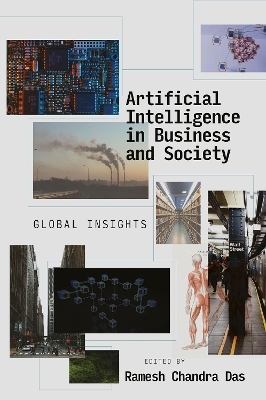
Artificial Intelligence in Business and Society
Emerald Publishing Limited (Verlag)
978-1-83708-023-6 (ISBN)
- Noch nicht erschienen (ca. Februar 2026)
- Versandkostenfrei
- Auch auf Rechnung
- Artikel merken
While AI is driving advancements in business and society, it also introduces challenges like ethical dilemmas and e-pollution. Its impact on both economic and social fronts is undeniable, with the potential to drive innovation, increase efficiency, and reduce waste. However, this great potential comes with significant responsibility, as the ethical implications and risks of AI must be carefully managed to harness its benefits for addressing global issues.
In Artificial Intelligence in Business and Society: Global Insights, authors delve into the multifaceted impacts of AI on business economics and social structures. This edited volume is divided into two sections: the first examines AI’s influence on economic growth, financial inclusion, and technological innovation, with contributions from experts across various fields. The second section explores AI’s social implications, including its role in education, job markets, health outcomes, elections, and human rights. Through diverse international perspectives, this work provides a comprehensive understanding of AI’s potential to drive sustainable development and address global challenges.
This collected edition is essential for policymakers, educators, business leaders, and anyone interested in the transformative power of AI. It offers valuable insights into how AI can drive sustainable development, improve human well-being, and address global challenges, while also highlighting the ethical considerations and risks involved.
Ramesh Chandra Das is Professor of Economics at Vidyasagar University, West Bengal, India. He has more than twenty-five years of teaching and research experience in a variety of economic fields including macroeconomics, financial economics, environmental economics and political economics.
Section I. Artificial Intelligence and its Roles upon Global Business and Economics
Chapter 1. Implications of AI Innovation on Economic Growth and Human Security: A Panel Data Study of an Emerging Economy; Napoleon Kurantin
Chapter 2. Role of Public Sector Banks Towards Financial Inclusion in the Era of AI: An Efficiency Review Study; Sagnik Maity and Amit Majumder
Chapter 3. Effect of Artificial Intelligence (AI) on GDP Growth of India in 2022: An Analysis; Suman Chakraborty and Riddhima Panda
Chapter 4. South Asian Labour Market Dynamics in the Era of Artificial Intelligence; Ashish Thakur
Chapter 5. Strategy Development with Artificial Intelligence Based Multi-Criteria Decision-Making Technique for Integration of Hospitals with Microgrids; Yaşar Gökalp, Serkan Eti, Hasan Dinçer, and Serhat Yüksel
Chapter 6. Coherence between Investment in Artificial Intelligence, Patent Seeking, GDP and Employment: A Cross Country Analysis; Shubhamita Sarkar and Ramesh Chandra Das
Chapter 7. Disruptive Digital Technologies in Emerging Artificial Intelligence: A Critical Analysis; José G. Vargas-Hernández, Omar C. Vargas-Gonzàlez, Selene Castañeda Burciaga, and Omar Alejandro Guirette Barbosa
Section II. Artificial Intelligence and Implications to Society
Chapter 8. Artificial Intelligence and the future of Education in Developing Economies: Theories and Empirics; Nilendu Chatterjee, Tonmoy Chatterjee, and Ghirmai Tesfamariam Teame
Chapter 9. Impact of Artificial Intelligence on the Future of Education, Skill Development and Job Market: Blessing or a Curse; Rajib Bhattacharyya and Kaushiki Banerjee
Chapter 10. Possibilities, Limitations and Pitfalls of Application of AI in the Arts and the Humanities: A Qualitative Study; Debdas Roy
Chapter 11. Early Adopters of AI and Gender Disparities in Health Outcomes; Vaishali Singh
Chapter 12. Unlocking the Interplay of Artificial Intelligence, Healthcare, Industrial Output, and Agriculture Productivity with Economic Development in BRICS Countries; Prasenjit Makur
Chapter 13. Artificial Intelligence in South Asian Elections: Balancing Engagement and Integrity Challenges; Saber Ahmed Chowdhury and Md. Zarif Rahman
Chapter 14. Impact of Artificial Intelligence on Human Rights: A Theoretical Analysis; Eyasin Khan and Joydev Barman
Chapter 15. Urban Public Transport Use and Socioeconomic Conditions in Genoa: A Logistic Regression Analysis and the Role of Artificial Intelligence; Martina De Anna, Enrico Ivaldi, and Enrico Musso
Chapter 16. Role of Artificial Intelligence in Society and Economics: A Critical Analysis; Satyesh Chandra Roy
| Erscheint lt. Verlag | 3.2.2026 |
|---|---|
| Verlagsort | Bingley |
| Sprache | englisch |
| Maße | 152 x 229 mm |
| Themenwelt | Informatik ► Theorie / Studium ► Künstliche Intelligenz / Robotik |
| Wirtschaft ► Betriebswirtschaft / Management ► Unternehmensführung / Management | |
| Wirtschaft ► Volkswirtschaftslehre | |
| ISBN-10 | 1-83708-023-2 / 1837080232 |
| ISBN-13 | 978-1-83708-023-6 / 9781837080236 |
| Zustand | Neuware |
| Informationen gemäß Produktsicherheitsverordnung (GPSR) | |
| Haben Sie eine Frage zum Produkt? |
aus dem Bereich