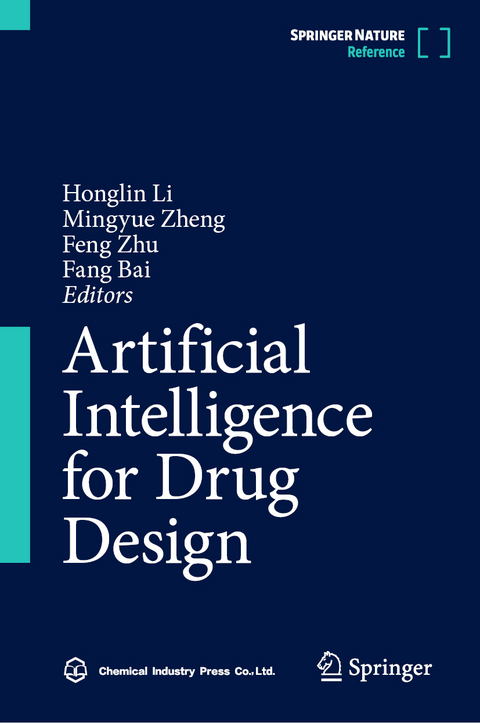
Artificial Intelligence for Drug Design
Springer Verlag, Singapore
978-981-95-2524-9 (ISBN)
- Titel nicht im Sortiment
- Artikel merken
Honglin Li Dean of the School of Pharmacy at East China Normal University and Director of the Innovation Center for AI and Drug Discovery. His research focuses on the development and application of computational methodologies for drug discovery and target identification, integrating artificial intelligence with experimental and theoretical approaches. Mingyue Zheng Professor and Principal Investigator at the Shanghai Institute of Materia Medica, Chinese Academy of Sciences. His work focuses on the development of artificial intelligence and big data-driven drug design technologies, including methods for biomedical big data mining, AI-powered precision drug design, and the discovery of novel targets and drug candidates. Feng Zhu Professor at the College of Pharmaceutical Science, Zhejiang University. His research focuses on identifying the druggability of therapeutic drug targets by leveraging AI and OMICs, developing innovative computational methods and online tools for drug target discovery, and investigating the mechanisms between drugs and key biological targets. Fang Bai Associate Professor jointly appointed in the School of Life Science and Technology and the Shanghai Institute for Advanced Immunochemical Studies at ShanghaiTech University. Her research focuses on developing advanced computational methods for drug design that integrate artificial intelligence with physical modeling. Recently, her work has addressed challenging drug targets—such as protein-protein interactions—by designing innovative therapeutic strategies, including molecular glues and PROTACs (proteolysis-targeting chimeras).
Part 1 Foundations of Machine Learning .- Chapter 1 Supervised Learning.- Chapter 2 Unsupervised Learning.- Chapter 3 Reinforcement Learning.- Chapter 4 Model Evaluation and Validation.- Chapter 5 Application Examples and Code.- Part 2 Fundamentals of Deep Network Architecture Design.- Chapter 6 Convolutional Neural Networks.- Chapter 7 Recurrent Neural Networks.- Chapter 8 Transformer.- Chapter 9 Graph Neural Networks.- Part 3 Deep Generative Models.- Chapter 10 Variational Self-Encoders.- Chapter 11 Generative Adversarial Networks 084.- Chapter 12 Stream Generative Models 088.- Part 4 Deep Reinforcement Learning.- Chapter 13 Value Function-Based Algorithms.- Chapter 14 Policy Gradient Algorithms.- Chapter 15 CartPole Programming Examples.- Part 5 Natural Language Processing, Knowledge Graphs, and Interpretable Artificial Intelligence.- Chapter 16 Natural Language Processing and Text Mining.- Chapter 17 Knowledge Mapping.- Chapter 18 Interpretable Artificial Intelligence.- Part 6 Molecular Structure and Bioactivity Data.- Chapter 19 Biomolecule Structure Database.- Chapter 20 Small Molecule Structure Databases.- Chapter 21 Bioactive Databases.- Part 7 Molecular Data Representation.- Chapter 22 Characterization of Small Molecule Compounds.- Chapter 23 Protein Characterization.- Chapter 24 Characterization of Nucleic Acid Sequences.- Part 8 Drug Target Discovery and Identification.- Chapter 25 Biomics Analysis and Drug Target Discovery and Drug Repositioning.- Chapter 26 Sequence-Based Discovery of Druggable Targets of Proteins.- Chapter 27 Structure- and Network-Based Drugable Target Identification.- Chapter 28 Network Pharmacology and Drug Redirection.- Part 9 Molecular Structure Prediction.- Chapter 29 Protein Structure Prediction.- Chapter 30 Nucleic Acid Structure Prediction.- Chapter 31 Conformational Prediction of Small Molecules.- Part 10 The Developments in Quantum Chemistry and Molecular Force Fields.- Chapter 32 Artificial Intelligence for Computational Chemistry.- Chapter 33 Development and Optimization of Molecular Force Fields.- Part 11 Small Molecule Drug Synthesis and De Novo Design .- Chapter 34 Fragment-Based Drug Design.- Chapter 35 Molecular Generative Modeling.- Chapter 36 Three-Dimensional Molecular Generation.- Chapter 37 Inverse Synthesis Prediction.- Chapter 38 Reaction Performance Prediction and Reaction Condition Optimization.- Part 12 Small Molecule Drug Design and Optimization.- Chapter 39 Small Molecule-Target Binding Affinity Prediction and Scoring Function Design.- Chapter 40 Molecular Docking and Virtual Screening Methods Incorporating Artificial Intelligence.- Chapter 41 Ligand-Based Virtual Screening.- Part 13 AI-Based Design of Macromolecular Drugs.- Chapter 42 Macrocyclic Drug Design.- Chapter 43 Protein and Peptide Macromolecular Drug Design.- Chapter 44 Nucleic Acid Macromolecular Drug Design.- Part 14 ADMET Property Prediction.- Chapter 45 Artificial Intelligence-Based ADMET Prediction.- Chapter 46 Drug Toxicity Prediction.- Chapter 47 Drug Metabolite Prediction.- Part 15 Drug Crystal Form Prediction and Formulation Design.- Chapter 48 Drug Crystal Form Prediction.- Chapter 49 Drug Dosage Form Design.
| Erscheinungsdatum | 29.11.2025 |
|---|---|
| Zusatzinfo | 215 Illustrations, color; 32 Illustrations, black and white |
| Verlagsort | Singapore |
| Sprache | englisch |
| Maße | 155 x 235 mm |
| Themenwelt | Informatik ► Theorie / Studium ► Künstliche Intelligenz / Robotik |
| Medizin / Pharmazie ► Medizinische Fachgebiete ► Pharmakologie / Pharmakotherapie | |
| Medizin / Pharmazie ► Pharmazie | |
| Technik ► Umwelttechnik / Biotechnologie | |
| ISBN-10 | 981-95-2524-1 / 9819525241 |
| ISBN-13 | 978-981-95-2524-9 / 9789819525249 |
| Zustand | Neuware |
| Informationen gemäß Produktsicherheitsverordnung (GPSR) | |
| Haben Sie eine Frage zum Produkt? |
aus dem Bereich