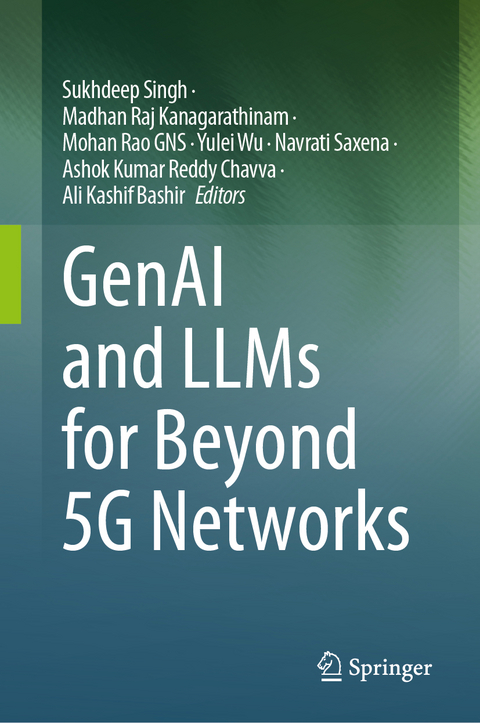
GenAI and LLMs for Beyond 5G Networks
Springer International Publishing (Verlag)
978-3-032-06417-2 (ISBN)
- Noch nicht erschienen - erscheint am 13.02.2026
- Versandkostenfrei
- Auch auf Rechnung
- Artikel merken
Beyond 5G and 6G Networks, the AI-Native Revolution explores the transformative convergence of generative artificial intelligence (GenAI), large language models (LLMs), and next-generation telecommunications. This book delves into the architectural innovations enabling AI-driven connectivity, from intelligent edge devices to adaptive radio access networks. It covers the integration of GenAI for real-time network optimization, generative modeling of wireless channels, and advanced analytics for actionable insights. Security frameworks for AI-native systems, orchestration of autonomous networks, and the fusion of AI with signal processing are thoroughly examined, offering practical solutions for researchers, engineers, and policymakers.
The book also addresses the challenges of computational constraints, ethical dilemmas, and regulatory complexities in deploying AI-driven networks. It provides a technical yet accessible roadmap for building equitable, trustworthy, and efficient systems, balancing innovation with responsibility. With insights grounded in rigorous research and real-world applications, this work is a guide for students, practitioners, and visionaries shaping the future of connectivity. It invites readers to reimagine networks as intelligent ecosystems that anticipate needs and empower humanity s highest aspirations.
Dr. Sukhdeep Singh is a General Manager at Samsung R&D Institute India – Bangalore, with over 9 years of impactful experience in AI/ML-driven telecom innovation, specializing in 5G/6G networks, Open RAN, and network digital twins. Prior to this he has received is Ph.D. from SKKU South Korea along with Superior Research Award. He has authored 55+ peer-reviewed publications, filed 60+ global patents (including US patents) and co-edited pioneering books including 6G Mobile Wireless Networks, AI in Wireless for B5G Networks, and GenAI & LLMs for B5G Networks. Dr. Singh is a recipient of numerous prestigious honors, including the IETE B. V. Baliga Memorial Award 2024, Best Research Paper Award at IEEE ICC 2024, 15 Samsung Excellence Awards, 5 Samsung Annual Author Awards, and Samsung Best Paper Award 2018 (Silver) conferred by Samsung CEO in Korea. He has mentored two flagship innovation programs in India, Invention Factory organized by IIT Bombay and IIT Jammu and Samsung's Solve for tomorrow. He has been featured in Forbes, Tedx, Outlook India, CNBC, Global Samsung Newsroom, and has served as General Chair at IEEE workshops, and visiting faculty at institutions such as Manipal University, making him a globally recognized thought leader in next-generation telecom and AI. Dr. Madhan Raj Kanagarathinam received the BE degree in computer science and engineering from Anna University, Chennai, India, in 2012. He pursued his MS and Ph.D. from Indian Institute of Technology (IIT) Madras. He has nine years of working experience in design and development of TCP/IP protocols, Multipath TCP and UNIX flavored operating systems. Currently, he is working as a Senior Chief Engineer for Samsung R&D Institute India Bangalore. Previously, he worked as an Engineer with Aricent Technology (India) Private Limited. He is the author of 30 articles, and more than 140 patents. His current research interests include communication and network which include Pre-6G/Beyond 5G, Next Generation Mobile Network, software defined network architecture, wireless transport layer protocols, and cross layer optimization technique. He is also the winner of IEEE Bangalore Young Technologist of the Year 2020. He is a senior member of the IEEE, and a member of the ACM. Mr. Mohan Rao GNS is the Corporate Vice President and Managing Director at Samsung Research & Development Bangalore (SRI-B). Having spent 26 years with Samsung, he has spearheaded ‘All Generations’ of Mobile and Network Protocol R&D spanning multiple markets and operators. He and his team have been key contributors to Wireless Protocol standardization, Securing multiple essential patents, End-to-end stack development of Inter RAT Protocols, Mobility Management, Protocol Systems, IMS, VoLTE/VoNR, RCS and many such cutting edge technologies. Post 5G deployment in the USA and European markets, they are now driving 6G Wireless Communications Research. Mohan is also a key proponent of kernel, application platform. He also handles and nurtures the Global talent pool across Samsung Electronics. Apart from building the Centre of Excellences, he also serves as a leader for the Overall Strategy development at SRIB. He received BE degree in Electronics & Communication in Nagarjuna University, Vijayawada, India in 1995 and stood as University Topper. He also did Management Course in Indian Institute of Management, Bangalore With 25+ patents in Wireless domain, he has received numerous awards including the prestigious "Best Overseas R&D Employee" twice from the President of Samsung Electronics. He was recently conferred Zinnov’s “Best Global Leader” award. He also won the Indian Achiever Award for “CTO of the Year” in Y2024. Prof. Yulei Wu is an Associate Professor working across the Faculty of Science and Engineering and the Bristol Digital Futures Institute, University of Bristol, UK. He is also a member of the Smart Internet Lab. He received his Ph.D. degree in Computing and Mathematics and B.Sc. (1st Class Hons.) degree in Computer Science from the University of Bradford, UK, in 2010 and 2006, respectively. His research interests focus on digital twins and ethics-responsible decision making and their applications on future networks, networked systems, and digital infrastructure. Before joining the University of Bristol, Dr. Wu was working in the University of Exeter and the Chinese Academy of Sciences (CAS). He is currently leading Smart Networks and Services (SmartNetS) Lab. His research has mainly been supported by the Engineering and Physical Sciences Research Council (EPSRC), Royal Society, University's Innovation Platform and industry. He has published more than 10 authored/edited monograph books, and over 150 research papers in prestigious international journals, including IEEE Journal on Selected Areas in Communications, IEEE Transactions on Parallel and Distributed Systems, IEEE Transactions on Mobile Computing, IEEE Transactions on Network and Service Management, IEEE Transactions on Communications, IEEE Transactions on Wireless Communications, IEEE Transactions on Vehicular Technology, IEEE Communications Magazine, IEEE Network, ACM Transactions on Internet Technology, and ACM Transactions on Multimedia Computing, Communications, and Applications, and at reputable international conferences such as ICDCS, IPDPS, GLOBECOM, ICC and WCNC. He authored/co-authored 8 ESI highly-cited papers by Clarivate Analytics and was the recipient of 5 Best Paper/Abstract Awards conferred by reputable international conferences. Some of his research results were featured by the IEEE Network Scanning the Literature and the IEEE Xplore Innovation Spotlight. He is the holder of 7 patents. He was elected as a Member of Youth Innovation Promotion Association of Chinese Academy of Sciences. He has been named in the Standford’s Top 2% Most Highly Cited Scientist since 2021. He has delivered more than 20 keynote/invited talks at technical conferences and institutions. He has supervised/co-supervised 7 PhD students to graduation. Dr. Wu serves as an Associate Editor of IEEE Transactions on Network and Service Management (TNSM) and IEEE Transactions on Network Science and Engineering (TNSE), as well as an Editorial Board Member of Computer Networks, Future Generation Computer Systems, and Nature Scientific Reports at Nature Portfolio. He also served/serves as a Guest Editor for many international journals, including IEEE Journal on Selected Areas in Communications (JSAC), IEEE Transactions on Industrial Informatics (TII), IEEE Transactions on Cognitive Communications and Networking (TCCN), IEEE Transactions on Sustainable Computing, and IEEE Transactions on Computational Social Systems (ICSS). Dr. Wu contributes to many conferences on his research areas as various roles, including the General Chair and the Program Chair. He has also served as the Program Committee Member of numerous professional conferences/workshops. He is a founder Steering Committee Chair of IEEE International Conference on Smart Computing, Networking and Services (SmartCNS). He was awarded the Outstanding Leadership Awards from IEEE Blockchain-2020, IEEE HPCC-2018, IEEE CIT-2017, IEEE ISPA-2013, and IEEE TrustCom-2012. He has also been a Reviewer for Newton Prize, many book proposals and grant proposals, as well as international conferences and journals including many IEEE/ACM Transactions and Magazines. He won the TNSE Excellent Editor Award in 2021 and 2022, and was awarded the Outstanding Contribution in Reviewing by Future Generation Computer Systems in 2018. He is chairing an IEEE Special Interest Group (SIG) on Ethical AI for Future Networks and Digital Infrastructure (2023-), and serving as Vice Chair Europe/Africa of IEEE ComSoc Cognitive Networks Technical Committee (2025-2026) and Technical Program Chair of IEEE ComSoc Network Operations and Management Technical Committee (2023-2025). He is a Senior Member of the IEEE and the ACM, and a Fellow of the HEA (Higher Education Academy). Prof. Navrati Saxena is an Associate Professor at the Department of Computer Science, San Jose State University (SJSU), California, USA. Prior to joining SJSU, she worked as an Assistant/Associate Professor and Director of the Mobile Ubiquitous System Information Center (MUSIC) at the College of Information and Communication Engineering (CICE), Sungkyunkwan University (SKKU), South Korea. At SKKU Prof. Saxena supervised 12 Ph.D. and 22 MS (research) students. She also served as an International student advisor in SKKU. Prior to joining SKKU, Prof. Saxena was a visiting researcher at the University of Texas at Arlington, USA. She received her Ph.D. degree from the University of Trento, Italy. Her research interests involve 5G wireless, IoT, social networking, smart grids, Device to Device (D2D), vehicular communications, and the like. She has co-authored one book; filed two patents and published one International book chapter on 6G; more than 90 Intl. journals and many Intl. conferences, with more than 4,000 citations (Google Scholar). She also serves as a guest editor in different Intl. journals, Technical Program Committee (TPC) Chair/member in many Intl. conferences. Mr. Ashok Kumar Reddy Chavva (Senior Member, IEEE) received the B.Tech. degree in electronics and communications engineering from Jawaharlal Nehru Technological University, Hyderabad, India, in 2003, and the M.E. degree in telecommunication engineering from Indian Institute of Science (IISc), Bengaluru, India, in 2005. In June 2005, he joined the wireless startup Beceem Communications, which was later acquired by Broadcom. Here, he worked on developing physical layer algorithms for the first 4G systems based on WiMAX and LTE. He remained with Broadcom until November 2013. Since then, he has been with the Samsung R&D Institute India-Bengaluru, where he currently leads a research and development team focused on the design of beyond-5G and 6G cellular systems. His research interests include physical layer algorithm design, performance evaluation of wireless communication systems, 5G NR and 6G system design, millimeter-wave communications, and the application of artificial intelligence to wireless systems. He has published 50+ papers in reputed international journals and conferences, and has 35+ granted patents. He received the Best Paper Award from IEEE CCNC, Las Vegas, USA, in 2016, the Best Paper (Third) from IEEE World 5G Forum, in 2020, and the winner of two challenges from ITU AI/ML 5G Challenge in 2021 and 2022. Prof. Ali Kashif Bashir holds the position of Professor of Computer Networks and Cybersecurity at the Manchester Metropolitan University in the United Kingdom. Additionally, he serves as the leader of the Future Networks lab. Throughout his career, Ali has presented more than 45 keynote speeches at international conferences, produced over 300 research articles, and successfully overseen multimillion-dollar projects worldwide. His students have won best paper awards, best PhD thesis awards, and several other recognitions. His research interests include internet of things/cyber physical systems, smart infrastructures, cybersecurity, and AI algorithms to solve interdisciplinary problems of networks and security. Ali is member of Council of Professors and Heads of Computing (CPHC), UK; an expert reviewer of EPSRC, UK, Irish Research Council, Ireland, National Sciences and Engineering Research Council (NSERC), Canada, MITACS, Accelerate, Canada, Qatar National Research Fund (QNRF), and Commonwealth, UK. He enjoys 7 honorary and adjunct professor positions across the globe. He was listed as IEEE Featured Author in 2021, highly cited 2% researchers by Stanford University 2021 and 2022, shortlisted for Clarivate Highly Cited award 2023. He is AE of over 10 international ISI indexed journals including two IEEE Transactions, and Scientific Reports, Nature, and EIC of IEEE Technology, Policy and Ethics, and Journal of Autonomous Intelligence.
Chapter 1 Introduction.- Chapter 2 Unlocking One-for-all Generative AI at Edge.- Chapter 3 Legal and Regulatory Frameworks Governing Generative AI for Enterprises.- Chapter 4 Securing GenAI and LLMs in Beyond 5G/6G UE and Networks.- Chapter 5 Designing Guardrails: Ensuring Responsible AI Behavior.- Chapter 6 GENATWIN: Enabling Scalable AI Evaluation in B5G Networks: A GenAI-Powered Digital Twin Framework.- Chapter 7 Large Generative AI Models in Telecom (GenAINet).- Chapter 8 Computational Aspects for Large Language Models (LLMs) in Radio Access Network (RAN).- Chapter 9 GenAI & LLMs for Source and Channel Coding in B5G Networks.- Chapter 10 Modeling Wireless Channels with Generative AI.- Chapter 11 Machine Learning-Based Intelligent Anomaly Detection and Maintenance in RAN.- Chapter 12 Intent-Based Networking and Conflict Resolution in B5G with LLMs and Explainable AI.- Chapter 13 A framework for Intent-Driven Kubernetes configuration generation using Large Language Models.- Chapter 14 Agent Orchestration for Resource Allocation in Self-Healing Networks.- Chapter 15 Leveraging Large Language Models (LLMs) for Service Optimization in Beyond 5G (B5G) Networks.- Chapter 16 AI-based On-Device Traffic Classification for Next Generation Mobile Network.- Chapter 17 Advanced Data Management & Analytics Using Large Language Models for B5G Networks.- Chapter 18 Conclusion.
| Erscheint lt. Verlag | 13.2.2026 |
|---|---|
| Zusatzinfo | X, 330 p. 75 illus., 59 illus. in color. |
| Verlagsort | Cham |
| Sprache | englisch |
| Maße | 155 x 235 mm |
| Themenwelt | Mathematik / Informatik ► Informatik ► Netzwerke |
| Informatik ► Software Entwicklung ► Mobile- / App-Entwicklung | |
| Informatik ► Theorie / Studium ► Künstliche Intelligenz / Robotik | |
| Schlagworte | 5G Networks • 6G Core • 6G networks • 6G RAN • Automation • B5G Core • B5G Networks • B5G RAN • Cloud Computing • Dynamic Network Slicing • energy efficiency • GenAI • Intelligent Orchestration • Large Language Models • LLMS • Network Management • Open RAN • Service Management • virtualization • vRAN |
| ISBN-10 | 3-032-06417-1 / 3032064171 |
| ISBN-13 | 978-3-032-06417-2 / 9783032064172 |
| Zustand | Neuware |
| Informationen gemäß Produktsicherheitsverordnung (GPSR) | |
| Haben Sie eine Frage zum Produkt? |
aus dem Bereich