


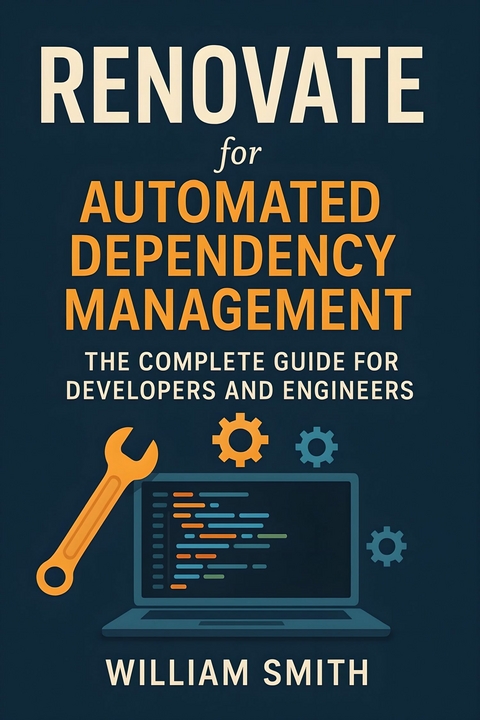
Renovate for Automated Dependency Management (eBook)
250 Seiten
HiTeX Press (Verlag)
978-0-00-101822-8 (ISBN)
'Renovate for Automated Dependency Management'
In an era marked by software complexity and relentless change, 'Renovate for Automated Dependency Management' offers an unrivaled deep dive into the world of automated dependency management. The book begins with a sweeping overview of how organizations have evolved from painstaking manual updates to sophisticated systems capable of seamlessly managing dependencies at scale. Through a comparative exploration of leading tools and the challenges faced by modern enterprises, it positions automated dependency management as a critical pillar within contemporary DevOps and Site Reliability Engineering practices.
The heart of the work is a comprehensive technical guide to Renovate, an industry-leading automation solution. Readers are led through its architectural foundations, from core functionality to policy enforcement and process orchestration. The text deftly details advanced configuration strategies, real-world integration patterns with CI/CD workflows, and the mechanisms that ensure security, compliance, and risk management in regulated environments. Special emphasis is placed on scalability-addressing scenarios from isolated projects to massive, multi-tenant enterprise deployments-as well as the extensibility required to handle both mainstream and edge-case ecosystems.
Drawing on rich case studies and practical strategies, the book provides actionable insights for both engineering leaders and hands-on practitioners. It guides organizations through the journey from manual to automated workflows, delivering techniques for fostering adoption, managing exceptions, and continuously measuring business value. With a closing look at future trends including AI-driven automation, software supply chain security, and open-source governance, 'Renovate for Automated Dependency Management' equips readers with the vision and expertise needed to navigate the evolving landscape of automated software maintenance.
Chapter 2
Renovate: Architecture and Internals
Dive beneath the surface of Renovate to discover the sophisticated engineering that fuels its leading-edge automation. This chapter illuminates the architectural principles, extensibility models, and operational safeguards that enable Renovate to handle the demand of large-scale dependency management with both flexibility and precision. If you want to harness—or extend—the true power of Renovate, understanding its internals is essential.
2.1 Core Functional Architecture
Renovate’s architecture is a sophisticated orchestration of modular components designed to automate dependency updates across diverse codebases. At its foundation lie distinct yet interconnected layers that handle repository onboarding, configuration parsing, update detection, pull request (PR) creation, and lifecycle management. These layers are underpinned by rigorous data modeling and decision logic to ensure precision and adaptability in automation workflows.
Central to the architecture is the Repository Onboarding module, which facilitates the initial integration of new repositories into the Renovate ecosystem. Upon onboarding, the module performs a detailed repository scan, extracting relevant metadata such as dependency files, version constraints, branch structure, and existing PR states. This data feeds into a structured repository model, represented internally as a combination of configuration objects and dependency trees. The configuration hierarchy respects Renovate’s declarative scope rules, enabling settings to be inherited, merged, or overridden from global to repository and package levels.
Following onboarding, the Configuration Parser interprets the repository’s Renovate configurations, typically expressed in JSON or YAML, converting them into actionable update policies. This parser handles complex constructs including scheduling rules, package grouping, automerge criteria, and semantic commit conventions. Its design upholds extensibility, allowing the introduction of plugin-based enhancements for specialized dependency ecosystems. Importantly, configuration merging logic resolves conflicts deterministically, prioritizing explicit repository settings while maintaining global defaults.
The Dependency Extraction Engine is tasked with analyzing the repository’s manifest and lock files to identify dependencies, their current versions, and allowable version ranges. This engine supports multiple package managers (e.g., npm, Maven, Docker), each with bespoke parsers and rules encapsulated via an adapter pattern. Dependency data structures are modeled as directed acyclic graphs (DAGs), wherein nodes represent packages and edges denote inter-package relationships or version constraints. This graph representation enables efficient traversal and incremental updates, particularly for transitive dependencies.
At the core of Renovate’s automation lies the Update Detection and Decision Engine. This module continuously queries external registries and version control platforms to identify newer package versions that satisfy the established constraints. Incorporating heuristics and prioritization strategies, it filters out negligible updates, such as patch releases that do not impact security or functionality unless explicitly configured otherwise. When multiple updates exist, the engine applies grouping policies to batch compatible upgrades into singular PRs, optimizing developer workflow.
The Pull Request Orchestrator governs the lifecycle of Renovate’s automated PRs. Once candidate updates are identified, this orchestrator composes branch names, commit messages, and PR titles based on configurable templates adhering to semantic versioning and changelog standards. It interfaces with Git hosting services (e.g., GitHub, GitLab) via REST or GraphQL APIs to create, update, or close PRs programmatically. The orchestrator also manages branch rebasing and conflict resolution strategies, including options for automerge upon successful checks.
A complementary State Management System persists all runtime information related to update attempts, PR statuses, and merge decisions. It employs a transactional key-value store optimized for concurrency, ensuring consistency across distributed Renovate workers. This system tracks metrics for each repository and update batch, facilitating analytics and alerting capabilities.
Coordination among these modules is achieved through an event-driven framework. Internal events such as “repository onboarded,” “configuration parsed,” and “update detected” trigger downstream processing stages, enabling asynchronous and scalable execution. This design supports high-throughput environments, where thousands of repositories may be monitored and updated simultaneously.
Data models are rigorously defined using TypeScript interfaces for strong type enforcement, providing clarity and maintainability. The principal entities include:
- RepositoryConfig: encapsulates all user-defined settings applicable to a repository.
- DependencyGraph: models dependencies and their relationships.
- UpdateCandidate: represents a potential version upgrade subject to review.
- PullRequestMetadata: contains all information for PR generation and tracking.
Decision engines combine rule-based policies with heuristics, balancing automation aggressiveness and risk. For example, Renovate can prioritize security updates or defer non-critical updates based on user preferences. This modulability empowers teams to tailor automation intensity.
Overall, Renovate’s core functional architecture exemplifies a modular, scalable, and extensible system that reliably automates dependency management. By precisely modeling repositories and dependencies, parsing declarative configurations, detecting actionable updates, and orchestrating PR lifecycles, the architecture enables continuous integration pipelines to maintain up-to-date, secure codebases with minimal human intervention.
2.2 Configuration Engine and Policy Enforcement
Renovate’s configuration engine is engineered to manage policy complexity with a high degree of precision and flexibility, enabling organizations to enforce consistent upgrade practices across diverse project environments. At its core, the engine interprets declarative configuration files that define how dependencies are to be monitored, updated, and maintained. These configurations, expressed in hierarchical JSON or YAML formats, support nested inheritance and fine-grained overrides, facilitating policy enforcement that adapts dynamically to changing organizational needs.
The interpretation of configuration occurs in a multi-phase process. Initially, Renovate loads global default configurations which establish baseline rules for dependency updates, such as versioning policies, update schedules, and semantic versioning constraints. These defaults propagate through nested scopes-repository-level configurations, package files, and even directory-specific overrides-allowing increasingly specific rules to supersede broader policies. This layered merging is accomplished by a deterministic algorithm that performs deep object merging while respecting data types and key-specific merging strategies. Scalars are overwritten, arrays may be concatenated or replaced based on explicit directives, and objects merge recursively to preserve nested policy structures.
To illustrate, consider a policy hierarchy where a global setting enforces a weekly update cadence, but a particular repository requires daily update checks for critical dependencies. This is represented in Renovate’s configuration by a global schedule key set to "weekly", overridden in the repository’s local configuration by a schedule key set to "daily". The engine merges these settings such that the repository obeys its more aggressive policy without altering the global baseline:
"schedule": ["every weekend"], // Global default
"repositories": {
...
| Erscheint lt. Verlag | 15.8.2025 |
|---|---|
| Sprache | englisch |
| Themenwelt | Mathematik / Informatik ► Informatik ► Programmiersprachen / -werkzeuge |
| ISBN-10 | 0-00-101822-1 / 0001018221 |
| ISBN-13 | 978-0-00-101822-8 / 9780001018228 |
| Informationen gemäß Produktsicherheitsverordnung (GPSR) | |
| Haben Sie eine Frage zum Produkt? |
 EPUB (Adobe DRM)
Größe: 730 KB
Kopierschutz: Adobe-DRM
Adobe-DRM ist ein Kopierschutz, der das eBook vor Mißbrauch schützen soll. Dabei wird das eBook bereits beim Download auf Ihre persönliche Adobe-ID autorisiert. Lesen können Sie das eBook dann nur auf den Geräten, welche ebenfalls auf Ihre Adobe-ID registriert sind.
Details zum Adobe-DRM
Dateiformat: EPUB (Electronic Publication)
EPUB ist ein offener Standard für eBooks und eignet sich besonders zur Darstellung von Belletristik und Sachbüchern. Der Fließtext wird dynamisch an die Display- und Schriftgröße angepasst. Auch für mobile Lesegeräte ist EPUB daher gut geeignet.
Systemvoraussetzungen:
PC/Mac: Mit einem PC oder Mac können Sie dieses eBook lesen. Sie benötigen eine
eReader: Dieses eBook kann mit (fast) allen eBook-Readern gelesen werden. Mit dem amazon-Kindle ist es aber nicht kompatibel.
Smartphone/Tablet: Egal ob Apple oder Android, dieses eBook können Sie lesen. Sie benötigen eine
Geräteliste und zusätzliche Hinweise
Buying eBooks from abroad
For tax law reasons we can sell eBooks just within Germany and Switzerland. Regrettably we cannot fulfill eBook-orders from other countries.
aus dem Bereich


