


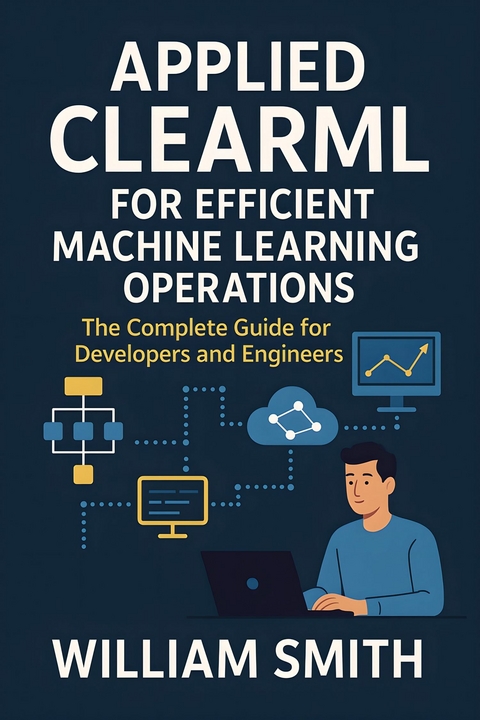
Applied ClearML for Efficient Machine Learning Operations (eBook)
250 Seiten
HiTeX Press (Verlag)
978-0-00-101820-4 (ISBN)
'Applied ClearML for Efficient Machine Learning Operations'
'Applied ClearML for Efficient Machine Learning Operations' presents a comprehensive exploration of ClearML as a powerhouse platform within the modern MLOps landscape. The book opens by grounding readers in the evolution from DevOps to MLOps, dissecting the unique lifecycle, security, and scalability challenges inherent in production machine learning. Delving deeply into ClearML's architecture, readers gain a nuanced understanding of its client-server-agent design and core extensibility, while thoughtful comparisons to solution peers like MLflow and Kubeflow offer a critical perspective on its unique value proposition.
The journey continues with a rich, practical focus on advanced experiment management, data and artifact lifecycle handling, and pipeline orchestration. Readers are equipped with actionable approaches for experiment tracking, dependency management, and collaborative workflow design. ClearML's robust integrations with external data science tools, support for distributed and cost-efficient model training, and detailed guides for building reproducible, auditable, and compliant ML systems make this volume an indispensable resource for professionals aiming to scale their operations reliably and securely.
Finally, the book turns toward future trends and innovative use cases, illustrating how ClearML enables cutting-edge AutoML, federated learning, and human-in-the-loop workflows. Practical guidance on production deployment, real-time inference, advanced security, and enterprise-grade governance ensures readers are empowered to operationalize ML at scale. Whether automating routine pipelines, optimizing resource allocation, or orchestrating complex cross-system workflows, this in-depth guide positions ClearML as an essential platform for delivering value across the entire ML lifecycle.
Chapter 2
Advanced Experiment Tracking and Management
Beneath every successful machine learning project lies a tangle of experiments, artifacts, and hidden dependencies. This chapter guides you through the art and science of mastering experiment management with ClearML—from structuring metadata to enabling true collaboration and reproducibility. Uncover strategies for integrating metrics, tracking every detail, and aligning your workflows with rigorous research and scalable production.
2.1 Experiment Data Structures and Metadata Schemas
The design of experiment data models within ClearML offers an intricate yet coherent framework for representing the diverse components involved in machine learning workflows. At the core lies the run metadata, a comprehensive record encapsulating the lifecycle of a single execution, which serves as the foundation for traceability, reproducibility, and subsequent analysis.
The run metadata schema organizes information into several interrelated domains. First, hyperparameters are systematically captured as key-value pairs, allowing for rigorous parameter tracking and comparisons across experiments. These hyperparameters often include nested or hierarchical configurations, necessitating flexible serialization formats such as JSON or YAML. ClearML ensures normalized storage of hyperparameters, preserving both data types and semantic relationships. This precise capture facilitates fine-grained querying and enables statistical analyses across multiple runs to discern parameter influence on outcomes.
Secondly, the metadata model incorporates code versioning information integral to ensuring reproducibility. Rather than relying solely on externally managed version control systems, ClearML embeds explicit references to the code state used during execution. This includes commit hashes, repository URLs, branch names, and any relevant patch information. In situations where code is programmatically modified or dynamically generated, ClearML supports capturing the full source bundle or diff artifacts. This embedded approach to code version metadata guarantees that any subsequent re-execution or audit accesses the exact source context, thereby preventing the notorious “code drift” problem that plagues long-term experiments.
Thirdly, the environment capture forms a crucial pillar of the metadata schema. This comprises details about the software stack, including Python packages, system libraries, operating system versions, hardware configurations, and container specifications where applicable. ClearML employs automated mechanisms to extract environment descriptors such as pip freeze outputs, Conda environment specifications, or Docker metadata. Importantly, these environment snapshots are normalized into structured metadata fields, enabling cross-run environment comparisons and facilitating automated environment reconstruction.
ClearML’s metadata schemas are designed with forward- and backward-compatible schema evolution in mind. The evolving nature of machine learning experiments, frameworks, and infrastructure necessitates a metadata schema that can gracefully accommodate extensions and modifications without disrupting existing dataset integrity. To achieve this, ClearML employs versioned JSON schema definitions for its metadata entities, alongside flexible fields dedicated to user-defined or experimental metadata. This capability enables incremental schema enhancements like adding new environment variables, supporting novel metadata types (e.g., GPU topology), or capturing custom runtime metrics. Consequently, legacy runs remain accessible and interpretable under newer schema versions, while newly created runs benefit from additional metadata richness.
Extensibility is further facilitated by ClearML’s modular metadata architecture. The schema design partitions metadata into atomic yet interlinked components. Each run record references discrete metadata objects such as hyperparameter sets, code snapshots, or environment manifests, which themselves may evolve independently. This modularity permits selective updates, reusability of metadata entities across multiple runs, and efficient metadata querying strategies. Additionally, ClearML exposes APIs permitting users to inject and manage domain-specific metadata alongside core experimental data without altering the primary schema, thus enabling tailoring to diverse research needs.
The benefits of meticulous metadata management in ClearML are multifold. Traceability is achieved by creating unambiguous causal links between runs, datasets, code, and environments. This comprehensive provenance information is indispensable for auditing experiments, diagnosing failures, or satisfying regulatory requirements in sensitive application domains. Rigorous metadata tracking enables full reproducibility, allowing future users or automated systems to reconstruct the exact experimental context and replicate results accurately, a cornerstone of scientific rigor in machine learning research.
Moreover, detailed metadata schemas unlock robust downstream analysis. Structured hyperparameter and performance data support hyperparameter optimization workflows, meta-learning, and automated machine learning pipelines. Rich environment metadata enables the dissection of performance variability attributable to hardware or software differences, while fine-grained code version data supports impact analysis of code changes on model behavior. The aggregation of such metadata across numerous experiments aids in building meta-knowledge bases that accelerate model development cycles.
An exemplary snippet of ClearML metadata for a run, represented in JSON-like pseudocode, illustrates this model:
"run_id": "abcd1234",
"hyperparameters": {
"learning_rate": 0.001,
"batch_size": 64,
"optimizer": "adam",
"layer_config": {
"layers": 4,
"units_per_layer": [128, 256, 256, 128]
}
},
"code": {
...
| Erscheint lt. Verlag | 15.8.2025 |
|---|---|
| Sprache | englisch |
| Themenwelt | Mathematik / Informatik ► Informatik ► Programmiersprachen / -werkzeuge |
| ISBN-10 | 0-00-101820-5 / 0001018205 |
| ISBN-13 | 978-0-00-101820-4 / 9780001018204 |
| Informationen gemäß Produktsicherheitsverordnung (GPSR) | |
| Haben Sie eine Frage zum Produkt? |
 EPUB (Adobe DRM)
Größe: 667 KB
Kopierschutz: Adobe-DRM
Adobe-DRM ist ein Kopierschutz, der das eBook vor Mißbrauch schützen soll. Dabei wird das eBook bereits beim Download auf Ihre persönliche Adobe-ID autorisiert. Lesen können Sie das eBook dann nur auf den Geräten, welche ebenfalls auf Ihre Adobe-ID registriert sind.
Details zum Adobe-DRM
Dateiformat: EPUB (Electronic Publication)
EPUB ist ein offener Standard für eBooks und eignet sich besonders zur Darstellung von Belletristik und Sachbüchern. Der Fließtext wird dynamisch an die Display- und Schriftgröße angepasst. Auch für mobile Lesegeräte ist EPUB daher gut geeignet.
Systemvoraussetzungen:
PC/Mac: Mit einem PC oder Mac können Sie dieses eBook lesen. Sie benötigen eine
eReader: Dieses eBook kann mit (fast) allen eBook-Readern gelesen werden. Mit dem amazon-Kindle ist es aber nicht kompatibel.
Smartphone/Tablet: Egal ob Apple oder Android, dieses eBook können Sie lesen. Sie benötigen eine
Geräteliste und zusätzliche Hinweise
Buying eBooks from abroad
For tax law reasons we can sell eBooks just within Germany and Switzerland. Regrettably we cannot fulfill eBook-orders from other countries.
aus dem Bereich


