


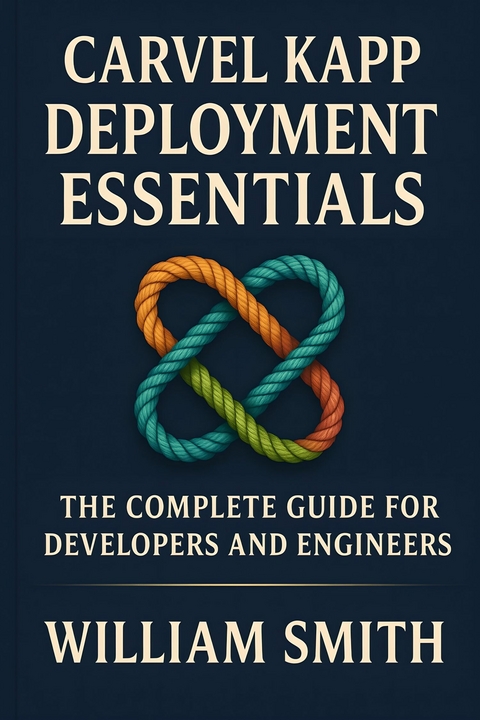
Carvel Kapp Deployment Essentials (eBook)
250 Seiten
HiTeX Press (Verlag)
978-0-00-101805-1 (ISBN)
'Carvel Kapp Deployment Essentials'
Carvel Kapp Deployment Essentials is a comprehensive guidebook designed for Kubernetes practitioners who seek to master robust, reliable, and scalable application delivery using the Carvel Kapp toolchain. Beginning with a clear introduction to the Carvel ecosystem, the book explores the architectural principles and deployment philosophies that distinguish Kapp from other Kubernetes deployers such as Helm, ArgoCD, and Flux. Readers will gain deep insights into Kapp's unique approach to application abstraction, resource ownership, and advanced command-line operations, positioning it as an essential tool for modern infrastructure teams.
The book progresses from foundational concepts to sophisticated deployment workflows, emphasizing best practices for declarative application management, change control, and multi-environment strategies. Dedicated chapters provide actionable guidance for executing blue-green and canary deployments, orchestrating complex resources and dependencies, and scaling operations for large enterprise environments. Seamless integration of ytt and imgpkg is thoroughly covered, demonstrating how dynamic manifest generation and OCI-compliant packaging optimize the entire app lifecycle. In parallel, security, policy enforcement, and compliance best practices ensure readers build robust systems with auditability and governance at the forefront.
Detailed treatment is given to observability, diagnostics, and troubleshooting, empowering operations and SRE teams to monitor, analyze, and resolve deployment challenges with confidence. Advanced topics such as plugin development, event-driven automation, multi-tenancy, and cross-cluster orchestration illustrate how Kapp supports both extensibility and scale in dynamic enterprise landscapes. Concluding with a forward-looking perspective, the book highlights emergent deployment patterns, ecosystem integration, and case studies that showcase Kapp's pivotal role in modern platform engineering. Whether you are a DevOps engineer, platform architect, or open-source contributor, Carvel Kapp Deployment Essentials is your authoritative resource for elevating Kubernetes deployments.
Chapter 2
Deployment Workflows and Best Practices
Uncover the strategies and workflow blueprints that set award-winning deployment teams apart. This chapter offers a deep exploration of the methodologies and tactical best practices for harnessing Kapp’s full power—from declarative application delivery to sophisticated rollout patterns and team collaboration structures. Prepare to rethink how Kubernetes application changes move through environments and how operational risk is systematically tamed.
2.1 Declarative Application Deployments
Declarative application deployments represent a paradigm shift in managing the entire lifecycle of software systems, transitioning from imperative step-by-step commands to state-oriented specifications. Central to this approach within Kubernetes ecosystems is kapp (Kubernetes Application tool), which encapsulates application deployment and management through a comprehensive declarative model. Utilizing kapp’s declarative framework enables a deterministic, auditable, and consistent means of manifest management, resilience against drift, and predictable infrastructure reconciliation.
At its core, the declarative model employed by kapp treats the desired application state as a primary source of truth, expressed via manifests (YAML or JSON files). These manifests comprehensively describe resources: deployments, services, config maps, and custom resources. Unlike imperative commands, which explicitly enumerate actions to change resources, the declarative approach emphasizes specifying what the cluster’s final state should be, delegating the orchestration of operations to kapp’s reconciliation engine.
kapp operates by computing the minimal set of changes needed to transition the current cluster state to the declared state. The reconciliation workflow begins with loading the supplied manifests, parsing them into resource objects, and correlating these objects with existing cluster resources based on unique identifiers (typically namespace, name, and kind). Dependencies between resources are inferred to order operations correctly, ensuring, for example, services are created before pods that consume them.
One of the fundamental mechanisms kapp introduces is drift detection, which identifies discrepancies between the desired state in the manifests and the actual live state in the cluster. Drift can occur due to manual interventions, operator actions, or external controllers. kapp reports any such inconsistencies during the planning phase prior to applying changes, offering a clear insight into deviations. This facilitates preventive measures against unexpected configuration drift, allowing operators to consciously reconcile or roll back changes.
The declarative workflow with kapp hinges on three primary commands: kapp deploy, kapp inspect, and kapp delete. The deploy command ingests the input manifests, executes drift detection, computes diffs, and applies only necessary create, update, or delete operations. Notably, kapp preserves history by annotating deployed objects with metadata, enabling robust rollbacks and auditing. Inspect provides a snapshot of current application state and resource status, useful for continuous monitoring and validation. Delete cleanly removes all managed resources in a controlled manner, respecting resource dependencies.
The advantages of this declarative model emerge prominently in complex pipeline environments. By embedding kapp within CI/CD workflows, declarative pipelines achieve idempotency and reproducibility. For instance, a pipeline step may trigger kapp deploy with a fixed version of manifests stored in version control. On repeated execution, kapp applies no changes if the cluster already matches the desired state, thus preventing accidental drift or duplicate side effects characteristic of imperative scripting.
In contrast, imperative deployment scripts require explicit management of creation, patching, or deletion commands, increasing the probability of human errors and race conditions in asynchronous distributed systems. Imperative commands often lack an intrinsic mechanism to detect drift unless supplemented by additional tooling. Furthermore, imperative workflows tend to be brittle to partial failures; manual sequencing of commands must be perfectly orchestrated to preserve application integrity. Debugging failures in imperative automation is generally more complex due to the lack of a unified state representation.
Integrating kapp with advanced manifest generation, such as Helm or templating engines, further strengthens declarative deployments. Although these tools generate manifests imperatively from templates, the output consumed by kapp remains declarative, preserving the guarantees of drift detection and reconciliation. This hybrid approach allows dynamic configuration without sacrificing the benefits of managing the final cluster state in a declarative manner.
To exemplify a typical deployment workflow using kapp, consider the following command execution:
During execution, kapp outputs a diff summary indicating added, changed, or removed resources. If no changes are detected, it reports that the application is already up to date. When changes are required, kapp applies them in a transactionally consistent way, rolling back on failure to maintain cluster integrity.
Changes Namespace Name Kind Op In default my-app-svc Service create v1 default my-app-deploy Deployment update apps/v1 SucceededThis feedback loop of declaring intent, verifying drift, and applying minimal delta changes is the cornerstone of robust infrastructure reconciliation. In highly dynamic environments, such reconciliation can be automated and executed at regular intervals or triggered by source control events, ensuring that cluster state converges rapidly and predictably on the desired configuration.
- Declarative application deployment shifts focus from procedural instructions to specifying the desired final state.
- kapp computes and applies the minimal necessary changes to align cluster state with declared manifests.
- Drift detection identifies deviations between live cluster resources and manifests, enabling early intervention.
- History preservation through metadata annotations supports rollbacks and auditing.
- Declarative deployments integrated with CI/CD pipelines enable idempotency and reproducibility.
- Compared to imperative scripts, declarative workflows reduce human error, race conditions, and improve failure recovery.
- Combining kapp with templating tools offers dynamic configuration while maintaining declarative reconciliation benefits.
kapp’s declarative application deployment model transforms application lifecycle management by emphasizing state definition over procedural execution. Its capabilities for manifest management, precise drift detection, and reliable reconciliation make it an indispensable tool in modern Kubernetes pipelines. Compared to imperative approaches, kapp provides increased safety, clarity, and predictability-qualities essential for scalable and maintainable cloud-native operations.
2.2 Idempotency and Change Control
Kapp’s core strength lies in its ability to enforce idempotency within complex deployment environments, thereby ensuring that repeated application of manifests results in a consistent target state. This guarantee is fundamental in large-scale systems where deployments may occur frequently, often across distributed clusters, and where unintended drift must be rigorously avoided. Kapp achieves this through a combination of its robust built-in diff engine, meticulous state capture mechanisms, and strategic change control processes.
At the heart of kapp’s idempotency model is its proprietary diff engine, which operates by performing a precise comparison between the desired resource configuration and the current cluster state. Unlike traditional declarative tools that may rely solely on API server responses or client-side manifests, kapp introspectively queries each managed resource’s live state before calculating differences. This approach allows it to detect subtle divergences, including field-level changes, annotations, and labels, facilitating a granular understanding of what must be reconciled.
...| Erscheint lt. Verlag | 15.8.2025 |
|---|---|
| Sprache | englisch |
| Themenwelt | Mathematik / Informatik ► Informatik ► Programmiersprachen / -werkzeuge |
| ISBN-10 | 0-00-101805-1 / 0001018051 |
| ISBN-13 | 978-0-00-101805-1 / 9780001018051 |
| Informationen gemäß Produktsicherheitsverordnung (GPSR) | |
| Haben Sie eine Frage zum Produkt? |
 EPUB (Adobe DRM)
Größe: 706 KB
Kopierschutz: Adobe-DRM
Adobe-DRM ist ein Kopierschutz, der das eBook vor Mißbrauch schützen soll. Dabei wird das eBook bereits beim Download auf Ihre persönliche Adobe-ID autorisiert. Lesen können Sie das eBook dann nur auf den Geräten, welche ebenfalls auf Ihre Adobe-ID registriert sind.
Details zum Adobe-DRM
Dateiformat: EPUB (Electronic Publication)
EPUB ist ein offener Standard für eBooks und eignet sich besonders zur Darstellung von Belletristik und Sachbüchern. Der Fließtext wird dynamisch an die Display- und Schriftgröße angepasst. Auch für mobile Lesegeräte ist EPUB daher gut geeignet.
Systemvoraussetzungen:
PC/Mac: Mit einem PC oder Mac können Sie dieses eBook lesen. Sie benötigen eine
eReader: Dieses eBook kann mit (fast) allen eBook-Readern gelesen werden. Mit dem amazon-Kindle ist es aber nicht kompatibel.
Smartphone/Tablet: Egal ob Apple oder Android, dieses eBook können Sie lesen. Sie benötigen eine
Geräteliste und zusätzliche Hinweise
Buying eBooks from abroad
For tax law reasons we can sell eBooks just within Germany and Switzerland. Regrettably we cannot fulfill eBook-orders from other countries.
aus dem Bereich


