


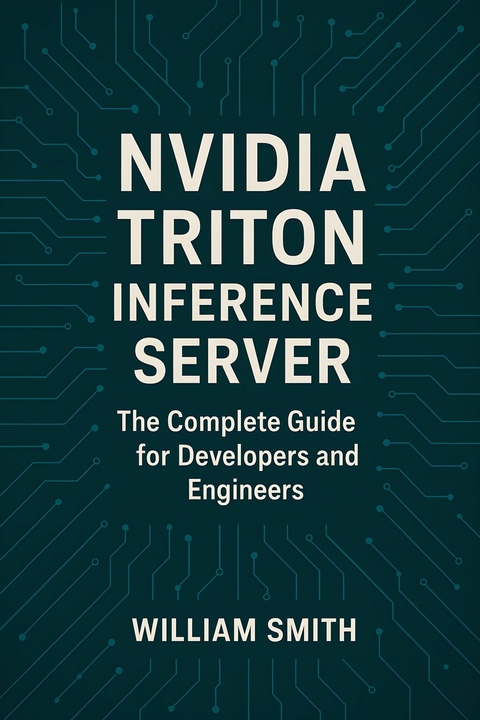
Nvidia Triton Inference Server (eBook)
250 Seiten
HiTeX Press (Verlag)
978-0-00-101740-5 (ISBN)
'Nvidia Triton Inference Server'
Nvidia Triton Inference Server is the definitive guide for deploying and managing AI models in scalable, high-performance production environments. Meticulously structured, this book begins with Triton's architectural foundations, examining its modular design, supported machine learning frameworks, model repository management, and diverse deployment topologies. Readers gain a comprehensive understanding of how Triton fits into the modern AI serving ecosystem, exploring open source development practices and practical insights for integrating Triton into complex infrastructures.
Delving deeper, the book provides an end-to-end treatment of model lifecycle management, configuration, continuous delivery, and failure recovery. It unlocks the power of Triton's APIs-via HTTP, gRPC, and native client SDKs-while detailing sophisticated capabilities like advanced batching, custom middleware, security enforcement, and optimized multi-GPU workflows. Readers benefit from expert coverage of performance engineering, profiling, resource allocation, and SLA-driven production scaling, ensuring robust and efficient AI inference services at any scale.
Triton's operational excellence is showcased through advanced orchestration with Docker, Kubernetes, and cloud platforms, highlighting strategies for high availability, resource isolation, edge deployments, and real-time observability. The final chapters chart the future of AI serving, from large language models and generative AI to energy-efficient inference and privacy-preserving techniques. With rich examples and best practices, 'Nvidia Triton Inference Server' is an authoritative resource for engineers, architects, and technical leaders advancing state-of-the-art AI serving solutions.
Chapter 2
Model Configuration and Lifecycle Management
Behind every production-grade AI deployment is rigorous configuration and a robust lifecycle strategy. This chapter pulls back the curtain on the practices and mechanisms that ensure your models are not only deployed, but also versioned, orchestrated, updated, and safeguarded for continuous excellence. Learn how configuration fine-tuning, seamless updates, and agile rollback strategies power resilient, adaptable, and enterprise-ready model serving.
2.1 Model Configuration Files and Parameters
NVIDIA Triton Inference Server relies on model configuration files, typically named config.pbtxt, to precisely define the parameters that govern model execution, resource allocation, and inference behavior. These configuration files serve as a critical interface between the model architecture and Triton’s runtime optimizations, enabling fine-grained control over performance, scalability, and resource utilization. The configuration files adopt a declarative protobuf text format, allowing users to specify both mandatory properties and optional attributes that elevate deployment flexibility.
At the core of every Triton model configuration is the name field, which identifies the model within the server’s namespace. This name must match the directory containing the model repository files and act as a stable handle for client-server communication. Alongside naming, the platform attribute explicitly defines the inference backend, such as tensorrt_plan, tensorflow_graphdef, or onnxruntime, dictating how the server loads and executes the model artifacts.
Input and output specifications are among the most important sections of the configuration file. Each input and output tensor is declared with a set of attributes: name, data_type, dims, and optionally format. Accurate definition of these tensors ensures proper data unmarshalling, validation, and internal memory layout. For example, a model accepting images may specify inputs with data_type: TYPE_UINT8 and explicit dimensions reflecting channels, height, and width. Outputs must likewise declare dimensionality and data type to enable clients to properly interpret inference results. The use of dims parameters allows symbolic or static dimensions, with -1 signaling dynamic shape support.
Dynamic batching is a pivotal feature exposed through the configuration file’s dynamic_batching block. When enabled, Triton combines multiple inference requests into a single batch, optimizing GPU utilization and throughput without burdening clients to batch manually. Parameters under dynamic_batching include max_batch_size, which sets the upper bound on batch size aggregation, and preferred_batch_sizes, a list of batch sizes for which Triton applies optimized scheduling heuristics. Latency trade-offs are tunable via preserve_ordering, max_queue_delay_microseconds, and priority_levels, facilitating fine control over batching granularity versus real-time responsiveness. Properly configured dynamic batching frequently yields order-of-magnitude improvements in throughput for variable-load environments.
Besides input/output and batching, the configuration file supports extensive optimization flags to tailor model execution. For instance, instance_group defines the number and type of model instances, specifying whether to run on CPU or GPU and how many replicas to spawn. This attribute directly impacts parallelism and pipeline concurrency. Users can specify optimization.profile to enable TensorRT optimization profiles, allowing dynamic execution parameters without reloading the model. The ensemble attribute orchestrates multi-model pipelines, where outputs from one model feed as inputs to another, essential for complex inference workflows. Enabling response_cache can mitigate latency by caching identical inference outputs.
Deployment best practices recommend keeping configuration files as explicit and minimal as possible to reduce maintenance complexity. Avoid redundant attributes where defaults suffice, and leverage symbolic dimensions for models expected to handle variable input sizes. Continuous profiling should guide iterative tuning of batch sizes and instance counts, balancing throughput with latency constraints specific to production workloads. Version control of config.pbtxt files alongside model artifacts ensures traceability and reproducibility of deployment environments.
The impact of well-crafted configuration files extends beyond raw performance. By clearly documenting input and output semantics within the configuration, maintainability and usability for integration teams is greatly enhanced. Automation and CI/CD pipelines benefit from deterministic behavior encoded in configuration, minimizing human error. Triton’s modular configuration design supports incremental model upgrades and rolling deployments without service disruption by allowing different versions with custom settings side-by-side in the model repository.
platform: "tensorrt_plan"
max_batch_size: 64
input [
{
name: "input__0"
data_type: TYPE_FP32
dims: [3, 224, 224]
}
]
output [
{
name: "output__0"
data_type: TYPE_FP32
dims: [1000]
}
]
dynamic_batching {
max_queue_delay_microseconds: 100
...
| Erscheint lt. Verlag | 15.8.2025 |
|---|---|
| Sprache | englisch |
| Themenwelt | Mathematik / Informatik ► Informatik ► Programmiersprachen / -werkzeuge |
| ISBN-10 | 0-00-101740-3 / 0001017403 |
| ISBN-13 | 978-0-00-101740-5 / 9780001017405 |
| Informationen gemäß Produktsicherheitsverordnung (GPSR) | |
| Haben Sie eine Frage zum Produkt? |
 EPUB (Adobe DRM)
Größe: 696 KB
Kopierschutz: Adobe-DRM
Adobe-DRM ist ein Kopierschutz, der das eBook vor Mißbrauch schützen soll. Dabei wird das eBook bereits beim Download auf Ihre persönliche Adobe-ID autorisiert. Lesen können Sie das eBook dann nur auf den Geräten, welche ebenfalls auf Ihre Adobe-ID registriert sind.
Details zum Adobe-DRM
Dateiformat: EPUB (Electronic Publication)
EPUB ist ein offener Standard für eBooks und eignet sich besonders zur Darstellung von Belletristik und Sachbüchern. Der Fließtext wird dynamisch an die Display- und Schriftgröße angepasst. Auch für mobile Lesegeräte ist EPUB daher gut geeignet.
Systemvoraussetzungen:
PC/Mac: Mit einem PC oder Mac können Sie dieses eBook lesen. Sie benötigen eine
eReader: Dieses eBook kann mit (fast) allen eBook-Readern gelesen werden. Mit dem amazon-Kindle ist es aber nicht kompatibel.
Smartphone/Tablet: Egal ob Apple oder Android, dieses eBook können Sie lesen. Sie benötigen eine
Geräteliste und zusätzliche Hinweise
Buying eBooks from abroad
For tax law reasons we can sell eBooks just within Germany and Switzerland. Regrettably we cannot fulfill eBook-orders from other countries.
aus dem Bereich


