


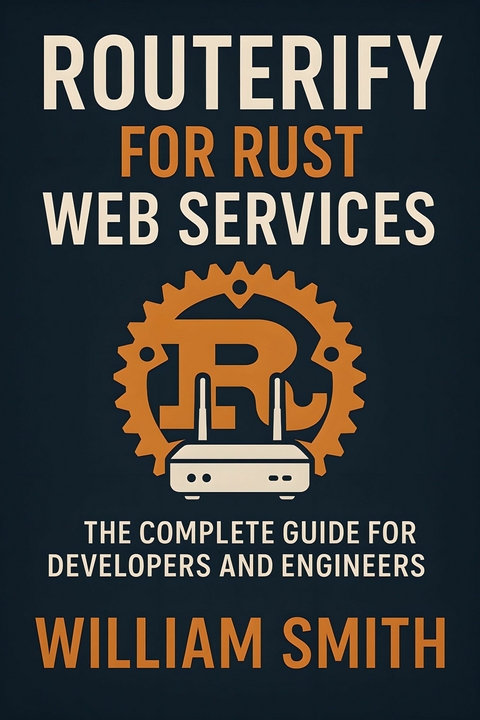
Routerify for Rust Web Services (eBook)
250 Seiten
HiTeX Press (Verlag)
978-0-00-101737-5 (ISBN)
'Routerify for Rust Web Services'
Unlock the full potential of high-performance, reliable web services in Rust with 'Routerify for Rust Web Services.' This comprehensive guide explores the intricate landscape of Rust's asynchronous web ecosystem, delving into the principles that shape Routerify's efficient design atop foundational technologies like Hyper and Tokio. From advanced project structuring to critical comparisons with other web frameworks, readers gain deep insight into why Routerify is uniquely suited for modern web development in Rust.
The book systematically addresses every layer of web application architecture-illuminating Routerify's sophisticated routing algorithms, handler composition, middleware systems, and robust data interfacing methods. Through clear explanations and real-world patterns, it demonstrates how to construct modular, maintainable, and high-performing web services. Readers are guided through advanced strategies for authentication, authorization, secure transport, input validation, and defense against common vulnerabilities, ensuring safe and scalable deployments.
For teams seeking production excellence, the guide covers essential DevOps practices, runtime diagnostics, testing, observability, and container-based deployments. Forward-looking chapters explore asynchronous concurrency, real-time APIs, service meshes, and cutting-edge API paradigms like gRPC and GraphQL. Drawing on in-depth case studies, 'Routerify for Rust Web Services' stands as an indispensable resource for engineers, architects, and Rust enthusiasts aiming to deliver robust web solutions with confidence and technical rigor.
Chapter 1
Routerify and the Rust Web Ecosystem
Discover how Routerify stakes its claim within the evolving and ambitious landscape of Rust web technologies. This chapter invites you to interrogate the motivations, design philosophies, and ecosystem decisions that have shaped Routerify, positioning it as a pragmatic yet forward-thinking tool for building scalable, maintainable web services in Rust. Prepare to examine the interplay between language-level power, community dynamics, and the shifting landscape of web frameworks.
1.1 Rust’s Web Landscape: Strengths and Challenges
Rust has emerged as a compelling choice for web services, distinguished by its rigorous safety guarantees and high performance. Its foundational design goals—memory safety without garbage collection, zero-cost abstractions, and fine-grained control over resource management—address many classical issues inherent to systems programming. These features translate directly to benefits in web service implementations, where reliability and throughput are paramount.
At the core of Rust’s appeal in web development is its ownership model. By enforcing strict compile-time checks on data ownership and borrowing, Rust virtually eliminates entire classes of runtime errors such as null pointer dereferencing, use-after-free, and data races in concurrent contexts. These safety guarantees enable developers to build web services with confidence, reducing the need for extensive runtime validations and the complexity of error handling typically seen in languages without strong compile-time enforcement. This verification model is a significant innovation for web architectures that demand robust fault tolerance and uptime, especially in microservices environments where services must remain resilient under varying loads and interactions.
Performance-wise, Rust offers predictability and efficiency equivalent to C and C++. Its lack of a garbage collector avoids the nondeterministic pause times associated with automatic memory management, which can be critical in latency-sensitive applications such as real-time web APIs or streaming services. The language’s fine control also allows developers to optimize CPU and memory usage precisely, tailoring resource consumption to specific deployment environments—from small edge devices to large cloud infrastructure.
Nevertheless, these strengths are tempered by practical challenges. One significant area is ecosystem maturity, which, while rapidly evolving, presently lags behind that of more established web development languages like JavaScript, Python, or Java. The available web frameworks, such as Actix, Rocket, and Warp, have achieved substantial stability and feature completeness but remain fewer and less standardized compared to frameworks in other ecosystems. This relative immaturity affects both the availability of libraries and the integration with other systems, potentially increasing the effort required to implement comprehensive solutions or to adapt Rust components within heterogeneous infrastructures.
The learning curve associated with Rust is another critical consideration. The ownership and borrowing system, while powerful, imposes a steep cognitive load on developers, especially those accustomed to garbage-collected languages. Writing idiomatic, efficient asynchronous code in Rust also requires mastering futures, tasks, and the async/await syntax, which, coupled with Rust’s strict type system, can be daunting. Unlike other languages where asynchronous operations are often abstracted away, Rust’s async model involves explicit management of lifetimes and state machines, demanding deeper understanding of concurrency primitives and event-driven paradigms.
The challenges in asynchronous programming extend to tooling and runtime as well. Although Rust’s async ecosystem—highlighted by runtimes like Tokio and async-std—provides robust infrastructures for scalable, non-blocking web services, the ecosystem is still maturing with respect to ease of use, debug support, and ecosystem-wide conventions. Complex dependencies on asynchronous traits and compatibility issues between different runtime ecosystems can introduce friction in building and maintaining large-scale services.
These characteristics deeply influence architectural and operational decisions in Rust-based web systems. Architecturally, developers tend to prefer smaller, well-isolated microservices that leverage Rust’s strengths in safe concurrency and low-latency processing. The language encourages explicit error handling and strict type guarantees, which manifest in more predictable failure modes and easier root cause analysis, benefiting observability and maintainability. On the other hand, teams must allocate substantial effort to design APIs and concurrency models that align with Rust’s ownership semantics and asynchronous paradigms.
From an operational standpoint, Rust’s predictable performance facilitates highly optimized resource allocation and scaling strategies, enhancing cost-efficiency in cloud deployments. However, the relative scarcity of Rust-native monitoring and tracing tools compared to mature ecosystems can necessitate additional integration work with external tooling. Moreover, building expertise in Rust operations requires training and experience, particularly for incident response involving concurrency bugs or subtle lifetime violations.
Rust’s web landscape offers a compelling proposition: truly safe and performant services with fine-grained control over resource management, balanced against ecosystem immaturity and a demanding development model. Understanding these trade-offs is essential for making informed choices about adopting Rust in web architectures, where its unique advantages can directly enhance reliability and efficiency but require investment in learning and ecosystem navigation.
1.2 The Principles Behind Routerify
Routerify emerged from a convergence of evolving needs in web server-side development, primarily targeting the Node.js ecosystem’s demand for modular, maintainable, and high-performance HTTP routing solutions. Its conceptual, architectural, and design foundations are rooted in key principles that address longstanding issues in web routing middleware, specifically composability, minimalism, predictability, and extensibility. These principles not only guided Routerify’s core API design but also shaped its internal implementation strategies, creating a distinctive profile compared to its contemporaries.
At the core of Routerify’s design lies composability, a principle emphasizing the creation of small, reusable pieces of functionality that can be combined flexibly. This reflects a broader functional programming ethos increasingly embraced in modern JavaScript development. Routerify facilitates composability at the routing level by enabling developers to define isolated route handlers and subsequently aggregate them into larger routing structures. This is achieved through its hierarchical router model, where routers can be nested with defined scopes and path prefixes, allowing encapsulation of route concerns and middleware stacks. This contrasts with traditional monolithic routers, where all route definitions exist flatly, often complicating state management and middleware application.
By promoting composability, Routerify enhances maintainability and testability. Individual route modules can be developed, tested, and reasoned about independently before integration. This modularity also enables clearer separation of concerns, where middleware functions relate to specific contexts rather than proliferating globally or requiring intricate conditional logic. The composability model supports dynamic routing assemblies, useful in large-scale or microservices architectures, where route configurations may be recombined or extended at runtime.
Minimalism is another pillar shaping Routerify’s philosophy. The implementation embraces the “less is more” approach by minimizing dependencies and retaining a lightweight core. Routerify avoids the common pitfalls of feature bloat seen in many routing libraries that attempt to cater to every possible edge case and protocol extension internally. Instead, it focuses on core HTTP routing concerns with a lean API surface. This minimalism is evident in its streamlined API, which exposes only essential constructs required to define routes, attach middleware, and control route chaining. The principle of minimalism enhances performance by reducing runtime overhead and accelerates learning curves by presenting a clear, uncluttered interface to developers.
Minimalism also directly informs Routerify’s internal request processing pipeline. Instead of maintaining complex routing tables or relying on elaborate pattern matching engines, Routerify leverages efficient routing algorithms that balance simplicity and speed. This strategic simplicity fosters predictable behavior, as developers can anticipate how route resolution occurs without wrestling with opaque internal mechanisms.
Predictability acts as a third cornerstone in Routerify’s architecture. Predictability in routing behavior is crucial for debugging, security, and performance tuning. Routerify achieves predictability through deterministic route matching and explicit ...
| Erscheint lt. Verlag | 15.8.2025 |
|---|---|
| Sprache | englisch |
| Themenwelt | Mathematik / Informatik ► Informatik ► Programmiersprachen / -werkzeuge |
| ISBN-10 | 0-00-101737-3 / 0001017373 |
| ISBN-13 | 978-0-00-101737-5 / 9780001017375 |
| Informationen gemäß Produktsicherheitsverordnung (GPSR) | |
| Haben Sie eine Frage zum Produkt? |
 EPUB (Adobe DRM)
Größe: 845 KB
Kopierschutz: Adobe-DRM
Adobe-DRM ist ein Kopierschutz, der das eBook vor Mißbrauch schützen soll. Dabei wird das eBook bereits beim Download auf Ihre persönliche Adobe-ID autorisiert. Lesen können Sie das eBook dann nur auf den Geräten, welche ebenfalls auf Ihre Adobe-ID registriert sind.
Details zum Adobe-DRM
Dateiformat: EPUB (Electronic Publication)
EPUB ist ein offener Standard für eBooks und eignet sich besonders zur Darstellung von Belletristik und Sachbüchern. Der Fließtext wird dynamisch an die Display- und Schriftgröße angepasst. Auch für mobile Lesegeräte ist EPUB daher gut geeignet.
Systemvoraussetzungen:
PC/Mac: Mit einem PC oder Mac können Sie dieses eBook lesen. Sie benötigen eine
eReader: Dieses eBook kann mit (fast) allen eBook-Readern gelesen werden. Mit dem amazon-Kindle ist es aber nicht kompatibel.
Smartphone/Tablet: Egal ob Apple oder Android, dieses eBook können Sie lesen. Sie benötigen eine
Geräteliste und zusätzliche Hinweise
Buying eBooks from abroad
For tax law reasons we can sell eBooks just within Germany and Switzerland. Regrettably we cannot fulfill eBook-orders from other countries.
aus dem Bereich


