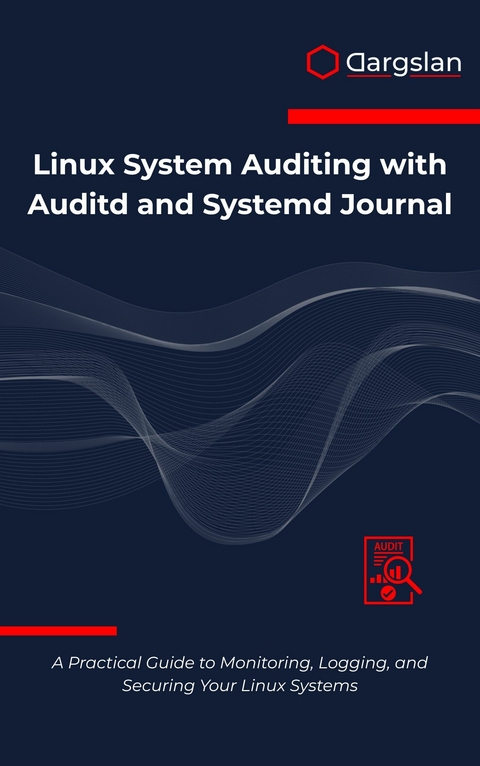
Linux System Auditing with Auditd and Systemd Journal (eBook)
364 Seiten
Dargslan s.r.o. (Verlag)
978-0-00-099948-1 (ISBN)
Master Linux System Security and Monitoring with the Complete Guide to Auditd and Systemd Journal
Transform your Linux administration skills with this comprehensive, hands-on guide to system auditing and logging. 'Linux System Auditing with Auditd and Systemd Journal' is the definitive resource for Linux administrators, security professionals, and DevOps engineers who need to implement robust monitoring, logging, and security auditing solutions across their Linux infrastructure.
Why This Book Is Essential for Linux Professionals
In today's security-conscious environment, effective system auditing isn't optional-it's critical. This book bridges the gap between basic Linux knowledge and advanced auditing expertise, providing practical, real-world solutions that work across all major Linux distributions including Ubuntu, CentOS, RHEL, and Debian.
What Sets This Book Apart
Unlike generic system administration guides, this book focuses exclusively on mastering Linux auditing tools. You'll gain deep expertise in both auditd (the Linux Audit Framework) and systemd journal, learning how these powerful tools work individually and together to provide comprehensive system visibility and security monitoring.
Comprehensive Coverage from Basics to Advanced Techniques
Starting with fundamental concepts, you'll quickly progress to advanced implementations including centralized logging architectures, automated audit rule deployment, and enterprise-scale monitoring solutions. Every technique is demonstrated with practical examples, configuration files, and troubleshooting guidance tested in real Linux production environments.
Key Learning Outcomes Include:
Complete auditd configuration and rule management for Linux systems
Advanced systemd journal analysis and log management techniques
File, directory, and process monitoring strategies specific to Linux environments
Network activity auditing and security event detection
Centralized logging setup for multi-server Linux infrastructures
Automated deployment and management of audit configurations
Log security, integrity protection, and compliance frameworks
Integration with existing Linux security and monitoring tools
Practical, Hands-On Approach
Every chapter includes step-by-step tutorials, real-world scenarios, and practical exercises designed for immediate implementation. The extensive appendices provide quick-reference guides, bash one-liners for log analysis, and curated resources for continued learning.
Perfect for Multiple Skill Levels
Whether you're a Linux newcomer looking to understand system auditing fundamentals or an experienced administrator seeking to optimize your monitoring infrastructure, this book provides clear, actionable guidance tailored to your needs.
Proven Techniques for Real-World Challenges
Learn to solve common Linux auditing challenges including performance optimization, storage management, compliance reporting, and security incident response. The book includes detailed case studies from actual production Linux environments, showing how to apply these techniques at scale.
Start Building Better Linux Infrastructure Today
Join thousands of Linux professionals who have transformed their system monitoring and security capabilities. Whether you're managing a single Linux server or hundreds of cloud instances, the techniques in this book will elevate your skills and improve your infrastructure's security, compliance, and reliability.
Introduction
Understanding the Critical Need for System Auditing
In the sprawling landscape of modern computing infrastructure, Linux systems serve as the backbone for countless organizations, from small startups to multinational corporations. These systems process sensitive data, handle critical business operations, and maintain the digital infrastructure that keeps our interconnected world functioning. However, with great power comes great responsibility, and the responsibility to monitor, secure, and audit these systems has never been more crucial.
System auditing represents the systematic examination and recording of events, activities, and changes that occur within a computer system. It serves as both a detective mechanism for investigating security incidents and a preventive measure for identifying potential vulnerabilities before they can be exploited. In the context of Linux systems, auditing encompasses everything from tracking user logins and file modifications to monitoring network connections and system configuration changes.
The digital age has ushered in an era where cyber threats evolve at an unprecedented pace. Advanced persistent threats, insider attacks, and sophisticated malware campaigns target Linux systems with increasing frequency and complexity. Traditional security measures, while essential, are no longer sufficient on their own. Organizations require comprehensive visibility into their system activities to detect anomalies, investigate incidents, and maintain compliance with regulatory requirements.
Consider a scenario where an unauthorized user gains access to a production server. Without proper auditing mechanisms in place, this intrusion might go undetected for weeks or months, allowing the attacker to exfiltrate sensitive data, install backdoors, or compromise additional systems. However, with robust auditing capabilities, security teams can identify suspicious activities in real-time, trace the attacker's actions, and implement appropriate countermeasures before significant damage occurs.
The Evolution of Linux Auditing Technologies
Linux auditing has undergone significant evolution since the early days of simple log files and basic system monitoring. The journey began with traditional syslog mechanisms, which provided basic logging capabilities but lacked the granularity and security features required for modern environments. System administrators relied primarily on log files scattered across various directories, making comprehensive analysis challenging and time-consuming.
The introduction of the Linux Audit Framework marked a pivotal moment in system auditing capabilities. Developed initially for meeting Common Criteria security standards, this framework provided a kernel-level auditing infrastructure capable of monitoring system calls, file access, and user activities with unprecedented detail. The audit framework operates at the kernel level, making it extremely difficult for malicious actors to tamper with or disable without leaving traces.
Parallel to the development of specialized auditing tools, the systemd initialization system revolutionized Linux logging through its integrated journal service. The systemd journal represents a paradigm shift from traditional text-based logging to structured, binary logging that offers enhanced performance, reliability, and querying capabilities. This evolution has transformed how administrators interact with system logs, providing powerful filtering and analysis tools that were previously unavailable.
The convergence of these technologies has created a comprehensive auditing ecosystem that addresses the diverse needs of modern Linux environments. Organizations can now implement layered auditing strategies that combine kernel-level monitoring with application-specific logging, creating a holistic view of system activities.
Core Components: Auditd and Systemd Journal
The Linux Audit Daemon (auditd)
The audit daemon, commonly known as auditd, serves as the user-space component of the Linux Audit Framework. This powerful service operates as the primary interface between the kernel's audit subsystem and system administrators, providing configuration management, log processing, and event correlation capabilities.
Auditd's architecture is designed for reliability and security. The daemon runs with elevated privileges and maintains a persistent connection to the kernel's audit subsystem. This design ensures that audit events are captured even during system stress or potential security incidents. The daemon's configuration allows for fine-grained control over what events are monitored, how they are processed, and where they are stored.
The audit rules engine within auditd provides administrators with the flexibility to define custom monitoring policies. These rules can target specific files, directories, system calls, or user activities. For example, an organization might configure rules to monitor all access attempts to sensitive configuration files, track privilege escalation activities, or log network connection attempts.
# Example: Basic auditd service management
sudo systemctl status auditd
sudo systemctl start auditd
sudo systemctl enable auditd
# View current audit rules
sudo auditctl -l
# Check audit daemon configuration
sudo cat /etc/audit/auditd.conf
Note: The auditd service requires careful configuration to balance security monitoring with system performance. Overly broad audit rules can generate excessive log volumes and impact system performance.
The Systemd Journal Service
The systemd journal represents a fundamental reimagining of system logging for modern Linux distributions. Unlike traditional syslog implementations that rely on plain text files, the journal employs a structured, binary format that enables efficient storage, indexing, and retrieval of log data.
The journal service integrates seamlessly with the systemd ecosystem, automatically collecting logs from various sources including kernel messages, system services, and applications. This centralized approach eliminates the fragmentation common in traditional logging systems, where different services might write to separate log files using inconsistent formats.
One of the journal's most significant advantages is its built-in integrity features. The journal can cryptographically sign log entries, providing tamper detection capabilities that are essential for security auditing. Additionally, the binary format includes metadata that enables sophisticated filtering and analysis operations.
# Basic journalctl commands for log analysis
journalctl --since "2024-01-01" --until "2024-01-02"
journalctl -u sshd.service
journalctl -p err
journalctl --grep="authentication failure"
# Real-time log monitoring
journalctl -f
# Display journal disk usage
journalctl --disk-usage
Command Explanation: The journalctl command serves as the primary interface for querying and analyzing systemd journal logs. The --since and --until options allow time-based filtering, while -u filters by systemd unit, and -p filters by priority level.
Integration and Synergy
The true power of Linux system auditing emerges when auditd and the systemd journal work in concert. While auditd excels at low-level system monitoring and security-focused event tracking, the systemd journal provides comprehensive application and service logging. Together, they create a multi-layered auditing infrastructure that can address diverse monitoring requirements.
This integration becomes particularly valuable during incident response scenarios. Security analysts can correlate low-level audit events from auditd with higher-level application logs from the journal to construct comprehensive timelines of system activities. For instance, an audit event showing unauthorized file access can be correlated with authentication logs in the journal to identify the source of the breach.
The complementary nature of these tools also extends to compliance requirements. Many regulatory frameworks require organizations to maintain detailed audit trails of system activities. The combination of auditd's security-focused monitoring and the journal's comprehensive logging capabilities provides the coverage necessary to meet these requirements.
Real-World Applications and Use Cases
Financial Services Compliance
Financial institutions operate under stringent regulatory requirements that mandate comprehensive audit trails for all system activities. Consider a major bank that processes millions of transactions daily across hundreds of Linux servers. The bank implements auditd rules to monitor all access to customer data files, track privilege escalation events, and log system configuration changes. Simultaneously, the systemd journal captures application-level events from trading systems, customer portals, and internal tools.
This dual-layer approach enables the bank to demonstrate compliance with regulations such as SOX, PCI-DSS, and GDPR. When auditors request evidence of data access controls, security teams can provide detailed reports showing exactly who accessed what data, when the access occurred, and what actions were performed.
Healthcare Data Protection
Healthcare organizations face unique challenges in protecting patient data while maintaining operational efficiency. A large hospital network implements comprehensive auditing to protect electronic health records (EHR)...
| Erscheint lt. Verlag | 9.8.2025 |
|---|---|
| Sprache | englisch |
| Themenwelt | Mathematik / Informatik ► Informatik ► Betriebssysteme / Server |
| ISBN-10 | 0-00-099948-2 / 0000999482 |
| ISBN-13 | 978-0-00-099948-1 / 9780000999481 |
| Informationen gemäß Produktsicherheitsverordnung (GPSR) | |
| Haben Sie eine Frage zum Produkt? |
 EPUB (Adobe DRM)
Größe: 1,4 MB
Kopierschutz: Adobe-DRM
Adobe-DRM ist ein Kopierschutz, der das eBook vor Mißbrauch schützen soll. Dabei wird das eBook bereits beim Download auf Ihre persönliche Adobe-ID autorisiert. Lesen können Sie das eBook dann nur auf den Geräten, welche ebenfalls auf Ihre Adobe-ID registriert sind.
Details zum Adobe-DRM
Dateiformat: EPUB (Electronic Publication)
EPUB ist ein offener Standard für eBooks und eignet sich besonders zur Darstellung von Belletristik und Sachbüchern. Der Fließtext wird dynamisch an die Display- und Schriftgröße angepasst. Auch für mobile Lesegeräte ist EPUB daher gut geeignet.
Systemvoraussetzungen:
PC/Mac: Mit einem PC oder Mac können Sie dieses eBook lesen. Sie benötigen eine
eReader: Dieses eBook kann mit (fast) allen eBook-Readern gelesen werden. Mit dem amazon-Kindle ist es aber nicht kompatibel.
Smartphone/Tablet: Egal ob Apple oder Android, dieses eBook können Sie lesen. Sie benötigen eine
Geräteliste und zusätzliche Hinweise
Buying eBooks from abroad
For tax law reasons we can sell eBooks just within Germany and Switzerland. Regrettably we cannot fulfill eBook-orders from other countries.
aus dem Bereich