Metaverse for Sustainable Development (eBook)
555 Seiten
Wiley-Scrivener (Verlag)
978-1-394-27220-4 (ISBN)
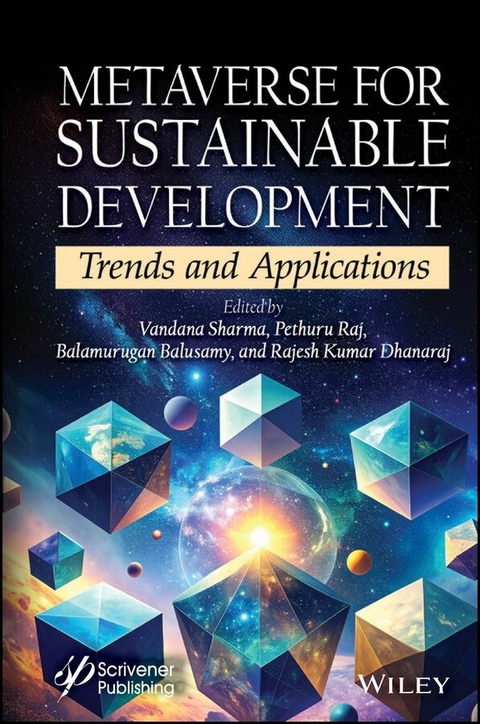
Unlock the future of technology and sustainable development by purchasing Metaverse for Sustainable Development: Trends and Applications, a comprehensive guide that delves into immersive application building, groundbreaking innovations, and the transformative potential of the metaverse across various industries.
Metaverse for Sustainable Development: Trends and Applications explains the fine details of metaverse application building, demonstrating how integrated platforms in association with a suite of tools come in handy for enabling application construction. The metaverse is the next big thing influenced by virtual and augmented reality paradigms. This user experience will be more immersive and mesmerizing, empowering innovative, disruptive, and transformative technologies to create a spectacular platform for visualizing and realizing business-critical and people-centric metaverse systems. This book explores various metaverse models for healthcare information systems, including the latest technologies, such as the Brain-Computer Interface. Through real-world data and case studies, readers will gain a comprehensive understanding of the metaverse's potential for the Internet of Things, blockchain, artificial intelligence, 5G, and 3D modelling for creating and sustaining immersive virtual worlds.
Metaverse for Sustainable Development: Trends and Applications is a vital resource for understanding the end-to-end implementation of metaverse technologies.
1
Demystifying the Metaverse Era: The Enabling Technologies and Industry Use Cases
Pethuru Raj1, N. Gayathri2 and Vandana Sharma3*
1 Edge AI Division, Reliance Jio Platforms Ltd., Bangalore, India
2 Department of CSE, GITAM University, Bangalore, India
3 Department of Computer Science, Christ University, Bengaluru, India
Abstract
Metaverse can be called a 3D shared virtual space that is hyper realistic, immersive, instinctive, and interactive. Through metaverse, people try to visualize life in the manner that do not exist in the real world. The potential and promising digital technologies turn out to be a huge enabler of the metaverse dream. This chapter is to delineate the various versatile metaverse applications, implementation technologies, and use cases (individual as well as industrial).
Keywords: Metaverse, augmented reality, artificial intelligence, virtual reality
1.1 Introduction
Metaverse [1] is representing the next-generation universe, which will be mesmerizingly multi-dimensional, multi-purpose, and multifaceted. Users can enter into a metaverse environment through a specialized VR headset (this is very expensive at this point of time). In the future, this costly and bulky gear can become a software library to be pre-installed in our smartphones. Through a small additional hardware module, experimenting and experiencing the projected metaverse can be fully facilitated. So, the metaverse represents a kind of extended virtual world. Here in this shared virtual world, every participant can have his own augmented digital “body” (avatar) that he or she can easily customize. Also, the participant can have a home filled up with a growing collection of preferred artifacts, etc. He or she can visit hundreds of places and spaces virtually. He can communicate with various users in the imaginary world, accomplish some complicated works collaboratively, play games intuitively with intensity, spend time usefully in learning and sharing what is learned, etc. In short, whatever we do in our everyday surroundings (house, motels or any public place, etc.) can be comfortably replicated in a virtual environment. The metaverse idea is definitely blooming because it brings forth a dazzling array of individual and industrial use cases [2]. For an example, experts point out that the metaverse can reduce our travel needs across the globe. Instead, we can enjoy and experience different dream locations across the world with all the comfort at our homes. On the other side, we can have our physical places and products getting augmented substantially through augmented reality (AR) gears. In a 3D environment, visualization and communication between various things happen in a smooth manner. We can quickly switch between activities and locations by making a simple gesture. In the digital world, everything is connected and readily available and accessible to understand its unique capabilities.
1.1.1 Metaverse Technologies and Tools
With more such pulsating and peculiar use cases emerging and evolving, building and releasing metaverse applications formally leveraging an end-to-end technology stack is gaining the momentum in the recent past. Fortunately, there are several development and deployment platforms and frameworks for producing and delivering new-generation metaverse offerings. However, building such applications is very tricky yet trendsetting. The mission of establishing and sustaining the metaverse is radically simplified through the power of a bevy of digital technologies. In this section, we are to discuss the most indispensable technologies that can speed up the dawn of the metaverse era.
- Augmented reality
- Virtual reality dealing with metaverse
- AI for metaverse
- Natural language processing
- Blockchain technology
- The Internet of Things (IoT)—digitized entities, connected devices, drones, robots, etc.
- Data fabric and mesh
- 5G and 6G communication
- Digital twins
- Edge and cloud-native computing
- Service mesh
- Serverless processing
- Event-driven architecture (EDA) and event mesh
- Augmented and virtual reality (AR/VR) for Metaverse
- Cybersecurity
1.2 The Trends and Transitions in the Digital Era
- The web is tending toward Web 3.0.
- The universe is heading toward Metaverse.
1.2.1 About Web 3.0
Rather than using central database, in Web 3.0, applications use a decentralized environment. Communities will be developed as a decentralized autonomous organization (DAO). Web 3.0 will also make use of AI toward producing intelligent and adaptive applications. HTML will still continue to be a foundational layer with Web 3.0, but how it connects to data sources and where those data sources reside are possibly different.
- Decentralized—Web 3.0 applications will be architected and developed in a decentralized fashion. In a decentralized setup, there is no central control.
- Blockchain-enabled—This is clearly the enabler for the origin of decentralized services. Blockchain can also create a decentralized database, which is an immutable ledger of transactions and activities. Such an enablement helps in providing authenticity in an increasingly decentralized world which is accountable.
- Cryptocurrency-based—Its usage will become a crucial feature of Web 3.0 services.
- Autonomous and AI-enabled—Automation is a characteristic of Web 3.0, and it will be supported by AI algorithms and techniques.
As indicated above, Web 3.0 is the next evolution of the Internet paradigm [3]. This represents the evolution of how users are able to create and control their identities, digital content, and services. The digital creators can make money by leveraging the popular blockchain technology in a highly secure manner. The aspect of non-fungible tokens (NFTs) is a popular one for the blockchain technology. NFTs turn out to be a shining example of owning, securing and selling digital arts and assets with the aid of the powerful blockchain method. NFTs make it possible for items to exist uniquely in the increasingly digital and connected world. In the current web environment, digital data and content can be cut, copied and pasted by anyone at will, but certain digital items are very important and memorable and hence it is mandatory to ensure their ownership and manipulation. Therefore, noteworthy digital arts are being formally tokenized and secured through the inherent strength of blockchain.
Web 3.0 is blossoming as an effective tool for decentralization. Web 3.0 is being built on the blockchain protocol, which is decentralized management of financial data and further governance of the same. This protocol does not mandate for hosting and management of digital content and services in a centralized location. Actually, the real power lies with the creator. In the current Web 2.0, everything is centralized and controlled. Digital creators do not have the full power. Instead, Web 2.0 service providers gain all the power of managing digital content and services. For example, Twitter can remove our account and content anytime without our approval because the operating control lies with Twitter.
Previously, the semantic web was termed as Web 3.0. The Internet paradigm started with Web 1.0 (simple web) and then moved over to social Web 2.0 and the world is tending toward Web 3.0 (semantic web) with much maturity and sustained growth of digital technology, but as it turns out, the projected semantic web is not exactly as Web 3.0. The semantic web seems acquiring a special significance because it has the inherent potential to enable many web pages can be brought together to be correlated using a semantic protocol. Such an arrangement helps users to extract highly beneficial relationships hidden between web pages. A comprehensive search is possible when the idea of semantic web matures with the technologies and tools which are promising. Semantically correct content and services will be identified and supplied for any search query. All web pages can be indexed based on their relevance and affinity. Answering for complex questions will be a correct and comprehensive affair.
The current web pages and portals provide minimal experiences only, but Web 3.0 will be three-dimensional; thereby, users can get an immersive experience in the web world as in the real world. Increasingly, our everyday and industrial environments are being stuffed and sandwiched with scores of multifaceted sensors, actuators and other edge technologies. Therefore, people will get a kind of interactive experience due to the triggers originating from the environment sensors. Gestures, voice commands, and other movements will guarantee a distinct experience. In simple terms, Web 3.0 is the decentralized Internet succulently built on the blockchain technology. The economic value of Web 3.0 exponentially grows. Web 3.0 can host NFTs, applications and their data in a decentralized, publicly discoverable, network-accessible, highly usable and secure manner. Web 3.0 applications, tokens, and data on blockchain layer are being seen as a game-changer.
Blockchain [4] and Web 3.0 data can get analyzed through the leverage of AI algorithms and models to extract actionable insights. In the Web 3.0 world, not only making sense out of data but also making money is to thrive soon. Experts are pondering the ways and means of integrating Web 3.0 and blockchain together to put a stimulating and sparkling foundation. With the...
| Erscheint lt. Verlag | 5.8.2025 |
|---|---|
| Sprache | englisch |
| Themenwelt | Mathematik / Informatik ► Informatik |
| Technik ► Elektrotechnik / Energietechnik | |
| Schlagworte | authentication • Decentralized Identity Management Syste • Extended Reality • Fully Immersive Shared Space • Hyper-Spatiotemporal Shared Space • Internet Extended Reality • Key Agreement Scheme • Massive Data Flow • metaverse • Metaverse-AKA • next-generation internet • Pervasive User Profiling Activities • Privacy Preserving Seamless Cross-Metaverse Authentication • Privacy-Preserving Seamless Cross-Metaverse Authentication • Self-Sustaining Virtual Shared Space Advanced Learning Systems |
| ISBN-10 | 1-394-27220-0 / 1394272200 |
| ISBN-13 | 978-1-394-27220-4 / 9781394272204 |
| Informationen gemäß Produktsicherheitsverordnung (GPSR) | |
| Haben Sie eine Frage zum Produkt? |
 EPUB (Adobe DRM)
Kopierschutz: Adobe-DRM
Adobe-DRM ist ein Kopierschutz, der das eBook vor Mißbrauch schützen soll. Dabei wird das eBook bereits beim Download auf Ihre persönliche Adobe-ID autorisiert. Lesen können Sie das eBook dann nur auf den Geräten, welche ebenfalls auf Ihre Adobe-ID registriert sind.
Details zum Adobe-DRM
Dateiformat: EPUB (Electronic Publication)
EPUB ist ein offener Standard für eBooks und eignet sich besonders zur Darstellung von Belletristik und Sachbüchern. Der Fließtext wird dynamisch an die Display- und Schriftgröße angepasst. Auch für mobile Lesegeräte ist EPUB daher gut geeignet.
Systemvoraussetzungen:
PC/Mac: Mit einem PC oder Mac können Sie dieses eBook lesen. Sie benötigen eine
eReader: Dieses eBook kann mit (fast) allen eBook-Readern gelesen werden. Mit dem amazon-Kindle ist es aber nicht kompatibel.
Smartphone/Tablet: Egal ob Apple oder Android, dieses eBook können Sie lesen. Sie benötigen eine
Geräteliste und zusätzliche Hinweise
Buying eBooks from abroad
For tax law reasons we can sell eBooks just within Germany and Switzerland. Regrettably we cannot fulfill eBook-orders from other countries.
aus dem Bereich