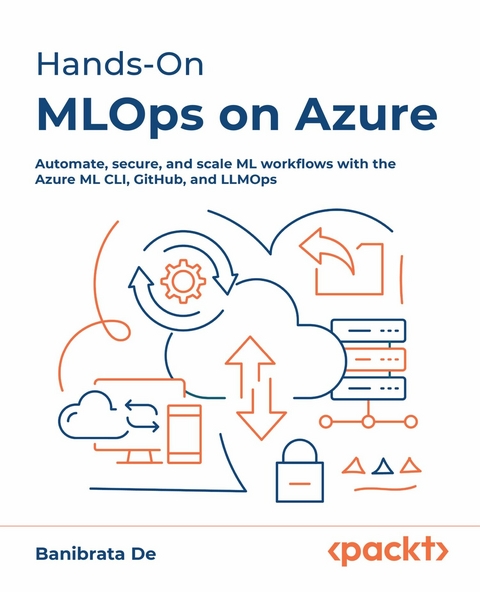
Hands-On MLOps on Azure (eBook)
276 Seiten
Packt Publishing (Verlag)
978-1-83620-032-1 (ISBN)
Effective machine learning (ML) now demands not just building models but deploying and managing them at scale. Written by a seasoned senior software engineer with high-level expertise in both MLOps and LLMOps, Hands-On MLOps on Azure equips ML practitioners, DevOps engineers, and cloud professionals with the skills to automate, monitor, and scale ML systems across environments.
The book begins with MLOps fundamentals and their roots in DevOps, exploring training workflows, model versioning, and reproducibility using pipelines. You'll implement CI/CD with GitHub Actions and the Azure ML CLI, automate deployments, and manage governance and alerting for enterprise use. The author draws on their production ML experience to provide you with actionable guidance and real-world examples. A dedicated section on LLMOps covers operationalizing large language models (LLMs) such as GPT-4 using RAG patterns, evaluation techniques, and responsible AI practices. You'll also work with case studies across Azure, AWS, and GCP that offer practical context for multi-cloud operations.
Whether you're building pipelines, packaging models, or deploying LLMs, this guide delivers end-to-end strategy to build robust, scalable systems. By the end of this book, you'll be ready to design, deploy, and maintain enterprise-grade ML solutions with confidence.
A practical guide to building, deploying, automating, monitoring, and scaling ML and LLM solutions in productionKey FeaturesBuild reproducible ML pipelines with Azure ML CLI and GitHub ActionsAutomate ML workflows end to end, including deployment and monitoringApply LLMOps principles to deploy and manage generative AI responsibly across cloudsPurchase of the print or Kindle book includes a free PDF eBookBook DescriptionEffective machine learning (ML) now demands not just building models but deploying and managing them at scale. Written by a seasoned senior software engineer with high-level expertise in both MLOps and LLMOps, Hands-On MLOps on Azure equips ML practitioners, DevOps engineers, and cloud professionals with the skills to automate, monitor, and scale ML systems across environments. The book begins with MLOps fundamentals and their roots in DevOps, exploring training workflows, model versioning, and reproducibility using pipelines. You'll implement CI/CD with GitHub Actions and the Azure ML CLI, automate deployments, and manage governance and alerting for enterprise use. The author draws on their production ML experience to provide you with actionable guidance and real-world examples. A dedicated section on LLMOps covers operationalizing large language models (LLMs) such as GPT-4 using RAG patterns, evaluation techniques, and responsible AI practices. You'll also work with case studies across Azure, AWS, and GCP that offer practical context for multi-cloud operations. Whether you're building pipelines, packaging models, or deploying LLMs, this guide delivers end-to-end strategy to build robust, scalable systems. By the end of this book, you'll be ready to design, deploy, and maintain enterprise-grade ML solutions with confidence. What you will learnUnderstand the DevOps to MLOps transitionBuild reproducible, reusable pipelines using the Azure ML CLISet up CI/CD for training and deployment workflowsMonitor ML applications and detect model/data driftCapture and secure governance and lineage dataOperationalize LLMs using RAG and prompt flowsApply MLOps across Azure, AWS, and GCP use casesWho this book is forThis book is for DevOps and Cloud engineers and SREs interested in or responsible for managing the lifecycle of machine learning models. Professionals who are already familiar with their ML workloads and want to improve their practices, or those who are new to MLOps and want to learn how to effectively manage machine learning models in this environment, will find this book beneficial. The book is also useful for technical decision-makers and project managers looking to understand the process and benefits of MLOps.]]>
Preface
Machine Learning Operations (MLOps) is an emerging discipline that brings together machine learning, DevOps, and data engineering to streamline and automate the end-to-end lifecycle of machine learning models—from development and experimentation to deployment and monitoring. This book introduces MLOps in a practical, scenario-driven way, with real-world examples using Azure ML, GitHub Actions, and cloud-native services. It aims to help you operationalize machine learning models efficiently and reliably in enterprise environments. The book concludes by exploring the latest trends in LLMOps—applying MLOps to large language models such as GPTs.
Who this book is for
This book is written for DevOps engineers, cloud engineers, SREs, and technical leads who are involved in deploying and managing machine learning systems. It also serves project managers and decision-makers looking to understand MLOps processes and best practices. You are expected to have a working knowledge of the following:
- Machine learning concepts (model training, evaluation, data preparation)
- Cloud computing (Azure, AWS, or GCP)
- Software development tools such as version control, testing, and CI/CD
- Python programming
A background in DevOps is especially helpful, as this book builds on DevOps principles and extends them to ML workflows.
What this book covers
Chapter 1, Understanding DevOps to MLOps, introduces DevOps fundamentals and transitions into MLOps practices such as faster experimentation, deployment, and model governance across cloud platforms.
Chapter 2, Training and Experimentation, guides you through creating ML workspaces, tracking experiments, and optimizing models using hyperparameter tuning.
Chapter 3, Reproducible and Reusable ML, focuses on building repeatable ML pipelines and managing environments to ensure consistent and efficient ML development.
Chapter 4, Model Management (Registration and Packaging), covers model registration, packaging, versioning, and deployment strategies to support the full model lifecycle.
Chapter 5, Model Deployment: Batch Scoring and Real-Time Web Services, explores how to implement scoring jobs for batch processing and real-time prediction using scalable cloud services.
Chapter 6, Capturing and Securing Governance Data for MLOps, delves into governance, lineage tracking, compliance, and security of ML workflows.
Chapter 7, Monitoring the ML Model, shows how to track model performance, detect data drift, monitor resource usage, and conduct controlled rollouts.
Chapter 8, Notification and Alerting in MLOps, teaches you how to use event-driven alerts (e.g., via Event Grid) to detect anomalies and trigger automated responses.
Chapter 9, Automating the ML Lifecycle with ML Pipelines and GitHub Workflows, details how to orchestrate model deployment using GitHub Actions and infrastructure-as-code practices.
Chapter 10, Using Models in Real-world Applications, presents three cloud-based case studies (Azure, GCP, AWS) to demonstrate MLOps in practical industry settings.
Chapter 11, Exploring Next-Gen MLOps, introduces LLMOps, showing how to work with large language models (LLMs), Retrieval-Augmented Generation (RAG), and responsible AI practices.
To get the most out of this book
The following table outlines the key software and tools covered in this book, along with the recommended operating systems to ensure optimal compatibility and performance.
| Software/hardware covered in the book | Operating system requirements |
| Azure ML CLI v2 (latest version) | Windows, macOS, or Linux |
The installation instructions are already part of the book.
If you are using the digital version of this book, we advise you to type the code yourself. Doing so will help you avoid any potential errors related to the copying and pasting of code.
After reading this book, you will be equipped to design reproducible ML pipelines that automate data preparation, training, and scoring; register, package, and deploy models using industry-grade practices; and implement governance, monitoring, and alerting to ensure transparency and compliance. You’ll learn how to orchestrate the ML lifecycle using Azure ML CLI v2 and GitHub Actions with an infrastructure-as-code approach, apply MLOps principles across real-world cloud scenarios, and take your first steps into LLMOps—operationalizing large language models with a focus on safety, ethics, and performance.
The author acknowledges the use of cutting-edge AI with the sole aim of enhancing the language and clarity within the book, thereby ensuring a smooth reading experience for readers. It’s important to note that the content itself has been crafted by the author and edited by a professional publishing team.
Conventions used
There are a number of text conventions used throughout this book.
Code in text: Indicates code words in text, database table names, folder names, filenames, file extensions, pathnames, dummy URLs, user input, and Twitter handles. For example: “In this example, job.yaml contains the schema of the job. Azure ML CLI v2 supports extensive use of YAML files to specify complex schemas for different command-line inputs.”
A block of code is set as follows:
name: mygreat_registry location: eastus description: "My Azure ML Registry" tags: "Awesome : Great" "ML is" : "Fun" Any command-line input or output is written as follows:
az ml job create --file pipeline.yml az ml schedule create --file pipeline.yml Bold: Indicates a new term, an important word, or words that you see on the screen. For instance, words in menus or dialog boxes appear in the text like this. For example: “Notice the rich metadata in Figure 4.4, along with the Created by job section.”
Warnings or important notes appear like this.
Tips and tricks appear like this.
Get in touch
Feedback from our readers is always welcome.
General feedback: If you have questions about any aspect of this book, email us at customercare@packt.com and mention the book title in the subject of your message.
Errata: Although we have taken every care to ensure the accuracy of our content, mistakes do happen. If you have found a mistake in this book, we would be grateful if you would report this to us. Please visit www.packtpub.com/support/errata and fill in the form.
Piracy: If you come across any illegal copies of our works in any form on the internet, we would be grateful if you would provide us with the location address or website name. Please contact us at copyright@packt.com with a link to the material.
If you are interested in becoming an author: If there is a topic that you have expertise in and you are interested in either writing or contributing to a book, please visit authors.packtpub.com.
Stay Sharp in Cloud and DevOps – Join 44,000+ Subscribers of CloudPro
CloudPro is a weekly newsletter for cloud professionals who want to stay current on the fast-evolving world of cloud computing, DevOps, and infrastructure engineering.
Every issue delivers focused, high-signal content on topics like:
- AWS, GCP & multi-cloud architecture
- Containers, Kubernetes & orchestration
- Infrastructure as Code (IaC) with Terraform, Pulumi, etc.
- Platform engineering & automation workflows
- Observability, performance tuning, and reliability best practices
Whether you’re a cloud engineer, SRE, DevOps practitioner, or platform lead, CloudPro helps you stay on top of what matters, without the noise.
Scan the QR code to join for free and get weekly insights straight to your inbox:
https://packt.link/cloudproShare your thoughts
Once you’ve read Hands-On MLOps on Azure, we’d love to hear your thoughts! Please click here to go straight to the Amazon review page for this book and share your feedback.
Your review is important to us and the tech community and will help us make sure we’re delivering excellent quality content.
Download a free PDF copy of this book
Thanks for purchasing this book!
Do...
| Erscheint lt. Verlag | 1.8.2025 |
|---|---|
| Sprache | englisch |
| Themenwelt | Mathematik / Informatik ► Informatik |
| ISBN-10 | 1-83620-032-3 / 1836200323 |
| ISBN-13 | 978-1-83620-032-1 / 9781836200321 |
| Informationen gemäß Produktsicherheitsverordnung (GPSR) | |
| Haben Sie eine Frage zum Produkt? |
 EPUB (Ohne DRM)
Digital Rights Management: ohne DRM
Dieses eBook enthält kein DRM oder Kopierschutz. Eine Weitergabe an Dritte ist jedoch rechtlich nicht zulässig, weil Sie beim Kauf nur die Rechte an der persönlichen Nutzung erwerben.
Dateiformat: EPUB (Electronic Publication)
EPUB ist ein offener Standard für eBooks und eignet sich besonders zur Darstellung von Belletristik und Sachbüchern. Der Fließtext wird dynamisch an die Display- und Schriftgröße angepasst. Auch für mobile Lesegeräte ist EPUB daher gut geeignet.
Systemvoraussetzungen:
PC/Mac: Mit einem PC oder Mac können Sie dieses eBook lesen. Sie benötigen dafür die kostenlose Software Adobe Digital Editions.
eReader: Dieses eBook kann mit (fast) allen eBook-Readern gelesen werden. Mit dem amazon-Kindle ist es aber nicht kompatibel.
Smartphone/Tablet: Egal ob Apple oder Android, dieses eBook können Sie lesen. Sie benötigen dafür eine kostenlose App.
Geräteliste und zusätzliche Hinweise
Buying eBooks from abroad
For tax law reasons we can sell eBooks just within Germany and Switzerland. Regrettably we cannot fulfill eBook-orders from other countries.
aus dem Bereich