


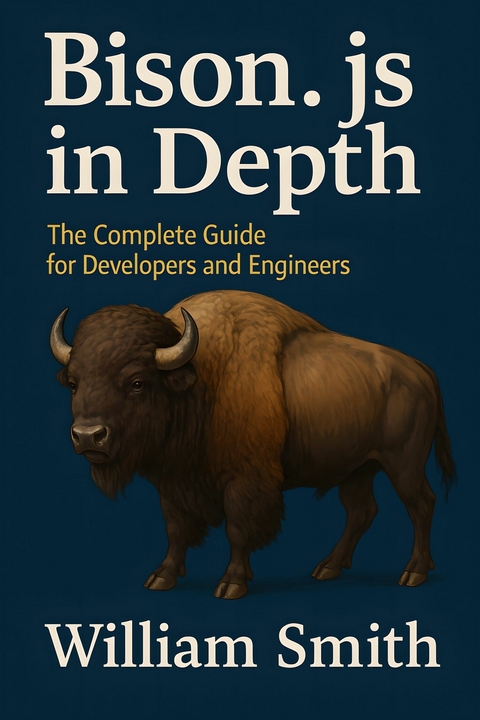
Bison.js in Depth (eBook)
250 Seiten
HiTeX Press (Verlag)
978-0-00-097904-9 (ISBN)
'Bison.js in Depth'
'Bison.js in Depth' is a comprehensive and authoritative guide to building robust, high-performance parsers in modern JavaScript applications. The book begins by laying a deep foundation in parsing fundamentals, demystifying the theoretical landscape of LR and LALR algorithms, and illustrating how Bison.js innovatively extends these classical paradigms for contemporary software development. Readers are led through the evolution of parser generators from Yacc and GNU Bison to the rise of Bison.js, establishing the context, strengths, and architectural highlights that set Bison.js apart from alternative JavaScript options such as PEG.js, Nearley, and ANTLR4.
Throughout the work, the author addresses the intricate practices of grammar definition, modularization, and validation, providing actionable insights and advanced techniques for handling precedence, ambiguity, and recursion. Integration strategies for lexers-including both established solutions like moo and custom lexers-are explored in detail, alongside comprehensive discussions on error handling, diagnostics, and performance engineering. The book delves into the nuances of semantic actions, parse tree and AST construction, and the propagation of context and metadata, ensuring that readers acquire the skills necessary for both functional correctness and developer-friendly tooling.
More than a technical manual, 'Bison.js in Depth' is enriched with real-world case studies, engineering best practices, and forward-looking explorations of emerging trends in language tooling, cloud-native parsing, and AI-assisted grammar inference. Coverage extends to testing, continuous validation, extensibility, and system integration, making this book indispensable for language designers, compiler builders, and anyone developing sophisticated source code tools or domain-specific languages for the JavaScript ecosystem.
Chapter 1
Modern Parsing Fundamentals and the Role of Bison.js
Parsing is at the heart of programming language implementation and tooling, but what really distinguishes modern parser generators in the JavaScript ecosystem? This chapter unveils the theoretical insights and engineering considerations that have shaped the evolution of parser design—from the classic LR algorithms to their practical, high-performance incarnations in Bison.js. We dissect pivotal parsing concepts, reveal how Bison.js pushes traditional boundaries, and establish its role amidst a vibrant landscape of JavaScript parser technologies.
1.1 Parsing Theory: LR, LALR, and Beyond
Parsing techniques based on deterministic automata form the backbone of many modern compiler front-ends, providing efficient and robust syntactic analysis for context-free grammars. Among the most prominent strategies are the LR family of algorithms, each representing a trade-off between expressive power, table size, and implementation complexity.
At the foundation lies the LR(0) method, which constructs a finite automaton representing viable prefixes of the input, equipped with items-productions augmented by a parsing position denoted by a dot. The LR(0) automaton’s states correspond to sets of items closed under the grammar’s productions, encoding positions where parsing decisions are required. The core challenge here is the shift-reduce conflict, emblematic of ambiguity where the parser cannot determine whether to shift the next symbol or reduce by a production. LR(0) parsers cannot resolve these inherently, limiting their applicability to relatively simple grammars.
Enhancing this approach, the LR(1) algorithm introduces lookahead symbols in the items, transforming them into LR(1) items of the form
where a is a terminal symbol expected to follow the production. These lookaheads empower the parser to distinguish among reduction possibilities based on the subsequent input, substantially reducing nondeterminism. The creation of the LR(1) automaton involves augmenting each LR(0) item with lookahead sets and propagating signals through the closure and goto procedures, which results in significantly larger state graphs due to the combination of item core and lookaheads. Nonetheless, LR(1) parsing guarantees the recognition of a broad class of deterministic context-free grammars.
To mitigate the exponential growth in the LR(1) parser tables, Look-Ahead LR (LALR) parsers were devised. LALR parsers merge LR(1) states with identical LR(0) cores by combining their lookahead sets, often producing much smaller parse tables with minimal loss of language coverage. This compression enables practical usage in tools like yacc and bison, striking a convenient balance between power and resource consumption. However, merging states may introduce spurious conflicts, necessitating grammar refinements or manual disambiguation.
The algorithmic construction of these parsing tables proceeds through systematic steps:
- 1.
- Item Generation and Closure: Starting from an augmented start production, the parser generator computes closure under grammar productions, enriching items with possible lookaheads in LR(1) and LALR cases.
- 2.
- Goto Function Computation: For each state and grammar symbol, the parser transitions to subsequent states by advancing the dot over matching symbols, thereby building the canonical collection of sets of items.
- 3.
- Parse Table Construction: The ACTION and GOTO tables are constructed by associating shift, reduce, accept, or error actions with state and input symbol pairs based on items present.
These algorithms effectively resolve challenges such as ambiguous parse states and nondeterminism by leveraging lookahead information and careful state space construction. However, limitations persist for inherently ambiguous grammars or context-sensitive constructs, where generalized parsing methods or semantic predicates may be required.
Bison.js, a JavaScript adaptation of the widely used GNU Bison parser generator, implements an LALR(1) parsing strategy as its core, reflecting industry-standard methodology. Its implementation navigates the delicate balance between parser expressiveness and runtime efficiency within the constraints of JavaScript environments. By adopting traditional LR automaton construction algorithms with optimizations tailored to the target platform, Bison.js ensures compatibility with a large class of deterministic grammars while minimizing parse table sizes.
Additionally, Bison.js extends the classical LALR(1) framework with incremental parsing capabilities and integration hooks enabling custom semantic actions in JavaScript, demonstrating how theoretical foundations can be adapted to modern development ecosystems. This practical extension accommodates real-world programming language idioms and tooling requirements, facilitating rapid parser generation for web applications and embedded scripting contexts.
The LR-based parsing algorithms—ranging from LR(0) through LR(1) to LALR—illustrate a progression of techniques designed to balance determinism, lookahead information, and implementation complexity. Their theoretical underpinnings, as expressed through automata construction and parse table generation, address central problems in syntax analysis. Implementations such as Bison.js exemplify the continued relevance and adaptability of these theories for contemporary software engineering challenges.
1.2 Context-Free Grammars: Formalism and Practice
Context-free grammars (CFGs) form the foundational theoretical framework for describing the syntax of programming languages and many structured data formats. Formally, a CFG is defined as a 4-tuple G = (V,Σ,R,S) where:
- V is a finite set of nonterminal symbols,
- Σ is a finite set of terminal symbols, disjoint from V ,
- R is a finite set of production rules of the form A → α, where A ∈ V and α ∈ (V ∪ Σ)∗, and
- S ∈ V is the start symbol.
The language generated by G consists of all strings over Σ derivable from S by successive application of production rules.
CFGs are powerful enough to describe nested, recursive language constructs that regular expressions cannot capture. However, the expressiveness of CFGs comes with nuanced complexity in parsing, especially since CFGs allow infinite derivations and ambiguous syntax. Ambiguity arises when there exists a string in the language with more than one distinct parse tree rooted at S. Formally, ambiguity is an intrinsic property of the grammar, independent of the ultimately generated language. This ambiguity directly impacts parser implementation, often requiring disambiguation strategies through grammar refactoring or parser directives.
Recursion, both direct and indirect, is a hallmark characteristic crucial for modeling nested constructs such as arithmetic expressions or block-structured code. Left recursion, for instance, can cause naive parsers to enter infinite loops. Hence, practical parser design often involves transformations that eliminate left recursion or convert it into equivalent right recursion, trading theoretical purity for algorithmic tractability. This reflects the tension between the declarative mathematical elegance of CFGs and the operational demands of parser construction.
The Chomsky hierarchy establishes CFGs at the context-free level, differentiating them from regular and context-sensitive grammars. They are more expressive than regular grammars but less so than context-sensitive grammars, a balance that ensures parsing remains decidable and, with appropriate restrictions, efficiently implementable. Classical parsing algorithms such as CYK and Earley parsing guarantee correctness over all CFGs but can be computationally demanding (O(n3) time in the worst case). Meanwhile, deterministic parsing methods like LR and LALR variants, widely used in practical compilers, restrict grammars further to maintain linear-time performance.
Bison.js embodies an implementation of these CFG principles tailored for modern JavaScript environments, balancing theoretical foundations with real-world parsing needs. Building upon the established GNU Bison parser generator, Bison.js accepts grammars defined in a similar syntax and performs left-recursion elimination, conflict detection, and resolution where feasible. The tool enforces a deterministic subset of CFGs aligned with LALR(1) parsing, a practical compromise that enables efficient lookahead-based parsing while sacrificing the ability to handle some inherently ambiguous or highly complex grammars.
...| Erscheint lt. Verlag | 30.7.2025 |
|---|---|
| Sprache | englisch |
| Themenwelt | Mathematik / Informatik ► Informatik ► Programmiersprachen / -werkzeuge |
| ISBN-10 | 0-00-097904-X / 000097904X |
| ISBN-13 | 978-0-00-097904-9 / 9780000979049 |
| Informationen gemäß Produktsicherheitsverordnung (GPSR) | |
| Haben Sie eine Frage zum Produkt? |
 EPUB (Adobe DRM)
Größe: 737 KB
Kopierschutz: Adobe-DRM
Adobe-DRM ist ein Kopierschutz, der das eBook vor Mißbrauch schützen soll. Dabei wird das eBook bereits beim Download auf Ihre persönliche Adobe-ID autorisiert. Lesen können Sie das eBook dann nur auf den Geräten, welche ebenfalls auf Ihre Adobe-ID registriert sind.
Details zum Adobe-DRM
Dateiformat: EPUB (Electronic Publication)
EPUB ist ein offener Standard für eBooks und eignet sich besonders zur Darstellung von Belletristik und Sachbüchern. Der Fließtext wird dynamisch an die Display- und Schriftgröße angepasst. Auch für mobile Lesegeräte ist EPUB daher gut geeignet.
Systemvoraussetzungen:
PC/Mac: Mit einem PC oder Mac können Sie dieses eBook lesen. Sie benötigen eine
eReader: Dieses eBook kann mit (fast) allen eBook-Readern gelesen werden. Mit dem amazon-Kindle ist es aber nicht kompatibel.
Smartphone/Tablet: Egal ob Apple oder Android, dieses eBook können Sie lesen. Sie benötigen eine
Geräteliste und zusätzliche Hinweise
Buying eBooks from abroad
For tax law reasons we can sell eBooks just within Germany and Switzerland. Regrettably we cannot fulfill eBook-orders from other countries.
aus dem Bereich


