


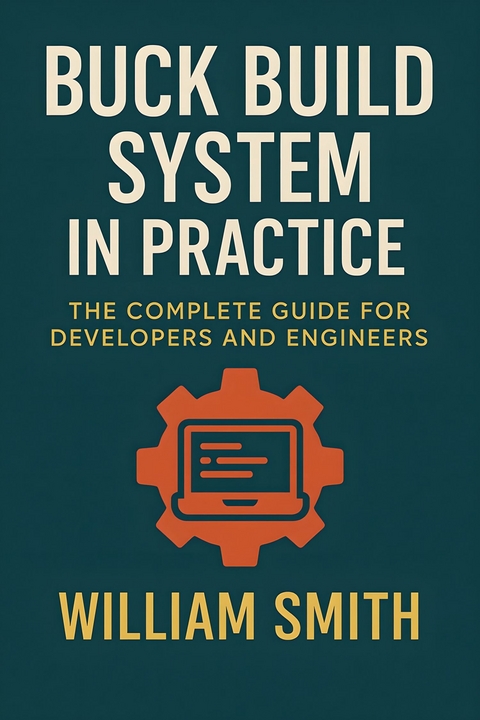
Buck Build System in Practice (eBook)
250 Seiten
HiTeX Press (Verlag)
978-0-00-097902-5 (ISBN)
'Buck Build System in Practice'
'Buck Build System in Practice' offers a definitive, in-depth exploration of the Buck build system and its transformative role in contemporary software development. Starting from the historical origins and core architectural principles, the book methodically introduces readers to Buck's underpinning concepts such as targets, rules, and dependency graphs, while guiding them through setup, multi-language support, and best practices for initial project configuration. Early chapters lay a sturdy foundation, enabling both newcomers and experienced engineers to grasp Buck's design philosophy and its advantages over alternative tools.
The heart of the book delves into declarative build specifications, sophisticated configuration management, and large-scale workspace design. With practical focus, it addresses advanced topics like dependency graph optimization, scalable monorepo patterns, resource-efficient caching, and incremental build strategies. Each section is fortified with actionable guidance, from defining and managing complex build targets to customizing build rules, integrating remote execution and distributed CI, and federating builds across massive codebases. Real-world practices are illustrated through case studies, ensuring readers can navigate the challenges of scaling Buck for teams of hundreds and codebases with millions of lines.
Crucially, the book extends beyond technical mechanics to encompass build pipeline security, compliance, and reproducibility-exploring sandboxing, secrets management, audit logging, and organizational policy enforcement-before concluding with advanced extension mechanisms, open-source governance, and forward-looking research trends. 'Buck Build System in Practice' is essential reading for engineers, architects, and DevOps leaders intent on mastering Buck in both modern and future-focused software environments, empowering them to build secure, high-performance, and maintainable systems at any scale.
Chapter 2
Declarative Build Specifications
What if your build system spoke the language of intent, not just instruction? This chapter demystifies Buck’s unique approach to declarative build definitions—transforming repetitive scripting into structured, readable, and scalable specifications. Discover how to model intricate dependencies, customize rules, and harness macros to compose robust builds that remain resilient in the face of rapid change.
2.1 BUILD Files: Anatomy and Semantics
Buck’s BUILD files represent the core artifact for defining build targets and their relationships within the Buck build system. These files are written in a domain-specific language based on Python syntax, yet they are subject to specific semantic rules that differentiate build configuration from implementation logic. Understanding the formal structure and semantics of BUILD files is essential for developing maintainable, scalable build specifications.
At the syntactic level, a BUILD file consists of a sequence of function calls, each representing the declaration of one or more build targets. Typical functions include java_library(), cxx_binary(), genrule(), among others, depending on the language and platform. These functions accept keyword arguments describing the attributes of targets: sources, dependencies, visibility, compiler options, and more. A minimal BUILD file might look as follows:
name = "core",
srcs = glob(["src/main/java/**/*.java"]),
deps = [":utils"],
)
The BUILD language is deliberately restricted: it does not support arbitrary Python features such as loops or variable assignments outside call expressions. This constraint ensures declarative clarity and deterministic parsing. The function calls are not user-defined functions but built-in rules interpreted by the Buck engine. Thus, each rule corresponds to a well-defined semantic template mapping syntactic parameters to build actions.
The semantic separation between build configuration and implementation logic is manifested as follows. BUILD files specify what to build by declaring targets and their dependencies. They avoid prescribing how to build in an imperative sense. Implementation details-like shell commands, compiler flags, or code generation sequences-are encapsulated within the variants of rule functions or invoked through dedicated macros or extensions. This separation enhances maintainability, as BUILD files remain concise declarative specifications of project structure, insulating users from the complexities of underlying toolchains.
Parsing a BUILD file is an essential step that converts the source text into an abstract syntax tree (AST) representation understood by Buck. The parser is designed to recognize the restricted Python-like grammar and validate the presence of expected rule invocations. Errors during parsing typically include syntax violations, missing attributes, or invalid data types for parameters. The parser also handles macros, which are higher-order functions simulating parameterized target declarations to reduce repetition.
Following parsing, Buck performs evaluation of the BUILD file in a controlled environment. This evaluation expands macros, resolves attribute expressions such as glob() calls, and computes the final normalized parameter sets for each target. Because BUILD files avoid side effects and mutable state, this evaluation is idempotent and reproducible, a critical property for correct incremental builds and caching. Targets’ dependency graphs are constructed during this phase, enabling scheduling and parallelization in subsequent build stages.
Evolving BUILD files as a codebase grows requires adherence to best practices that respect the declarative architecture and maintain clear semantic boundaries:
- Modularization: Divide large BUILD files into smaller, focused units reflecting logical components. This improves readability and reduces merge conflicts.
- Use of macros and repository rules: Encapsulate common patterns to avoid duplication. Macros provide parameterized abstractions while repository rules handle external dependencies robustly.
- Avoid embedding imperative logic: Keep BUILD files free from conditional or looping constructs that obscure target definitions. Instead, express variations through parametric macros or separate targets.
- Explicit declaration of visibility and dependencies: This prevents unintended coupling and supports fine-grained incremental builds.
- Consistent naming conventions and attribute usage: Facilitate automated tooling and improve discoverability of targets.
The evaluation lifecycle of BUILD files integrates tightly with Buck’s build engine. When a source file or BUILD file changes, Buck re-parses and re-evaluates only the affected BUILD files, recalculating target graphs selectively. This incremental evaluation is foundational to Buck’s performance at large scale.
BUILD files serve as a well-defined interface between the project’s source code and Buck’s build logic. Their formal structure-restricted to declarative rule calls-and strict semantic layering between configuration and logic afford a robust foundation for specifying builds. Proper comprehension of parsing and evaluation, coupled with disciplined authoring practices, enables the development of efficient, maintainable build specifications capable of scaling alongside complex software projects.
2.2 Defining Build Targets
In modern build systems, the concept of a build target is central to controlling the compilation or processing of source files into deliverables. Build targets encapsulate the specification of inputs, outputs, and the steps necessary for transformation, thereby enabling automation, modularity, and incremental builds. The granularity and composition of targets directly influence build efficiency, maintainability, and clarity of the project’s dependency structure.
A granular build target refers to the smallest unit of work, often representing the compilation or generation of one artifact from a specific set of inputs. Granularity enables precise change detection and minimal rebuilds. Conversely, composite build targets aggregate multiple granular targets or other composite targets, providing an abstraction layer that reflects logical groupings such as libraries, components, or entire subsystems.
Defining a build target involves specifying several key elements:
- Attributes: intrinsic properties defining the target’s behavior or nature, such as the target type (executable, library, archive), source files, and output names.
- Parameters: configurable options that influence target construction, for example, compiler flags, optimization levels, or platform-specific settings.
- Metadata: auxiliary information encapsulating descriptive or operational details, which may not affect the build commands directly, but assist in documentation, analytics, or conditional processing.
This triad facilitates fine control over a target’s definition, supports reuse, and allows the build system to make informed decisions about dependencies and outputs.
Granular targets begin with explicit declaration of:
- Input Sources: files or generated assets that feed into the build process.
- Outputs: expected artifacts produced, typically including binaries, object files, or intermediates.
- Build Actions: commands or scripts that invoke compilers, preprocessors, or other tools responsible for producing outputs.
For example, a typical granular target definition in a declarative...
| Erscheint lt. Verlag | 24.7.2025 |
|---|---|
| Sprache | englisch |
| Themenwelt | Mathematik / Informatik ► Informatik ► Programmiersprachen / -werkzeuge |
| ISBN-10 | 0-00-097902-3 / 0000979023 |
| ISBN-13 | 978-0-00-097902-5 / 9780000979025 |
| Informationen gemäß Produktsicherheitsverordnung (GPSR) | |
| Haben Sie eine Frage zum Produkt? |
 EPUB (Adobe DRM)
Größe: 635 KB
Kopierschutz: Adobe-DRM
Adobe-DRM ist ein Kopierschutz, der das eBook vor Mißbrauch schützen soll. Dabei wird das eBook bereits beim Download auf Ihre persönliche Adobe-ID autorisiert. Lesen können Sie das eBook dann nur auf den Geräten, welche ebenfalls auf Ihre Adobe-ID registriert sind.
Details zum Adobe-DRM
Dateiformat: EPUB (Electronic Publication)
EPUB ist ein offener Standard für eBooks und eignet sich besonders zur Darstellung von Belletristik und Sachbüchern. Der Fließtext wird dynamisch an die Display- und Schriftgröße angepasst. Auch für mobile Lesegeräte ist EPUB daher gut geeignet.
Systemvoraussetzungen:
PC/Mac: Mit einem PC oder Mac können Sie dieses eBook lesen. Sie benötigen eine
eReader: Dieses eBook kann mit (fast) allen eBook-Readern gelesen werden. Mit dem amazon-Kindle ist es aber nicht kompatibel.
Smartphone/Tablet: Egal ob Apple oder Android, dieses eBook können Sie lesen. Sie benötigen eine
Geräteliste und zusätzliche Hinweise
Buying eBooks from abroad
For tax law reasons we can sell eBooks just within Germany and Switzerland. Regrettably we cannot fulfill eBook-orders from other countries.
aus dem Bereich


