


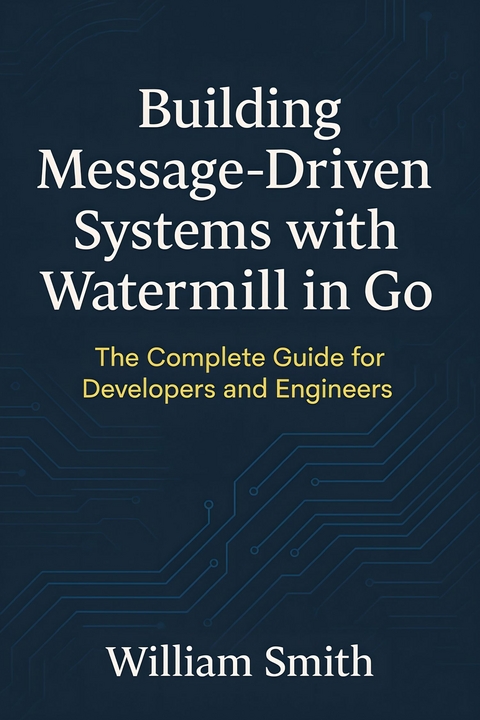
Building Message-Driven Systems with Watermill in Go (eBook)
250 Seiten
HiTeX Press (Verlag)
978-0-00-097900-1 (ISBN)
'Building Message-Driven Systems with Watermill in Go'
'Building Message-Driven Systems with Watermill in Go' is an authoritative guide to designing and operating modern, reliable, and scalable messaging architectures with Go and Watermill. Beginning with a comprehensive exploration of message-driven principles-including event-driven, pub/sub, and CQRS-the book provides an in-depth analysis of why Go's concurrency model and ecosystem make it uniquely suited to distributed systems. It addresses messaging topologies, native concurrency features, and a detailed rationale for utilizing Watermill amidst the landscape of Go libraries.
The core of the book demystifies Watermill's abstractions and architecture, guiding readers through practical topics such as routers, middleware, message metadata, and broker integration across platforms like Kafka, RabbitMQ, NATS, and cloud services. Rich chapters on schema design-featuring serialization strategies, contract evolution, and message validation-equip practitioners to build robust systems that excel in delivery guarantees, fault handling, and scalability. Advanced processing patterns, from transactional messaging and workflow orchestration to observability, are explored with actionable examples and middleware strategies.
Beyond system architecture, the book delves deeply into the operational, security, and lifecycle facets essential for production readiness. Topics include error handling at scale, high availability, disaster recovery, and compliance measures like auditing, privacy assurance, and regulatory controls. Comprehensive guidance on deployment (covering Kubernetes, CI/CD, configuration management, and secrets handling), alongside real-world case studies and open source community participation, makes this book an indispensable reference for Go professionals seeking to master message-driven systems with Watermill.
Chapter 1
Modern Message-Driven Architectures and Go
What does it really take to build resilient, responsive, and scalable systems today? In this chapter, we unravel the underlying principles that make message-driven architectures the backbone of modern distributed applications—and examine, with a critical eye, why Go has emerged as a language of choice for their implementation. From the philosophy of decoupled computation to the real-world engineering trade-offs, you’ll discover how the synergy between Go and message-driven paradigms can empower your systems to excel in today’s demanding environments.
1.1 Architectural Foundations of Message-Driven Systems
Message-driven systems constitute a paradigm designed to manage the increasing demands of distributed applications through decoupled components that interact predominantly via asynchronous message exchanges. The core theoretical underpinning of this paradigm lies in its ability to address the challenges of scalability, maintainability, and resiliency inherent in modern complex software architectures.
At the heart of message-driven architectures is the principle of decoupling. By isolating components through message interfaces rather than direct calls, systems enhance modularity and fault tolerance. This separation permits individual services or modules to evolve independently and scale horizontally. Decoupling also facilitates failure containment: when one component experiences failure or degradation, it does not immediately propagate to others, thus preserving overall system robustness.
A fundamental design style within this realm is event-driven architecture (EDA). In EDA, system components communicate by producing and consuming events-discrete notifications indicating that a particular state change or significant occurrence has taken place. Events are immutable facts; they describe “what happened” rather than “what to do.” By orienting around event emissions and reactions, systems embrace asynchronous flows that better accommodate latency, intermittent connectivity, and variable workloads. The event-driven approach aligns naturally with distributed environments where synchronous operations would degrade performance or availability.
Closely intertwined with event-driven principles is the publish/subscribe pattern. Unlike traditional client-server models where the sender and receiver are tightly coupled, publish/subscribe decouples communication into publishers, subscribers, and message brokers or event buses. Publishers emit messages without knowledge of consumers, while subscribers express interest in message topics or channels. The middleware infrastructure ensures reliable message delivery with various degrees of quality of service (QoS), including durable subscriptions and replay capabilities. This pattern enables scalable many-to-many communication, dynamic topology changes, and load distribution across multiple consumers, all essential for modern distributed systems that require flexibility and asynchronous processing.
Another architectural construct that fits well within message-driven systems is Command-Query Responsibility Segregation (CQRS). CQRS partitions the system responsibilities into two distinct models: commands for mutating state and queries for reading state. By segregating these concerns, systems can optimize command and query handling independently. Commands are often processed asynchronously, dispatched as messages to command handlers which enforce business rules and update the system state, potentially generating domain events. Queries leverage denormalized read models specifically designed for efficient data retrieval. CQRS complements message-driven designs by formalizing control flow and data flow separation, improving scalability and maintainability while simplifying compliance with eventual consistency constraints.
The notion of eventual consistency is a natural consequence of asynchronous message processing and distributed data management. Instead of pursuing immediate consistency, which often imposes significant coordination overhead, systems accept temporary discrepancies between replicas or components, with the guarantee that all will converge to a consistent state eventually. This trade-off enhances availability and partition tolerance, two critical facets described by the CAP theorem. Eventual consistency is realized through event sourcing, message replay, and compensating actions, ensuring that state changes are reproducible and auditable over time.
In sum, message-driven architectures leverage asynchronous communication as a fundamental mechanism to decouple components, facilitate scalability, and improve system resilience. Event-driven design promotes loose coupling through immutable event notifications, while the publish/subscribe pattern extends this principle to scalable and dynamic message dissemination. CQRS introduces separation of concerns that align well with message-based command handling and query servicing, promoting flexibility and efficient data access strategies. The acceptance of eventual consistency enables distributed systems to trade temporal synchronization for higher availability without sacrificing correctness in the long term.
This architectural foundation sets the stage for sophisticated distributed applications capable of responding to fluctuating demands, component failures, and complex integration scenarios. Message-driven systems embody a design philosophy that embraces asynchrony, loose coupling, and pragmatic data consistency to address the inherent complexities of contemporary computing environments.
1.2 Evaluating Go for Distributed Systems
Go, designed at Google with the explicit intent to improve developer productivity in large-scale software and infrastructure projects, has gained traction in the domain of distributed systems. Its language features align well with the needs of message-driven architectures, which demand high concurrency, efficient inter-process communication, and ease of deployment. A nuanced evaluation of Go’s concurrency primitives, type system, and ecosystem reveals both its strengths and constraints relative to established languages such as Java, Erlang, and Rust.
At the core of Go’s appeal for distributed systems is its lightweight concurrency model. Goroutines, which are functions or methods executing concurrently, are multiplexed onto a smaller number of OS threads by the Go scheduler. This model offers a significant efficiency improvement over traditional threading, enabling tens of thousands of goroutines to run simultaneously with minimal overhead. Goroutines’ stack sizes start at only a few kilobytes and grow dynamically, allowing the runtime to conserve system memory-a key factor for scalable distributed applications.
Coupled with goroutines, Go’s channels provide a robust yet simple mechanism for message passing. Channels are typed conduits that enable safe communication and synchronization between goroutines, thereby facilitating coordination without explicit locking or state sharing. The language enforces the use of channels through the type system, which reduces the likelihood of race conditions and deadlocks inherent in lower-level concurrency primitives. Moreover, select statements introduce non-blocking multiplexing over channels, enabling elegant handling of multiple concurrent events.
Go’s type system, though simpler and less expressive than those of Rust or Haskell, strikes a balance conducive to rapid development and maintainability. It is statically typed with structural typing via interfaces, supporting polymorphism without inheritance hierarchies. This facilitates abstraction and code reuse without incurring the complexity of explicit type hierarchies or generic programming models seen in other languages. However, the absence of higher-kinded types and limited support for generics (recently introduced but still evolving) can be constraining in crafting highly generic distributed system components or frameworks.
The ecosystem surrounding Go substantially accelerates the development of distributed systems. The standard library includes packages such as net/http, context, and encoding which underpin common distributed paradigms. Additionally, tooling such as go mod for dependency management and a robust build system simplify collaboration and deployment. Popular frameworks and libraries—gRPC for remote procedure calls, etcd for distributed key-value storage, and consul clients—extend Go’s capabilities in building resilient, service-oriented architectures.
Contextually, Go’s approach to concurrency contrasts significantly with Erlang’s actor model, Java’s thread-based multitasking, and Rust’s ownership-centric memory management. Erlang’s lightweight processes and message passing provide fault tolerance through isolation, features that Go approximates but does not enforce natively. While Erlang emphasizes error recovery and system supervision trees, Go leaves these architectural concerns primarily to the application developer, trading off some fault tolerance for flexibility and performance. Compared with Java, Go’s goroutines are more lightweight and naturally suited for high...
| Erscheint lt. Verlag | 24.7.2025 |
|---|---|
| Sprache | englisch |
| Themenwelt | Mathematik / Informatik ► Informatik ► Programmiersprachen / -werkzeuge |
| ISBN-10 | 0-00-097900-7 / 0000979007 |
| ISBN-13 | 978-0-00-097900-1 / 9780000979001 |
| Informationen gemäß Produktsicherheitsverordnung (GPSR) | |
| Haben Sie eine Frage zum Produkt? |
 EPUB (Adobe DRM)
Größe: 1,1 MB
Kopierschutz: Adobe-DRM
Adobe-DRM ist ein Kopierschutz, der das eBook vor Mißbrauch schützen soll. Dabei wird das eBook bereits beim Download auf Ihre persönliche Adobe-ID autorisiert. Lesen können Sie das eBook dann nur auf den Geräten, welche ebenfalls auf Ihre Adobe-ID registriert sind.
Details zum Adobe-DRM
Dateiformat: EPUB (Electronic Publication)
EPUB ist ein offener Standard für eBooks und eignet sich besonders zur Darstellung von Belletristik und Sachbüchern. Der Fließtext wird dynamisch an die Display- und Schriftgröße angepasst. Auch für mobile Lesegeräte ist EPUB daher gut geeignet.
Systemvoraussetzungen:
PC/Mac: Mit einem PC oder Mac können Sie dieses eBook lesen. Sie benötigen eine
eReader: Dieses eBook kann mit (fast) allen eBook-Readern gelesen werden. Mit dem amazon-Kindle ist es aber nicht kompatibel.
Smartphone/Tablet: Egal ob Apple oder Android, dieses eBook können Sie lesen. Sie benötigen eine
Geräteliste und zusätzliche Hinweise
Buying eBooks from abroad
For tax law reasons we can sell eBooks just within Germany and Switzerland. Regrettably we cannot fulfill eBook-orders from other countries.
aus dem Bereich


