


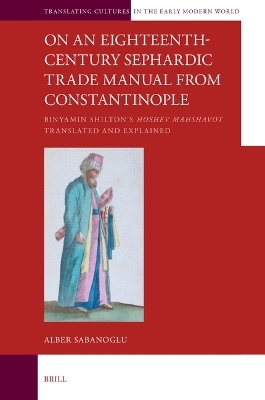
On an Eighteenth-Century Sephardic Trade Manual from Constantinople
Binyamin Shilton’s Translated and Explained
Seiten
2026
|
c 216 pp incl 33 facsimile scans
Brill (Verlag)
978-90-04-68722-6 (ISBN)
Brill (Verlag)
978-90-04-68722-6 (ISBN)
- Noch nicht erschienen (ca. Februar 2026)
- Versandkostenfrei
- Auch auf Rechnung
- Artikel merken
Transliteration, translation and analysis of one of the first books published in Ladino on a non-religious subject, with its rich content on the trade and mathematics teaching practices of the beginning of the eighteenth century.
Through the gate opened by Hoshev Mahshavot, one of the first books written in Ladino on a non-religious subject, this study explores the little-known world of the Constantinople Jewish traders of the early eighteenth century, their international networks, the goods that they sold and bought, the language that they used, and the way mathematics and trade were taught. What were the sources of inspiration for this manual? What was the state of knowledge of math and the sciences in Europe and the Ottoman Empire? How much interaction was there between authors of similar books in different communities? While addressing these and other questions, the author demonstrates that math could also be taught by means of anecdotes, refrains, or poems; and that trade was considered to be a science related to philosophy.
Through the gate opened by Hoshev Mahshavot, one of the first books written in Ladino on a non-religious subject, this study explores the little-known world of the Constantinople Jewish traders of the early eighteenth century, their international networks, the goods that they sold and bought, the language that they used, and the way mathematics and trade were taught. What were the sources of inspiration for this manual? What was the state of knowledge of math and the sciences in Europe and the Ottoman Empire? How much interaction was there between authors of similar books in different communities? While addressing these and other questions, the author demonstrates that math could also be taught by means of anecdotes, refrains, or poems; and that trade was considered to be a science related to philosophy.
Alber Sabanoglu (B.S. Engineering and B.A. History from Brown University, M.A. Mathematics from Tufts University) is Professor of Operations and Finance at IE University, Madrid. His academic interests lie with behavioral decision making and Sephardic and Ottoman History. He published short stories and essays in the USA, Australia, Spain, and Turkey.
| Erscheint lt. Verlag | 19.2.2026 |
|---|---|
| Reihe/Serie | Translating Cultures in the Early Modern World ; 1 |
| Verlagsort | Leiden |
| Sprache | englisch |
| Maße | 155 x 235 mm |
| Themenwelt | Schulbuch / Wörterbuch |
| Geisteswissenschaften ► Religion / Theologie ► Judentum | |
| Geisteswissenschaften ► Sprach- / Literaturwissenschaft ► Anglistik / Amerikanistik | |
| Geisteswissenschaften ► Sprach- / Literaturwissenschaft ► Literaturgeschichte | |
| Mathematik / Informatik ► Mathematik ► Geschichte der Mathematik | |
| Sozialwissenschaften ► Pädagogik | |
| Wirtschaft ► Volkswirtschaftslehre | |
| ISBN-10 | 90-04-68722-X / 900468722X |
| ISBN-13 | 978-90-04-68722-6 / 9789004687226 |
| Zustand | Neuware |
| Informationen gemäß Produktsicherheitsverordnung (GPSR) | |
| Haben Sie eine Frage zum Produkt? |
Mehr entdecken
aus dem Bereich



aus dem Bereich


