


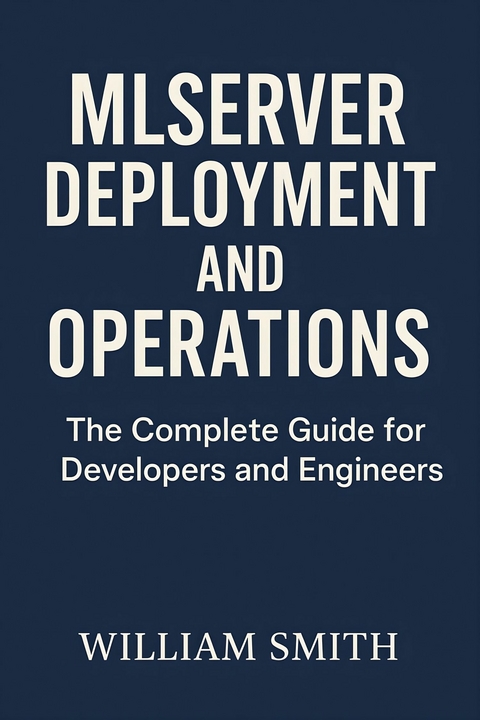
MLServer Deployment and Operations (eBook)
250 Seiten
HiTeX Press (Verlag)
978-0-00-097542-3 (ISBN)
'MLServer Deployment and Operations'
'MLServer Deployment and Operations' is a thorough and expertly curated guide to deploying, operating, and optimizing machine learning model servers in production environments. The book opens with foundational concepts, outlining architectural paradigms for ML serving, comprehensive model lifecycle management, and streamlined deployment pipelines. Readers will gain practical insights into managing diverse inference workload patterns, versioning strategies, artifact organization, and crucial pipeline transition steps that take models seamlessly from experimentation to real-world application.
As the journey progresses, the book dives deep into deployment strategies and automation, including advanced CI/CD workflows, risk-mitigating release patterns like blue/green and canary deployments, and vital rollback and disaster recovery mechanisms. With a strong focus on enterprise-grade APIs and interfaces, it explores robust API engineering-from REST and gRPC protocol design to authentication, rate limiting, and dynamic model selection. Readers also learn to build resilient infrastructure and orchestration frameworks using containers, Kubernetes, serverless approaches, and hybrid edge/cloud patterns, all while optimizing resource allocation, autoscaling, and load balancing for maximum performance and reliability.
Operational excellence is at the heart of the text, with dedicated chapters on observability, performance monitoring, and security. Advanced guidance covers logging, metrics, alerting, SLOs, and AIOps-powered automated remediation for self-healing operations. Essential topics on securing ML workloads span threat modeling, privacy compliance, RBAC, vulnerability management, and defending against adversarial attacks-all within the context of evolving regulatory demands. The book culminates in advanced topics such as distributed and federated serving, global model synchronization, state management in inference systems, and detailed, real-world case studies. Together, these sections equip engineering teams, architects, and ML practitioners with the knowledge needed to deliver scalable, secure, and future-proof ML serving platforms for even the most demanding production landscapes.
Chapter 2
Deployment Strategies and Automation
Automating the safe and continuous rollout of machine learning models is both an engineering art and an operational science. In this chapter, uncover the sophisticated strategies and modern tooling that empower organizations to ship, test, and evolve high-velocity ML systems with minimal human intervention—and maximal resilience. Navigate beyond traditional playbooks as we dissect advanced deployment patterns, risk mitigation, and the toolchains underpinning reliable AI in production.
2.1 Continuous Integration and Continuous Deployment (CI/CD)
Architecting reproducible and automated deployment pipelines for machine learning (ML) systems necessitates a fundamentally different approach compared to traditional software CI/CD workflows. Whereas classic software pipelines focus primarily on source code integration, compilation, unit and integration testing, and deployment artifacts, ML pipelines must integrate model building, data management, validation, testing, and promotion stages, acknowledging the intrinsic complexity and dynamism of ML artifacts.
A central challenge lies in the nature of ML artifacts themselves: models, training datasets, feature transformations, and scoring components all demand rigorous versioning and reproducibility guarantees. Unlike source code, which can be expressed as discrete text files with well-understood dependency graphs, ML artifacts include opaque numeric arrays, serialized computation graphs, and ephemeral training data snapshots. Consequently, a robust ML CI/CD pipeline mandates comprehensive data versioning mechanisms aligned with model versioning, ensuring that every deployed model corresponds unambiguously to a specific dataset, feature set, and training environment.
Environment consistency is a critical prerequisite to guarantee reproducibility across pipeline executions. Leveraging containerization technologies (e.g., Docker) and infrastructure-as-code tools (e.g., Terraform, Kubernetes manifests) enables precise encapsulation of runtime dependencies, from operating system versions to ML libraries and auxiliary utilities. Pipelines should enforce environment freeze or snapshotting to avert inconsistencies caused by drift in dependency versions or system configurations. Additionally, employing pipeline-as-code frameworks such as Kubeflow Pipelines, MLflow, TFX, or Apache Airflow facilitates declarative specification of pipeline stages, promoting transparency, version control, and automation.
Model validation gates introduce essential quality controls in the pipeline before any new model promotion to production. Automated validation encompasses multiple facets: statistical evaluation of model performance metrics on holdout or cross-validated datasets, fairness and bias assessments, robustness under adversarial inputs or data shifts, and computational efficiency benchmarks. These gates enforce predefined thresholds, ensuring that only models meeting or exceeding quality criteria can advance. Validation workflows typically integrate unit tests on pipeline components and integration tests with downstream systems to detect compatibility or performance regressions early.
Due to ML’s reliance on data, pipeline steps often merge data-centric version control with continuous integration concepts. Specialized tools for data versioning such as DVC (Data Version Control) or Pachyderm can track datasets and feature artifacts as first-class citizens, enabling reproducibility and traceability analogous to code commits in Git. This linkage between data versions, model snapshots, and pipeline runs forms the backbone of auditability and regulatory compliance for ML deployment.
Pipeline architecture involves several logical stages, often automated through orchestration platforms:
- 1.
- Data Ingestion and Preprocessing: Automated extraction and transformation of raw data into features, coupled with data quality checks and versioning.
- 2.
- Model Training: Execution of training jobs under fully specified environments, producing candidate model artifacts linked to data and feature versions.
- 3.
- Model Validation: Automated evaluation against validation datasets, bias and fairness metrics, and performance benchmarks; integration of human-in-the-loop for interpretability and approval if required.
- 4.
- Testing and Integration: Unit and integration tests to verify pipeline components, endpoint functionality, and backward compatibility with existing systems.
- 5.
- Model Promotion and Deployment: Controlled promotion of validated models to production environments, leveraging blue-green or canary deployment strategies to minimize risks.
- 6.
- Monitoring and Feedback: Continuous monitoring of deployed model performance, data drift detection, and triggering of pipeline re-execution upon detected anomalies.
The holistic automation of these stages demands robust orchestration, comprehensive logging, and alerting mechanisms integrated into the CI/CD pipeline. Pipeline-as-code frameworks offer reusable templates and versioning capabilities that bind the entire process within a consistent, auditable lifecycle.
from kfp import dsl
@dsl.pipeline(
name=’ML Model Training Pipeline’,
description=’An example pipeline for reusable ML training and validation’
)
def training_pipeline(train_data_version: str):
preprocess = dsl.ContainerOp(
name=’Data Preprocessing’,
image=’ml-preprocess:latest’,
arguments=[’--data-version’, train_data_version]
...
| Erscheint lt. Verlag | 24.7.2025 |
|---|---|
| Sprache | englisch |
| Themenwelt | Mathematik / Informatik ► Informatik ► Programmiersprachen / -werkzeuge |
| ISBN-10 | 0-00-097542-7 / 0000975427 |
| ISBN-13 | 978-0-00-097542-3 / 9780000975423 |
| Informationen gemäß Produktsicherheitsverordnung (GPSR) | |
| Haben Sie eine Frage zum Produkt? |
 EPUB (Adobe DRM)
Kopierschutz: Adobe-DRM
Adobe-DRM ist ein Kopierschutz, der das eBook vor Mißbrauch schützen soll. Dabei wird das eBook bereits beim Download auf Ihre persönliche Adobe-ID autorisiert. Lesen können Sie das eBook dann nur auf den Geräten, welche ebenfalls auf Ihre Adobe-ID registriert sind.
Details zum Adobe-DRM
Dateiformat: EPUB (Electronic Publication)
EPUB ist ein offener Standard für eBooks und eignet sich besonders zur Darstellung von Belletristik und Sachbüchern. Der Fließtext wird dynamisch an die Display- und Schriftgröße angepasst. Auch für mobile Lesegeräte ist EPUB daher gut geeignet.
Systemvoraussetzungen:
PC/Mac: Mit einem PC oder Mac können Sie dieses eBook lesen. Sie benötigen eine
eReader: Dieses eBook kann mit (fast) allen eBook-Readern gelesen werden. Mit dem amazon-Kindle ist es aber nicht kompatibel.
Smartphone/Tablet: Egal ob Apple oder Android, dieses eBook können Sie lesen. Sie benötigen eine
Geräteliste und zusätzliche Hinweise
Buying eBooks from abroad
For tax law reasons we can sell eBooks just within Germany and Switzerland. Regrettably we cannot fulfill eBook-orders from other countries.
aus dem Bereich


