


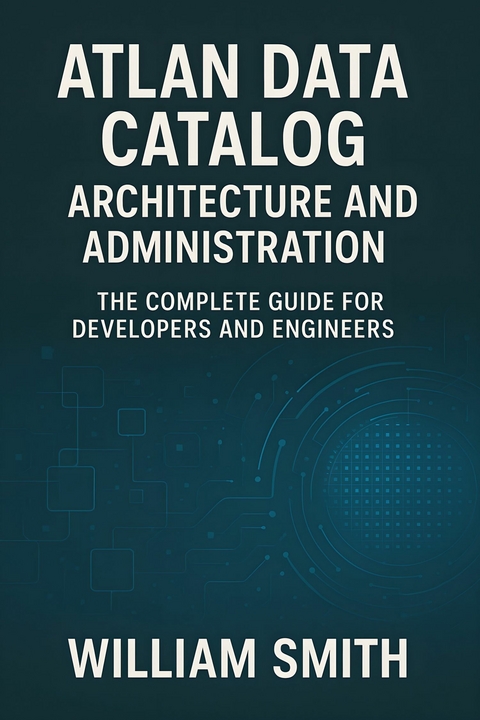
Atlan Data Catalog Architecture and Administration (eBook)
250 Seiten
HiTeX Press (Verlag)
978-0-00-097534-8 (ISBN)
'Atlan Data Catalog Architecture and Administration'
Atlan Data Catalog Architecture and Administration provides a comprehensive and authoritative exploration of Atlan's modern data catalog platform, tailored for architects, administrators, and data governance professionals who demand enterprise-grade reliability, extensibility, and performance. This meticulously structured guide traverses Atlan's architectural DNA-from foundational modular components and the technology stack to advanced topics such as microservices, containerization, and metadata storage abstractions. Readers are introduced to design philosophies that inform Atlan's robust, scalable, and highly customizable framework, setting the stage for seamless integration within complex data ecosystems.
The book systematically examines core operational facets, covering every layer of the metadata lifecycle. With deep dives into metadata ingestion and enrichment frameworks, readers gain hands-on understanding of connector architectures, pipeline orchestration, schema profiling, and mechanisms for both streaming and batch scenarios-all reinforced with strategies for error handling and data quality control. Discover how Atlan's sophisticated search, discovery, and data lineage systems, supported by powerful APIs, empower organizations to achieve granular visibility, impact analysis, and easy cross-functional collaboration. Extensive attention is devoted to Atlan's security architecture, addressing authentication, access governance, encryption, compliance, and auditing requirements that are crucial for regulatory alignment and risk mitigation.
Beyond deployment and operational excellence-including high availability, disaster recovery, infrastructure as code, and monitoring-this guide offers thoughtful coverage of integration frameworks and the ever-evolving landscape of data governance. Explore topics ranging from business glossary management and rule automation to the adoption of open standards, machine learning for metadata intelligence, decentralized data mesh paradigms, and self-service catalog democratization. Written with clarity and technical depth, Atlan Data Catalog Architecture and Administration is an indispensable resource for organizations looking to unlock true data value while maintaining control, compliance, and innovation in their data management journey.
Chapter 2
Metadata Ingestion and Enrichment Frameworks
Unlock the secrets behind intelligent metadata acquisition and transformation in Atlan. This chapter journeys deep into how Atlan systematically gathers, profiles, enriches, and ensures the quality of metadata from myriad sources, forming the backbone of discovery and governance. Discover the advanced mechanisms and automation underpinning every step—paving the way for accurate, contextualized, and actionable data intelligence.
2.1 Connector Architecture
Atlan’s unified connector framework is designed to seamlessly integrate a broad spectrum of data sources, spanning traditional on-premise databases, cloud-native repositories, and diverse SaaS platforms. This architecture enables consistent interaction and metadata extraction irrespective of the source’s inherent complexity or protocol diversity.
The core of Atlan’s connector architecture is an abstraction layer that standardizes communication patterns and data ingestion processes. This abstraction enables the framework to treat various source systems through a common interface, significantly reducing integration complexity. Connectors are categorized primarily into two types: generic connectors and specialized connectors. Generic connectors encapsulate standardized protocols such as JDBC, REST APIs, or ODBC drivers, allowing rapid onboarding of conventional databases like MySQL, Oracle, and PostgreSQL without bespoke development. These generic connectors implement a uniform set of operations-discovery, extraction, transformation, and metadata harvesting-thus providing consistent data lineage and governance capabilities.
Specialized connectors, by contrast, are tailored implementations that address the idiosyncrasies of complex or proprietary platforms such as Snowflake, Google BigQuery, Salesforce, or various cloud-native storage services (AWS S3, Azure Data Lake, etc.). These connectors often incorporate advanced parsing of platform-specific metadata and support optimized query execution paths or API batching techniques that generic connectors cannot leverage effectively. Moreover, specialized connectors integrate native security models and rate-limiting mechanisms to comply with source-specific constraints while preserving system integrity.
Extensibility is a fundamental design principle of Atlan’s connector ecosystem. The framework provides a comprehensive extensibility model whereby developers can create bespoke connectors encapsulating new or uncommon data sources. This model consists of a modular plugin architecture with well-defined lifecycle hooks-initialization, polling, error handling, and shutdown-that ensure new connectors integrate seamlessly with the platform’s orchestration engine. The extensibility system supports dynamic loading and configuration of connectors, enables versioned deployment, and abstracts retry logic and scheduling to simplify connector implementation.
Error isolation within the connector framework is implemented through a granular exception handling and retry mechanism. Each integration point maintains a distinct execution context, isolating faults such as network failures, authentication errors, or schema incompatibilities. Errors are categorized by severity and type, enabling intelligent retry strategies or alert escalation. For example, transient network failures trigger exponential backoff retries, while schema evolution conflicts prompt administrator intervention. This isolation prevents systemic failures, ensuring that disruptions in one connector do not propagate downstream or impact other connectors.
Lifecycle management of connectors encompasses automated deployment, updates, scaling, and decommissioning within the unified framework. Upon deployment, connectors undergo health checks and resource allocation with auto-scaling capabilities to handle varying workloads efficiently. Updates to connector code or configuration are rolled out with zero downtime through transactionally safe deployment pipelines, guaranteeing uninterrupted metadata synchronization. The system also supports graceful shutdown sequences, preserving in-flight processing and checkpointing progress to enable rapid recovery or pause-resume workflows.
Monitoring is embedded at multiple layers in the connector architecture to provide comprehensive observability and operational insights. Each connector exposes real-time metrics such as throughput, latency, error rates, and resource utilization, which are aggregated within Atlan’s centralized monitoring dashboard. Fine-grained auditing logs capture every interaction with source systems, helping trace data lineage and security compliance. Additionally, anomaly detection algorithms analyze connector metrics over time to predict potential degradation or failure, allowing proactive maintenance. Alerting mechanisms notify administrators of critical incidents with diagnostic context, facilitating rapid resolution.
In aggregate, the connector architecture in Atlan embodies a robust, scalable, and maintainable approach to heterogeneous data integration. Its careful balance between generic and specialized connectors, coupled with a powerful extensibility model and resilient operational frameworks, establishes a foundation capable of supporting enterprise-grade metadata management across the evolving data landscape. This architecture ensures that every integration point is not only efficient and secure but also manageable and observable, aligning with stringent governance and reliability requirements essential for modern data ecosystems.
2.2 Ingestion Pipelines and Scheduling
Efficient ingestion orchestration is critical for managing the flow of data from heterogeneous sources into downstream systems. An ingestion pipeline fundamentally represents a directed acyclic graph (DAG) of tasks, where each task corresponds to a discrete data processing or ingestion job. The composition of such pipelines requires explicit representation of task dependencies to ensure correctness and optimize resource utilization.
At the core of ingestion orchestration lies metadata-driven job runners, which dynamically interpret pipeline definitions and metadata configurations to instantiate and execute tasks. These job runners coordinate the sequence and concurrency of ingestion operations by adhering to dependency graphs specified in pipeline metadata. This abstraction decouples ingestion logic from static scheduling and enables flexible real-time adjustments to pipeline structures, such as adding incremental ingestion tasks or introducing validation checkpoints.
Dependency management in ingestion pipelines hinges on clear delineation of task prerequisites. Each task declares an input dependency set, often corresponding to upstream data availability or pre-processing completions. A common implementation strategy is to maintain a centralized dependency tracker that monitors task states and triggers downstream executions upon successful completions. This mechanism reduces the likelihood of cascading failures stemming from unsatisfied dependencies.
Job scheduling within ingestion pipelines involves multi-dimensional considerations encompassing task priority, resource constraints, retry policies, and execution windows aligned with data availability. Effective scheduling frameworks incorporate heuristics to prioritize incremental ingestion jobs over full reloads when data freshness is paramount, thereby minimizing unnecessary processing overhead. Incremental ingestion logic isolates new or modified data segments by comparing source metadata snapshots, whereas full ingestion entails complete source reprocessing to address data drift or schema evolution.
Task retries constitute an essential feature for ingestion robustness, particularly in distributed environments subject to transient failures such as network timeouts or service unavailability. Retry policies often specify maximum retry counts, backoff strategies (e.g., exponential or jittered delays), and failure escalation protocols. Integrating retry semantics into the scheduling algorithm guarantees stability without compromising throughput or inducing resource starvation.
Parallelization strategies are employed to accelerate ingestion throughput by simultaneously executing independent tasks. Pipelines designed with fine-grained task decomposition facilitate greater concurrency but require careful orchestration to avoid race conditions or resource contentions. Techniques such as partition-level parallelism allow ingestion jobs to process data slices in parallel, leveraging sharding keys defined in metadata. However, task parallelism must be balanced with overall system capacity and dependency constraints to prevent overutilization and ensure deterministic final states.
Instrumentation for scheduling and monitoring is indispensable for maintaining observability and control over complex ingestion workflows. Metrics collected at multiple levels include task execution durations, success/failure rates, resource utilization, and queue latencies. Logging frameworks augmented with context-rich metadata enable rapid diagnosis of bottlenecks and failure points. Moreover, alerting mechanisms tied to SLA thresholds and error rates permit proactive remediation.
A typical metadata job runner lifecycle involves the following...
| Erscheint lt. Verlag | 24.7.2025 |
|---|---|
| Sprache | englisch |
| Themenwelt | Mathematik / Informatik ► Informatik ► Programmiersprachen / -werkzeuge |
| ISBN-10 | 0-00-097534-6 / 0000975346 |
| ISBN-13 | 978-0-00-097534-8 / 9780000975348 |
| Informationen gemäß Produktsicherheitsverordnung (GPSR) | |
| Haben Sie eine Frage zum Produkt? |
 EPUB (Adobe DRM)
Kopierschutz: Adobe-DRM
Adobe-DRM ist ein Kopierschutz, der das eBook vor Mißbrauch schützen soll. Dabei wird das eBook bereits beim Download auf Ihre persönliche Adobe-ID autorisiert. Lesen können Sie das eBook dann nur auf den Geräten, welche ebenfalls auf Ihre Adobe-ID registriert sind.
Details zum Adobe-DRM
Dateiformat: EPUB (Electronic Publication)
EPUB ist ein offener Standard für eBooks und eignet sich besonders zur Darstellung von Belletristik und Sachbüchern. Der Fließtext wird dynamisch an die Display- und Schriftgröße angepasst. Auch für mobile Lesegeräte ist EPUB daher gut geeignet.
Systemvoraussetzungen:
PC/Mac: Mit einem PC oder Mac können Sie dieses eBook lesen. Sie benötigen eine
eReader: Dieses eBook kann mit (fast) allen eBook-Readern gelesen werden. Mit dem amazon-Kindle ist es aber nicht kompatibel.
Smartphone/Tablet: Egal ob Apple oder Android, dieses eBook können Sie lesen. Sie benötigen eine
Geräteliste und zusätzliche Hinweise
Buying eBooks from abroad
For tax law reasons we can sell eBooks just within Germany and Switzerland. Regrettably we cannot fulfill eBook-orders from other countries.
aus dem Bereich


