


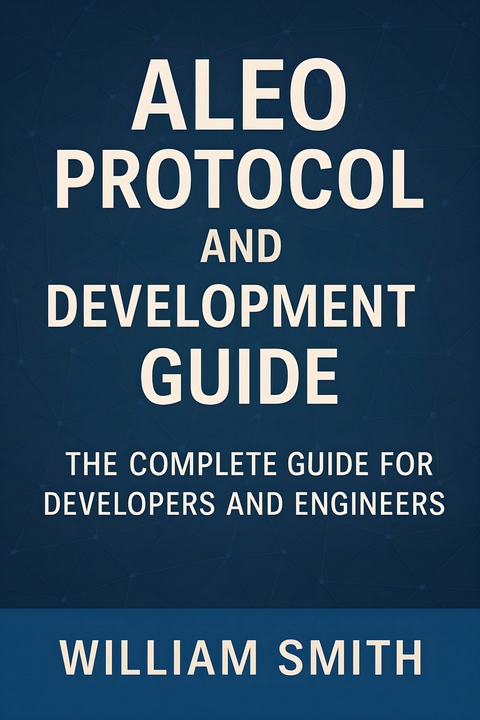
Aleo Protocol and Development Guide (eBook)
250 Seiten
HiTeX Press (Verlag)
978-0-00-097530-0 (ISBN)
'Aleo Protocol and Development Guide'
The 'Aleo Protocol and Development Guide' is an authoritative, comprehensive resource for professionals and technologists navigating the rapidly evolving landscape of zero-knowledge proofs (ZKPs) and privacy-centric blockchain architecture. The book begins with a deep dive into the foundations of the Aleo protocol, elucidating its vision, core principles, and contextualizing its innovations alongside other privacy chains such as Zcash and Tornado Cash. Readers gain not only a theoretical understanding of zero-knowledge platforms but also practical insights into the motivations and methodologies behind enabling privacy as a native primitive in decentralized systems.
Progressing through the chapters, the guide meticulously unpacks Aleo's cryptographic architecture, from the intricate details of zkSNARK technology and trusted setup ceremonies to the structural workings of its consensus mechanisms and state models. The application of zero-knowledge proofs is further explored with clear expositions on circuit design, proof performance engineering, and advanced ZKP features, accompanied by real-world case studies showcasing privacy-preserving decentralized applications. For developers, an entire section is devoted to smart contract development in Leo-Aleo's native language-covering language semantics, contract composition, deployment strategies, and robust testing methodologies.
Beyond protocol mechanics, the guide provides essential operational knowledge for node administrators and dives into best practices for securing applications at both the protocol and smart contract level. It also addresses ecosystem integration, interoperability, scaling strategies, and advanced applications, including privacy-preserving AI and confidential computing. Concluding with governance models, open research initiatives, and a forward-looking roadmap, this guide equips readers with the expertise and perspective to both build and innovate within the Aleo ecosystem, and to contribute meaningfully to the next generation of private, decentralized web technologies.
Chapter 1
Foundations of the Aleo Protocol
Delve into the intellectual roots and foundational principles that set Aleo apart in the cryptographic landscape. This chapter reveals not just what Aleo is, but why it arose: the urgent need for native privacy in decentralized computation, and the technical philosophy that underpins its architecture. Explore the conceptual breakthroughs, the historical evolution of zero-knowledge technologies, and the unique role Aleo plays in the future of confidential computation.
1.1 Aleo’s Vision and Mission
At the core of Aleo lies a compelling vision that elevates privacy from a mere feature to an indispensable right and foundational paradigm, especially within decentralized systems. The project advocates for privacy as a universal entitlement-one that extends beyond individual preferences to safeguard the very fabric of digital interactions in a world increasingly driven by data. This vision addresses the tension between transparency and confidentiality, aiming to harmonize them through innovative cryptographic constructs. In doing so, Aleo positions privacy not as an obstacle but as a critical enabler of trust, security, and autonomy in the evolving landscape of Web3.
The imperative for privacy in decentralized ecosystems emerges from both ideological and practical considerations. Decentralization offers resistance to censorship and centralized control; however, without privacy, it risks exposing user actions and sensitive data on public ledgers, which undermines confidentiality and limits widespread adoption. Aleo’s vision recognizes this paradox and seeks to resolve it by embedding privacy-preserving capabilities at the protocol level. This approach is essential to fostering an environment where users retain sovereignty over their information and developers can create applications that respect and enforce data minimization principles.
Aleo’s mission crystallizes this vision into a set of tangible objectives focused on empowering both developers and end-users. Central to this mission is the provision of a robust platform for private, programmable computation at scale. Unlike traditional blockchains constrained by public and transparent transaction data, Aleo leverages zero-knowledge succinct non-interactive arguments of knowledge (zk-SNARKs) and a novel programming framework to enable arbitrary computation while concealing inputs and execution details. By doing so, Aleo democratizes access to privacy-enhanced applications and smart contracts, allowing sophisticated logic to execute with cryptographic proof of correctness without revealing underlying data.
From an economic perspective, Aleo addresses the growing demand for privacy in digital finance and decentralized finance (DeFi) applications. Confidential financial transactions, private asset management, and protected identity mechanisms are not only compliance-critical in regulated environments but also foundational to user trust and market growth. Aleo’s infrastructure enables “privacy by default” in economic interactions, which can reduce risk vectors such as front-running, exposure of trading strategies, or unintended leakage of market-sensitive information. This economic lens reinforces Aleo’s relevance in driving the next generation of decentralized financial products where confidentiality and composability coexist.
Socially, Aleo’s mission intersects with broader concerns surrounding digital rights, surveillance, and equitable access to technology. By advocating privacy as a fundamental element of Web3, Aleo contributes to a landscape where marginalized or vulnerable populations can engage without fear of profiling or digital discrimination. The platform’s privacy guarantees also empower creators and organizations to innovate while maintaining control over proprietary algorithms or sensitive user data, fostering innovation ecosystems that balance openness and discretion. Such a social stance on privacy aligns Aleo with the ethos of decentralization-that of amplifying individual agency while resisting central points of exploitation.
Technically, the ambitious scope of Aleo necessitates breakthroughs in cryptographic engineering and systems design. Its mission includes the development of a user-friendly programming language apt for zero-knowledge proofs, a scalable virtual machine, and efficient proof-generation protocols that minimize computational overhead. These innovations collectively circumvent traditional limitations of zk-proof systems, such as latency and resource intensity, thereby enabling real-time, on-chain private computations. Furthermore, Aleo’s open-source ethos and developer tooling aim to lower barriers to entry, fostering a vibrant community that advances the technology and expands its applicability.
Within the broader cryptographic and Web3 landscapes, Aleo occupies a strategic space by integrating privacy seamlessly into the programmable blockchain paradigm. While numerous projects have enhanced privacy through mixers, shielded transactions, or off-chain solutions, Aleo’s comprehensive architecture for private programmability distinguishes it as a platform designed for the next wave of decentralized applications. This ambition to unify privacy and expressiveness aligns with emerging standards and interoperability efforts, positioning Aleo as a foundational layer for privacy-centric decentralized infrastructure.
The intended impact of Aleo extends beyond technological innovation; it is a catalyst for reshaping how privacy is perceived and implemented in decentralized networks. By embedding privacy as a first-class construct, Aleo challenges prevailing tradeoffs between utility and secrecy, transparency and anonymity. Its vision and mission collectively call for a paradigm shift where privacy enhances rather than hinders decentralization, fostering ecosystems that are secure, private, and inclusive at scale. This recalibration of priorities resonates with the evolving demands of users, regulators, and developers, marking Aleo as a pivotal initiative in realizing the full potential of Web3.
1.2 Principles of Zero-Knowledge Application Platforms
Zero-knowledge application platforms are fundamentally grounded in the cryptographic framework of zero-knowledge proofs (ZKPs), enabling verification of computation correctness without divulging any underlying data. At their core, these platforms harness properties essential to ensuring both security and usability: soundness, zero-knowledge, and succinctness. The architectures arising from these principles enable verifiable, confidential computation, expanding the horizons of privacy-preserving decentralized applications.
The soundness property guarantees that a dishonest prover cannot convince a verifier of a false statement. Formally, soundness ensures that if the input is invalid, the probability that the verifier accepts the proof is negligible. Practically, this underpins the trustworthiness of computations performed in untrusted environments, preventing forgery or denial of correctness. In zero-knowledge application platforms, soundness is enforced through rigorous cryptographic protocols derived from complexity-theoretic hardness assumptions, such as the discrete logarithm or lattice-based problems, depending on the underlying proof system.
The zero-knowledge property assures that the verifier learns nothing other than the truth of the statement being proven. This requirement is indispensable for maintaining privacy and confidentiality in computations where revealing intermediate values or inputs is unacceptable. Zero-knowledge protocols achieve this by transmitting proofs that are simulatable from public information alone, ensuring the proof transcript leaks no additional information. This cryptographic confidentiality transforms ZKPs from mere verification tools into privacy shields, enabling applications such as confidential smart contracts and private asset transfers.
Another foundational concept is succinctness, the ability to produce proofs that are quite short and quick to verify regardless of the original computation’s complexity. Succinctness is critical for scalability and practical adoption: without it, verifying large computations would incur substantial resource costs, leading to bottlenecks on constrained devices or blockchain validators. Succinct proofs, such as zk-SNARKs, typically provide constant or logarithmic proof sizes and verification times relative to the input size, enabling verification on-chain or within lightweight clients efficiently.
Realizing these principles in a platform entails managing inherent design trade-offs. For example, certain zero-knowledge proof systems may require a trusted setup phase, potentially introducing a trust assumption that contradicts decentralization goals. Consequently, platforms prioritize trust minimization by adopting transparent setup protocols or multi-party computation ceremonies that distribute trust boundaries. Furthermore, they optimize circuit representations of computations to reduce prover time and proof generation costs without sacrificing generality or expressiveness.
To build a practical zero-knowledge application platform, several architectural requirements must be met:
- ...
| Erscheint lt. Verlag | 24.7.2025 |
|---|---|
| Sprache | englisch |
| Themenwelt | Mathematik / Informatik ► Informatik ► Programmiersprachen / -werkzeuge |
| ISBN-10 | 0-00-097530-3 / 0000975303 |
| ISBN-13 | 978-0-00-097530-0 / 9780000975300 |
| Informationen gemäß Produktsicherheitsverordnung (GPSR) | |
| Haben Sie eine Frage zum Produkt? |
 EPUB (Adobe DRM)
Kopierschutz: Adobe-DRM
Adobe-DRM ist ein Kopierschutz, der das eBook vor Mißbrauch schützen soll. Dabei wird das eBook bereits beim Download auf Ihre persönliche Adobe-ID autorisiert. Lesen können Sie das eBook dann nur auf den Geräten, welche ebenfalls auf Ihre Adobe-ID registriert sind.
Details zum Adobe-DRM
Dateiformat: EPUB (Electronic Publication)
EPUB ist ein offener Standard für eBooks und eignet sich besonders zur Darstellung von Belletristik und Sachbüchern. Der Fließtext wird dynamisch an die Display- und Schriftgröße angepasst. Auch für mobile Lesegeräte ist EPUB daher gut geeignet.
Systemvoraussetzungen:
PC/Mac: Mit einem PC oder Mac können Sie dieses eBook lesen. Sie benötigen eine
eReader: Dieses eBook kann mit (fast) allen eBook-Readern gelesen werden. Mit dem amazon-Kindle ist es aber nicht kompatibel.
Smartphone/Tablet: Egal ob Apple oder Android, dieses eBook können Sie lesen. Sie benötigen eine
Geräteliste und zusätzliche Hinweise
Buying eBooks from abroad
For tax law reasons we can sell eBooks just within Germany and Switzerland. Regrettably we cannot fulfill eBook-orders from other countries.
aus dem Bereich


