


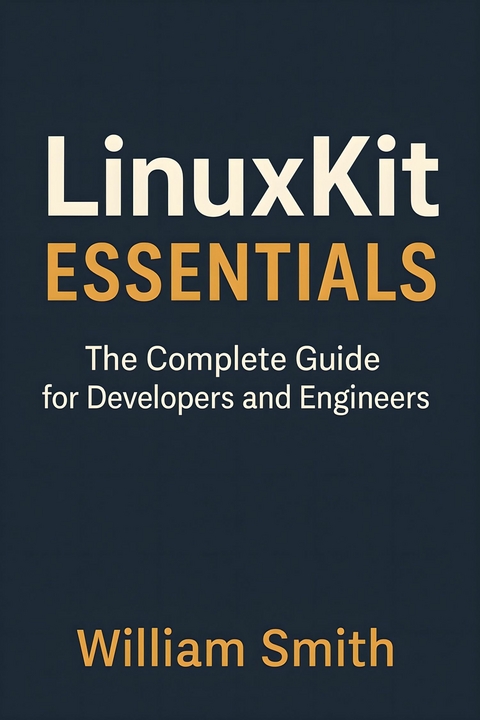
LinuxKit Essentials (eBook)
250 Seiten
HiTeX Press (Verlag)
978-0-00-097529-4 (ISBN)
'LinuxKit Essentials'
LinuxKit Essentials is the definitive guide for IT professionals and developers seeking to master the art of creating secure, minimal, and container-centric Linux operating systems. This comprehensive resource demystifies LinuxKit by charting its origins, architectural principles, and the modern problems it solves in a world pivoting toward containers and microservices. Through meticulous exploration, readers will gain a deep understanding of LinuxKit's modular approach, core components, and its unique container-first model, while discovering how it compares to related tools like Yocto, CoreOS, and Buildroot.
The book delves into practical, advanced topics such as crafting custom LinuxKit images, optimizing YAML configuration, and designing immutable, stateless systems tailored for any workload-from cloud to edge and embedded devices. Readers will find step-by-step guides on everything from kernel customization and service container best practices to debugging builds and automating robust test pipelines. Comprehensive coverage of networking, storage, and security aspects-including user namespaces, kernel hardening, image signing, and vulnerability management-equips practitioners to confidently deploy LinuxKit in highly regulated and mission-critical environments.
With thorough discussions on production-ready deployment strategies, lifecycle management, and real-world troubleshooting, LinuxKit Essentials bridges the gap between conceptual understanding and operational excellence. The book concludes by highlighting the thriving LinuxKit ecosystem, best practices drawn from industry deployments, future trends in container-native operating systems, and real-world case studies. Whether integrating with Kubernetes or building custom OS platforms for distributed IoT fleets, LinuxKit Essentials is an indispensable companion for harnessing the full power of modern, containerized Linux.
Chapter 2
YAML Configuration Deep Dive
How can a single YAML file orchestrate the intricate details of your own custom Linux operating system? This chapter unravels the structure, subtleties, and expressive power of LinuxKit’s declarative configuration language. By understanding each layer and extension point, you’ll gain the mastery needed to model precise system behavior, unleash advanced features, and guarantee both flexibility and predictability in every image you create.
2.1 Schema Structure and Validation
A LinuxKit YAML file serves as a blueprint for building immutable Linux system images. The fundamental principle underpinning its design is a rigid and meticulously defined schema that ensures consistency, correctness, and reproducibility of system builds. At its core, the YAML file encodes a declarative description of the components and configurations necessary for constructing a tailored operating system.
The schema is explicitly versioned, enabling both backward compatibility and progressive enhancements. A typical LinuxKit YAML begins with a schema field identifying the schema version, such as "linuxkit.schema.version: 1". This versioning governs permissible keys, expected data types, and validation rules. For example:
schema:
version: 1
The schema defines strict typing for each configuration element. The high-level structure includes fields such as kernel, init, onboot, services, files, and trust. Each expects a specific data type, frequently a map (dictionary), list (sequence), or scalar (string, integer, boolean). Typing extends recursively: the services field is a list of service definitions, each of which itself conforms to a sub-schema defining keys for name, image, command, binds, and so forth.
The following fragment illustrates the typed nature of services:
- name: "sshd"
image: "linuxkit/sshd:version"
command: ["/usr/sbin/sshd", "-D"]
capabilities:
- "net_bind_service"
In this example, name and image are strings, command is a list of strings, and capabilities is an optional list of strings. Any deviation from expected types-such as assigning an integer to name-violates schema constraints, resulting in validation failure.
Validation is a critical step between authoring and utilizing LinuxKit configurations. The tooling, typically provided by the linuxkit command-line utility, performs schema validation against the declared version. This encompasses type checking, presence of required fields, permissible values, and cross-field consistency. For instance, if a kernel field is omitted or if the init list is empty, the validator will report an error. Validation enforces early detection of misconfigurations, drastically reducing the likelihood of build or runtime failures.
Schema-driven validation also extends to intricate constraints such as the uniqueness of service names or the correctness of image references. The schema version defines whether new fields or behaviors are acceptable, thus preventing unintended usage of unsupported features in older schema contexts.
The processing pipeline for validation typically involves loading the YAML, decoding it into structured data, and verifying adherence to schema specifications using a library-generated validator or a custom validation engine embedded within LinuxKit tooling. This process can be summarized as follows:
- Load the YAML file
- Parse YAML into native data structures
- Identify schema version from linuxkit.schema.version
- Retrieve corresponding schema definition
- Recursively validate each field’s presence and type
- Check field-specific constraints and cross-dependencies
- Report errors or warnings, or pass validation
The schema’s strictly enforced structure serves as the foundation for reproducibility. Since every attribute must conform to the schema, and validation ensures no deviations, LinuxKit configurations guarantee that images built from the same YAML produce identical results. This deterministic behavior arises because the YAML captures all explicit build inputs and configuration metadata with no ambiguity.
In practice, this rigidity enables robust automation and integration into CI/CD pipelines. Schema-driven tooling can parse and analyze configurations statically, before any system image is instantiated. This allows developers and operators to catch errors such as missing fields, incorrect syntax, or unsupported features early, thus improving overall system reliability and reducing downtime.
Moreover, the schema provides a contract that software interfacing with LinuxKit can rely upon. Tools for diffing configurations, generating documentation, or visualizing dependency graphs utilize the schema to understand the semantics of YAML fields. This schema-as-contract paradigm enhances maintainability and facilitates collaboration across teams.
Beyond basic validation, LinuxKit’s schema supports extension points to customize or augment system builds. Custom configuration fields defined in later schema versions allow for more sophisticated validation rules, such as conditional constraints or value pattern matching. For example, service definitions can include resource limits or security options that are verified for correctness during schema validation.
The outcome of adhering to a strict, versioned schema and rigorous validation is a disciplined configuration process where system definitions are both human-readable and machine-verifiable. This discipline underlies LinuxKit’s promise of generating reliable, minimal, and reproducible Linux distributions tailored to specific use cases.
The LinuxKit YAML schema embodies a comprehensive, rigid, and formal type system that governs configuration semantics. Validation mechanisms ensure that only syntactically and semantically correct definitions proceed to image building, fostering reliability in production environments. The interplay of schema versioning, type enforcement, and tooling integration creates a robust ecosystem that transforms declarative system descriptions into reproducible, maintainable Linux images.
2.2 Defining the Kernel
The kernel section of a LinuxKit YAML configuration dictates the foundational operating system layer responsible for hardware interaction, process management, and system security. Selecting and customizing this kernel image determines not only the performance footprint but also the security posture and portability of the resulting artifact. Understanding the structure and available options in the kernel field is essential to effectively tailor LinuxKit distributions for specific environments.
At a basic level, the kernel image referenced in LinuxKit YAML can either...
| Erscheint lt. Verlag | 24.7.2025 |
|---|---|
| Sprache | englisch |
| Themenwelt | Mathematik / Informatik ► Informatik ► Programmiersprachen / -werkzeuge |
| ISBN-10 | 0-00-097529-X / 000097529X |
| ISBN-13 | 978-0-00-097529-4 / 9780000975294 |
| Informationen gemäß Produktsicherheitsverordnung (GPSR) | |
| Haben Sie eine Frage zum Produkt? |
 EPUB (Adobe DRM)
Kopierschutz: Adobe-DRM
Adobe-DRM ist ein Kopierschutz, der das eBook vor Mißbrauch schützen soll. Dabei wird das eBook bereits beim Download auf Ihre persönliche Adobe-ID autorisiert. Lesen können Sie das eBook dann nur auf den Geräten, welche ebenfalls auf Ihre Adobe-ID registriert sind.
Details zum Adobe-DRM
Dateiformat: EPUB (Electronic Publication)
EPUB ist ein offener Standard für eBooks und eignet sich besonders zur Darstellung von Belletristik und Sachbüchern. Der Fließtext wird dynamisch an die Display- und Schriftgröße angepasst. Auch für mobile Lesegeräte ist EPUB daher gut geeignet.
Systemvoraussetzungen:
PC/Mac: Mit einem PC oder Mac können Sie dieses eBook lesen. Sie benötigen eine
eReader: Dieses eBook kann mit (fast) allen eBook-Readern gelesen werden. Mit dem amazon-Kindle ist es aber nicht kompatibel.
Smartphone/Tablet: Egal ob Apple oder Android, dieses eBook können Sie lesen. Sie benötigen eine
Geräteliste und zusätzliche Hinweise
Buying eBooks from abroad
For tax law reasons we can sell eBooks just within Germany and Switzerland. Regrettably we cannot fulfill eBook-orders from other countries.
aus dem Bereich


